

Craft dark fantasy conflict that haunts your readers
TL;DR:
- Effective dark fantasy conflict involves high stakes that deeply affect characters' identities and morals.
- Building layered, escalating conflict with genuine consequences makes scenes emotionally haunting.
- Protagonist change and ripple effects confirm a conflict's lasting impact and story depth.
Forgettable conflict is the silent killer of otherwise brilliant dark fantasy. You can build the most oppressive gothic atmosphere, fill your world with eldritch horror and shadow-drenched castles, and still watch readers drift away if the tension feels hollow. The truth is, most conflict in dark fantasy fails not because it lacks action, but because it lacks cost. When conflict builds as pressure on what a protagonist truly wants, with opposing forces strong enough to make every choice sting, something extraordinary happens. This guide walks you through everything you need to make your conflict genuinely haunting, from foundational mechanics to common pitfalls.
Key Takeaways
| Point | Details |
|---|---|
| Layered conflict is vital | Compelling fantasy conflict blends external threats and internal struggles to drive both plot and transformation. |
| Stakes must reshape characters | High-stakes conflict in dark fantasy should permanently alter relationships, identities, and choices. |
| Costly decisions create tension | Every important choice should hurt, with victories carrying real loss or lasting consequences. |
| Avoid 'easy' outcomes | Ensure opposition matches desire and that resolutions are earned, not convenient. |
| Verify lasting impact | Great conflict leaves characters and readers changed—always check for real, irreversible aftermath. |
Understand the true nature of conflict in dark fantasy
Dark fantasy and gothic horror live and die by one thing: stakes that cut deeper than physical danger. A monster showing up to fight your protagonist is surface-level conflict. It gets hearts racing, sure, but it rarely sticks with readers after the book is closed. The conflict that lingers, the kind that readers recommend to friends at midnight, is the kind that forces characters to choose between two terrible things and then live with the wreckage of that choice.
“Stakes in dark fantasy should reshape identity, relationships, and agency. Characters should make difficult choices with real cost. Victory can be partial or pyrrhic.”
That quote captures something we think about a lot when writing in this space. The difference between a story that feels dark and a story that is dark comes down to whether the character on the other side of the conflict is fundamentally altered by it. Think about what we mean by internal versus external conflict here. External conflict is the monster, the curse, the collapsing empire. Internal conflict is whether your protagonist can betray their only friend to survive, or whether they can hold onto their humanity while becoming the very thing they hunted. The best dark fantasy layers both, so the external conflict forces the internal one into the open.
Pyrrhic victories are your friend in this genre. Your protagonist might slay the demon, but at the cost of their innocence, their loved one, or their soul. The pivotal decisions in Blood Tithe are a masterclass in this, where characters win battles but lose something irreplaceable in the process. That’s what transformation looks like in dark fiction. It’s messy, costly, and deeply satisfying to readers who came to the genre for exactly that kind of weight.
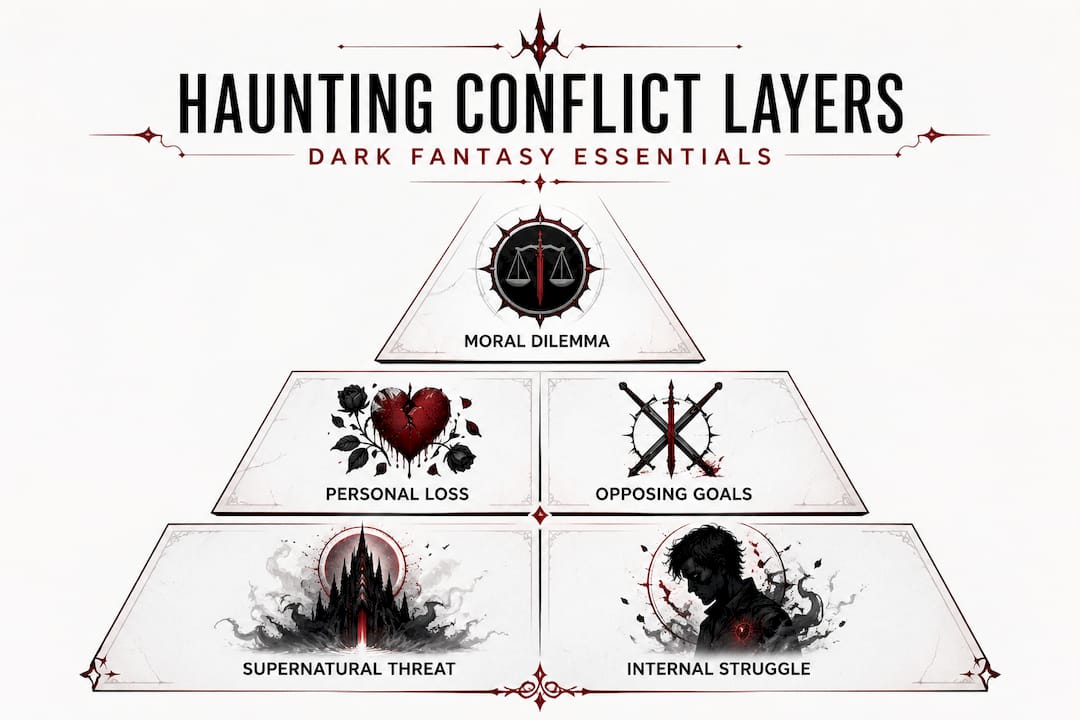
When you approach your own work, ask yourself honestly: does this conflict change who my character is at their core? If the answer is no, keep pushing until it does.
Core mechanics: Building irresistible, layered conflict
With a clear vision of what makes conflict impactful, let’s break down the mechanics you can apply scene by scene.
Start with want. Your protagonist needs something specific, something they can almost taste but can’t easily have. Then place an opposing force that is equally motivated. Not just an obstacle, but a force with its own goals and logic. The layered conflicts in Raise The Dead demonstrate exactly this: competing desires collide with supernatural forces, and neither side gets what it wants cleanly.
Here’s a quick-reference table for building conflict layers:
| Conflict layer | What it targets | Example in gothic horror |
|---|---|---|
| External supernatural | Physical survival | A cursed entity pursuing the protagonist |
| External social | Belonging, reputation | A community that turns against the hero |
| Internal moral | Values and identity | Choosing power over someone’s safety |
| Internal psychological | Sanity, self-perception | Doubting whether the protagonist is the villain |
Once you have your layers identified, think about escalation. Each scene should add pressure, not just repeat the same level of tension. A character being afraid is interesting once. A character being afraid while also making a choice that worsens their situation is compelling every time.
- Define what your protagonist wants with brutal specificity.
- Identify at least two forces that oppose it (one internal, one external).
- Raise the cost of each attempt your protagonist makes to get what they want.
- Force a choice where neither option is clean or safe.
- Let the consequences bleed into the next scene immediately.
One thing we see a lot in drafts is writers relying on clichés to manufacture tension: the ticking clock, the sudden amnesia, the convenient power boost at exactly the right moment. These feel like shortcuts to readers because they are shortcuts. Conflict built from character desire and genuine consequence doesn’t need those tricks. It carries its own momentum.
Pro Tip: Write your conflict from the antagonist’s point of view first, even if that scene never appears in the book. If you understand why the opposing force believes it’s right, the conflict becomes richer and harder to resolve cleanly. That ambiguity is gold in dark fantasy.
Escalating stakes: How to make choices costly and outcomes uncertain
Understanding how to build conflict, our next step is to escalate these tensions so that every outcome truly matters.

Escalation isn’t about increasing the body count or making the villain more powerful every chapter. Real escalation is about raising the personal cost for your protagonist at each turning point. Think about what they stand to lose: their relationships, their moral code, their sense of self, their physical safety. Each major conflict moment should threaten at least two of those simultaneously.
Here’s a comparison that’s useful when auditing your own scenes:
| Low-stakes conflict | High-stakes conflict |
|---|---|
| Protagonist risks physical injury | Protagonist risks identity and agency |
| Villain is obstacle only | Villain has compelling competing goal |
| Outcome is predictable | Outcome is uncertain until the last moment |
| Victory is clean and complete | Victory is partial, costly, or ambiguous |
| Character is unchanged after conflict | Character is fundamentally altered |
When writing dark fantasy battle scenes specifically, battles function as dramatic turning points where something must be permanently lost and the viewpoint restricted to keep horror at its sharpest. We love this framing because it stops writers from treating fights as cool spectacles and starts treating them as emotional earthquakes.
- Before writing any major conflict scene, list exactly what your protagonist stands to lose.
- Decide which of those losses will actually happen, no matter what.
- Make the resolution feel earned but not comfortable.
- Ensure the fallout shapes at least the next two scenes.
The consequences in End of The Line follow this pattern relentlessly. Characters don’t escape conflict unscathed. The aftermath is woven into everything that follows. That’s the goal. Readers should feel the weight of what happened every time the surviving characters open their mouths.
Pro Tip: If your protagonist can solve the conflict with their primary skill or power alone, the stakes probably aren’t high enough. Put your character’s greatest strength at odds with their deepest value, and now you have something worth reading.
Common mistakes and how to fix them
Now that you know how to escalate stakes, let’s tackle the mistakes that undermine conflict and show you how to avoid them.
Mistake one: A villain with no real agency. If your antagonist only exists to be defeated, the conflict has no genuine tension. Fix this by writing your villain’s goals with as much care as your protagonist’s. Give them a logical, even sympathetic, reason for what they do.
Mistake two: The hero solves everything. Dark fantasy especially punishes this mistake. If your protagonist is competent enough to solve every problem that arises, readers stop worrying about them. The fix is to make some problems genuinely unsolvable and let the protagonist fail in ways that matter.
Mistake three: Conflict is just violence. Punches and spells flying around are the surface of conflict, not the substance. The gothic horror tradition understands this instinctively. Psychological dread, social isolation, and moral corruption are far more disturbing than any battle scene. Layer these under your action sequences to give them real horror.
Mistake four: Static character arcs. If your protagonist is essentially the same person at the end of the novel as they were at the beginning, the conflict didn’t do its job. As the opposition must be as strong as protagonist desire, the collision between those two forces must change something fundamental.
“Outcomes shouldn’t be too easy. The opposition should match the protagonist’s drive at every turn, or the reader has nothing to fear.”
The costly choices in Blood Tithe show what it looks like when a character arc truly bends under pressure. Nobody walks away whole. That’s not grimdark for shock value. It’s honest storytelling about what conflict actually does to people.
Quick fixes to apply right now:
Boost your antagonist’s agency by giving them a goal that partially overlaps with your protagonist’s. Deepen internal struggle by asking what your protagonist believes about themselves that the conflict directly challenges. Guarantee change after conflict by listing one irreversible consequence before you write the scene.
Measuring lasting impact: How to know if your conflict works
Armed with fixes, let’s wrap up by making sure your crucial scenes actually deliver the catharsis and aftermath readers crave.
There’s a tempting temptation to declare a conflict scene “done” once the action is resolved. But strong conflict leaves fingerprints on everything that follows. Here’s how to check whether yours is pulling its weight.
| Sign your conflict works | What to look for |
|---|---|
| Character is changed | Protagonist’s behavior, values, or worldview shifts noticeably |
| Theme is embodied | The conflict illustrates the story’s core question without stating it |
| Outcome is ambiguous but satisfying | Reader feels the cost even in “victory” |
| Aftermath ripples forward | Consequences affect at least the next two major plot points |
As the principle holds, something must change permanently after every fight or major conflict beat. If you read back over a scene and everything is essentially the same as before it started, you’ve got a revision task on your hands.
- Read your conflict scene and ask: who is different, and how?
- Trace two consequences forward into subsequent scenes. If you can’t find them, add them.
- Check that the theme of the story is present in the conflict, not just the action.
- Ask whether a reader could predict the outcome from the setup. If yes, add one genuine uncertainty.
The lasting aftermath in End of The Line is a good case study here. Every major conflict leaves a scar. Some scars are literal, some are relational, and some are existential. That’s the full spectrum you want to work with when you revise flat or unsatisfying conflict scenes.
Revision is where most of this work actually happens, by the way. First drafts are for finding the conflict. Revision is for making it hurt the right way. Don’t be discouraged if your first pass feels shallow. It almost always does.
What most guides get wrong about fantasy conflict
Here’s the take we don’t see discussed enough. Most craft guides tell you to raise the stakes and increase danger. Add a bigger monster. Up the body count. Make the villain more powerful. And yes, external pressure matters, but that advice stops short of what actually makes dark fantasy conflict unforgettable.
The stories that stay with readers are the ones where the horror comes from a choice that couldn’t be undone. Not from a fight scene, however spectacular. Not from a villain who’s scary, however well-written. From a moment where the protagonist looked at two impossible options and chose, and the choosing cost them something about themselves they can never get back.
The unique approach in Raise The Dead leans into exactly this. The supernatural elements aren’t just threats; they’re mirrors that reflect what the characters fear about themselves. That’s the soul of gothic horror conflict. The monster outside is always a metaphor for the monster inside.
We’d argue the best dark fantasy writers think of conflict less as a plot engine and more as a moral laboratory. What does your world test in your characters? What would your protagonist do if the cost of winning was becoming the thing they hated most? Those are the questions that generate truly haunting conflict. Not how big the sword is, not how dark the magic feels.
So the next time you sit down to plot a conflict arc, skip the action checklist first. Start with the soul of your character and ask what choice could break them. Then build the plot around that.
Level up your dark fantasy: Next steps and resources
You’re ready to craft unforgettable conflict, and the best way to accelerate your learning is to study how it’s done in published dark fiction you can read right now.

The Gothika Series is built on exactly the principles we covered here: layered internal and external conflict, pyrrhic victories, and characters permanently changed by what they face. These novels are genuinely useful mentor texts for writers working in gothic and dark fantasy. If urban fantasy conflict is your focus, House of Cards brings high-stakes choices and moral ambiguity into a grittier contemporary setting that’s worth studying closely. And if you want to start exploring immediately without any barrier, we’ve got free dark fantasy fiction available for you right now. Dig in, take notes, and start applying what you’ve learned.
Frequently asked questions
What makes conflict “dark” or “gothic” in fantasy writing?
Dark or gothic conflict does more than endanger the protagonist physically. It reshapes identity, relationships, and agency, forcing characters into choices where genuine cost is unavoidable regardless of the outcome.
How do I avoid shallow or cliché conflict in my fantasy novel?
Layer internal and external struggles simultaneously, and make sure the opposition is strong enough to make every choice feel genuinely costly rather than a test your protagonist was always going to pass.
What are effective ways to raise stakes in dark fantasy scenes?
Clarify what your protagonist stands to lose before writing the scene, restrict your viewpoint to maximize intensity, and ensure that something changes permanently in the aftermath of every major conflict beat.
How can I check if my story’s conflict is working?
Look for deep and visible change in your protagonist after each major confrontation, a resolution that feels earned rather than clean, and consequences that ripple forward into subsequent scenes with genuine weight.