

How to Edit Dark Fantasy Manuscripts for Vivid Gothic Storytelling
TL;DR:
- Editing dark fantasy requires a detailed world bible and style sheet to ensure consistency.
- Focus on macro story structure before line editing to maintain atmospheric tension and coherence.
- Avoid info-dumps by revealing lore through character actions and sensory details rather than exposition.
You pour months into your dark fantasy manuscript, building haunted cities, cursed bloodlines, and shadow magic that keeps readers awake at night. Then you reread chapter seven and realize your necromancer’s power rules completely contradict chapter two, your protagonist’s name is spelled three different ways, and you somehow squeezed twelve pages of lore into a single scene that grinds the dread to a dead halt. We’ve been there. Editing dark fantasy and gothic horror is its own beast, and it requires a system that respects both the logic of your world and the feeling you’re trying to sustain. Let’s talk about how to actually do that.
Key Takeaways
| Point | Details |
|---|---|
| Build a world bible | Create and update a comprehensive glossary to maintain consistency across your fantasy manuscript. |
| Beware info-dumps | Trim excessive exposition and reveal lore only when it supports character choices or plot tension. |
| Edit in stages | Separate developmental editing (structure) from line editing (language) to focus your revisions. |
| Maintain genre tone | Assess your atmosphere and ensure dread or gothic mood remains consistent throughout the manuscript. |
| Fix contradictions early | Spot and resolve any conflicting terms, rules, or lore before final polishing to avoid confusing readers. |
Prepare Your Editing Toolkit
After reviewing why editing matters for your gothic manuscript, let’s start with what you need before you dive in.
The single most powerful thing you can do before touching a word of your manuscript is build a world bible. It sounds fancy, but a world bible is really just a document where you track every invented term, character name, place name, magic rule, and political structure in your story. As editors at the Editors’ Association note, it’s essential to create and maintain a glossary and style sheet to prevent contradictions in names, invented terms, magic systems, politics, and other fantasy rules. Without it, you’re editing blind. You’ll fix a contradiction in chapter nine without realizing you introduced a new one in chapter fourteen.
Your world bible doesn’t need to be a work of art. A simple document organized by category works beautifully. Think: characters and their physical descriptions, magic system rules and limitations, geography, factions, and invented vocabulary with consistent spelling. If your dark elf matriarch is described as silver-haired in chapter one but ash-blond in chapter eight, your world bible will catch that before a reader does.
Beyond the world bible, your toolkit should include a dedicated style sheet just for tone words. Gothic and dark fantasy live or die by atmosphere, so keeping a running list of descriptors that belong to your world (and ones that don’t) helps you stay consistent during line edits. Cold clinical prose breaks dread. So does accidentally cheerful dialogue in a chapter meant to feel crushing. Having that reference nearby keeps your editing honest.
Software matters too. Tools like Scrivener let you split your manuscript view so you can check earlier chapters while editing later ones. Plain word processors work fine if you prefer them. What matters is that you’re not editing from memory alone.
Pro Tip: Every time you revise a chapter and change a detail about a character, creature, or rule, update your world bible the same day. Don’t trust yourself to remember it later. Your future self will thank you.
Mentally, prepare for multiple passes. Editing a gothic fantasy manuscript in one sweep is like trying to find every shadow in a dark room with one glance. You’ll miss things. Plan for at least three distinct rounds of revision before you call it done.
Step-by-Step Editing Process for Fantasy Manuscripts
With your toolkit ready, here’s the step-by-step editing approach for dark fantasy manuscripts.
Start at the macro level. Before you worry about a single sentence, you need to confirm that your story’s architecture holds up. That means checking plot structure for holes, verifying that your world-building is internally consistent, and confirming that your character arcs actually arc. In dark fantasy, world-building consistency is not optional. If your magic system has rules in act one, those rules need to remain intact or have a story-earned reason for changing by act three. Readers of gothic horror and dark fantasy are often intensely perceptive about this. They notice when you bend your own rules for plot convenience, and it pulls them right out of the dread you’ve spent the whole book building.
A useful way to approach macro editing is to write a single-sentence summary of each chapter as you read through. This reverse outline reveals pacing problems, repetitive scenes, and missing transitions that you can’t spot when you’re buried in prose.
Once the big-picture structure holds, move into developmental concerns. This is where you look at scene-level decisions. Is every scene earning its place? Does each chapter create forward momentum or deepen atmosphere in a meaningful way? Gothic stories often include scenes that feel static but serve a tonal purpose, and that’s fine as long as you’re choosing those scenes intentionally. If a scene does nothing for plot, character, or atmosphere, cut it.
The table below compares developmental editing and line editing, so you know exactly what you’re checking at each pass.
| Focus Area | Developmental Editing | Line Editing |
|---|---|---|
| Scale | Whole manuscript | Paragraph and sentence |
| Questions asked | Does the story work? | Does the prose work? |
| Main concerns | Plot, structure, world-building | Clarity, rhythm, word choice |
| Genre-specific focus | Lore consistency, arc coherence | Atmosphere, dread, tension |
| Order in process | First pass | Second or third pass |
After your developmental pass, move to line editing. This is where you sharpen each sentence, cut redundancy, and make sure every word is pulling weight. In gothic fiction, pacing at the sentence level creates dread. Short, fragmented sentences build tension. Longer, winding ones create a sense of unease and slow suffocation. Play with that intentionally.
Just as the world bible prevents contradictions in invented terms and names, your line editing pass should use that same document to verify that every appearance of a term is spelled and used consistently down to the smallest detail.
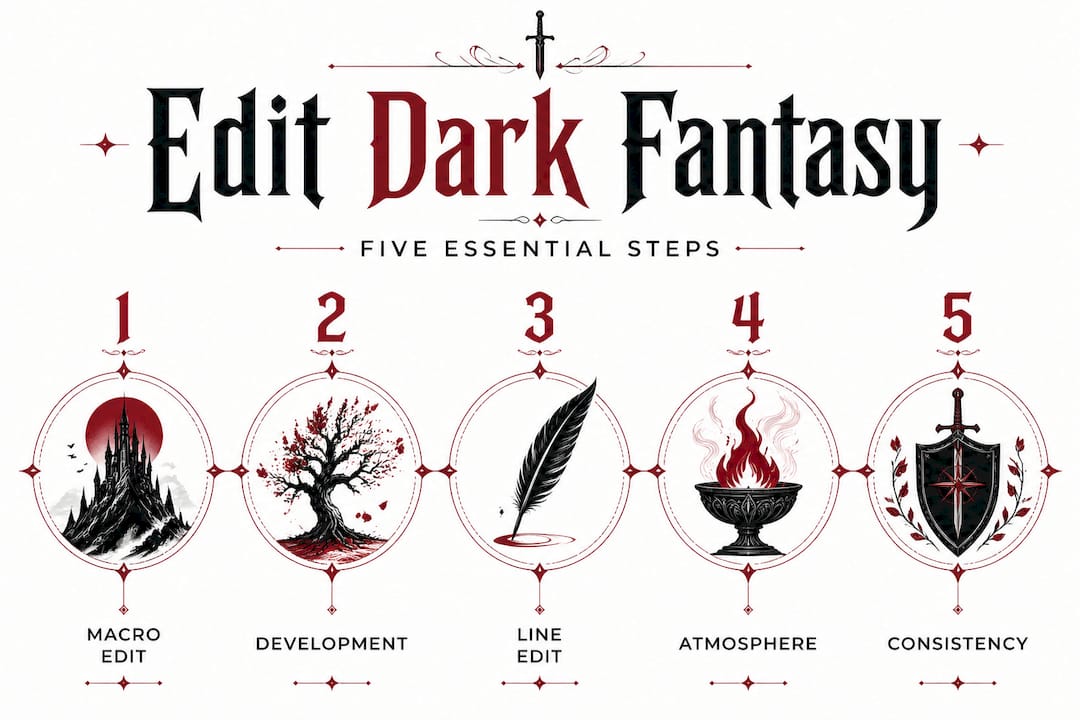
Pro Tip: Add an atmosphere editing pass after your line edit. Read a chapter and ask: does this feel like my world? Is the dread present? Sometimes a chapter is grammatically perfect and emotionally hollow. That’s a real problem in gothic storytelling, and it’s one that only an atmosphere-focused pass will surface.
Avoiding Info-Dumps and Lore Overload
Having organized your editing process, the next challenge is tackling info-dumps and lore.
An info-dump is exactly what it sounds like: a large chunk of explanation dropped into the narrative, usually all at once, that tells the reader everything about your world instead of letting them discover it. It’s the chapter that reads like a history textbook instead of a horror story. It’s the dialogue scene where one character explains the entire political structure of the cursed empire to another character who should already know it.
In dark fantasy and gothic horror specifically, the info-dump risk is especially high because these genres depend on rich world-building. Too much lore explanation overwhelms readers, and the fix is revising toward organic reveal, sharing information only when it matters to a character’s choices, while keeping internal logic clear enough that the dread stays coherent.
“Revise toward organic reveal: only when it matters to choices, while keeping internal logic clear enough that dread remains coherent.” — Six Tips for Editing Fantasy, Editors’ Association of Canada
The trick is learning to weave lore through action and character experience. Instead of explaining that the old families of your gothic city control the blood markets through a paragraph of backstory, show your protagonist being turned away from a merchant because she doesn’t carry the right bloodline seal. The reader learns the same information, but they learn it while something is happening, which keeps tension alive.
Using a tight character point of view (POV) is one of the most effective tools against info-dumps. When you write from inside a character’s perspective, you naturally filter information through what they notice, feel, and know. A character who has lived in a haunted city for thirty years doesn’t think in exposition. She thinks in reaction and sensory detail. Keeping that filter in place during your edit will naturally strip out the clunky “as you know” style lore drops.
Balancing explanation with mystery is also key. Gothic horror thrives on what the reader doesn’t fully understand. You don’t need to explain every ritual, every creature’s origin, or every curse’s source. Some things should stay in shadow. During your editing pass, ask yourself: is this explanation serving the story, or is it serving my ego as the person who built this world? Sometimes cutting the explanation entirely creates more dread than any amount of lore ever could.
Common Editing Mistakes in Dark Fantasy and How to Fix Them
Now, let’s look at the mistakes that most often trip up dark fantasy manuscripts and how to resolve them.
The most common mistake we see is inconsistent magic or supernatural rules. You establish early on that your protagonist can only use her necromantic abilities at great personal cost, and then in the climax she raises an army with no apparent consequence. Readers feel this even if they can’t name it. The fix is using your world bible to log every instance where supernatural abilities are used, then checking that log against your established rules. If you need to break a rule for story reasons, make sure the story earns that moment.

Contradictory lore is the close cousin of inconsistent magic. Character names that shift spelling, locations that move between chapters, historical events that change dates. These feel like small things, but in gothic fiction where world-building is the foundation of the mood, they’re genuinely corrosive. The style sheet exists precisely to catch these before they reach a reader.
Tone mismatch is subtler but just as damaging. A chapter that reads like a cozy mystery dropped into your gothic horror manuscript will kill the atmosphere you’ve been building. During your editing passes, flag any scene that feels tonally off and ask why. Sometimes it’s a word choice issue. Sometimes it’s a pacing issue. Sometimes the whole scene needs rethinking.
Flat secondary characters are another common issue. In gothic fiction, secondary characters often serve as thematic mirrors or sources of dread. If they’re underdeveloped, they become props rather than contributors to the story’s atmosphere. Give them consistent motivations and sensory detail even in small scenes.
Pro Tip: Read your most atmospheric chapters aloud. If you find yourself rushing through a sentence or stumbling over the rhythm, that’s the manuscript telling you something needs adjusting. Gothic prose should feel like it has weight. If it doesn’t land out loud, it won’t land on the page either.
A Fresh Perspective on Editing Dark Fantasy
Here’s something we think a lot of generic editing advice gets wrong: it treats clarity as the ultimate goal. In most genres, that’s reasonable. In dark fantasy and gothic horror, it’s actively harmful advice.
Clarity is a tool, not a destination. Your reader should understand the world well enough to feel dread, but they should not understand it so completely that the mystery evaporates. Conventional editing wisdom says: make every element clear, resolve every ambiguity, ensure every rule is explained. But gothic fiction earns its power from exactly the opposite. The unnamed thing scratching behind the wall. The ritual whose purpose is half-understood. The curse that seems to follow its own logic that no character ever fully deciphers.
What we’ve learned from years of reading and editing in this genre is that the best dark fantasy manuscripts are the ones where the author knows everything and reveals just enough. The author’s confidence in the world’s internal consistency creates a sense of solid ground beneath the reader’s feet, even when the story is actively terrifying. That confidence only comes from the kind of rigorous editing we’ve been talking about here.
The uncomfortable truth is that editing dark fantasy is harder than editing realistic fiction, because you’re simultaneously maintaining two things at once: logical coherence AND deliberate ambiguity. That’s a tension most editing guides don’t even acknowledge. The goal isn’t a perfectly explained world. It’s a world that feels real precisely because it behaves consistently, even in its shadows.
Explore More Dark Fantasy Editing and Books
Ready to apply these editing methods? Here are resources to deepen your craft or find inspiration.
At SandDancer Publications, we’re writers too, and we put these exact editing principles into practice with every title we publish. Our catalog includes award-winning dark fantasy and gothic horror ebooks that model the kind of immersive, atmosphere-forward storytelling this article is all about.

Browsing professionally edited dark fantasy fiction is one of the best ways to study how lore, atmosphere, and pacing work together at the sentence level. When you see it done well, it gives you a concrete target for your own revisions. Head over to SandDancer’s ebook collection and explore titles by Tony Fuentes and C.S. Kading. Sign up for our newsletter while you’re there for writing tips, event updates, and insider looks at what goes into building worlds that actually haunt readers.
Frequently Asked Questions
What is a world bible and why is it vital for editing fantasy manuscripts?
A world bible is a reference document that tracks invented names, terms, rules, and settings across your manuscript, and maintaining it is the most reliable way to prevent contradictions that break immersion in fantasy storytelling.
How do I identify info-dumps in my manuscript?
Look for passages where story action stops and explanation takes over for more than a paragraph or two. The info-dump risk is especially high in dark fantasy, so revise by revealing lore only when it directly affects a character’s choices.
What are the biggest editing mistakes unique to dark fantasy?
The most damaging mistakes are inconsistent supernatural rules, contradictory lore, and tone mismatches between chapters. Using a consistent style sheet throughout your editing process addresses all three of these at once.
Should I edit for atmosphere or logic first?
Start with logical consistency during your developmental pass to make sure your world holds together, then focus on atmosphere and tone in a later pass where you read specifically for how the prose feels rather than what it says.