

Essential tips for writing a dark fantasy novel with gothic flair
TL;DR:
- Atmosphere and world-building are essential for immersing readers in a dark fantasy setting.
- Complex, morally ambiguous characters deepen emotional impact and create compelling narratives.
- A well-designed magic system with clear rules and costs enhances tension and character development.
Writing dark fantasy is one of those creative experiences that sounds thrilling in theory and then humbles you fast. You picture brooding castles, cursed bloodlines, and morally broken heroes, and then you sit down to actually write it and realize the genre demands a lot more than just turning the lights off on a regular fantasy story. The good news? We've been in those trenches, and we want to share what actually works. Whether you're just starting your first gothic novel or trying to figure out why your current draft feels flat, these tips will help you craft a story that genuinely unsettles, moves, and stays with readers long after the last page.
Key Takeaways
| Point | Details |
|---|---|
| Establish atmosphere early | A compelling dark fantasy world starts with a strong, immersive sense of atmosphere and mood. |
| Build complex characters | Morally gray, deeply motivated characters bring authenticity and emotional weight to your story. |
| Give magic systems consequence | Magic should have logical rules and real costs to shape the plot and character journeys. |
| Leverage gothic elements | Striking monsters, artifacts, and haunting locations elevate your narrative. |
| Balance darkness with contrast | Blend the bleak with moments of humanity and emotional depth for a lasting impact. |
Laying the groundwork: Defining atmosphere and world-building
Let's start where every great dark fantasy begins: the world itself. Not just the map or the political system, but the feeling of the place. Atmosphere is the invisible hand that grips a reader from sentence one and never quite lets go. If your world doesn't feel alive and menacing before your protagonist does anything dramatic, you've already lost part of your audience.
Defining a core dark atmosphere early, whether that's gothic brooding with decaying castles or a barren, desolate wasteland, is one of the most effective tools for immersing readers in bleakness from the start. That means your first chapter isn't just about plot setup. It's about weather, architecture, the way people speak to each other, the sound the wind makes through broken shutters. Every sensory detail you include is a brick in the wall of your atmosphere.
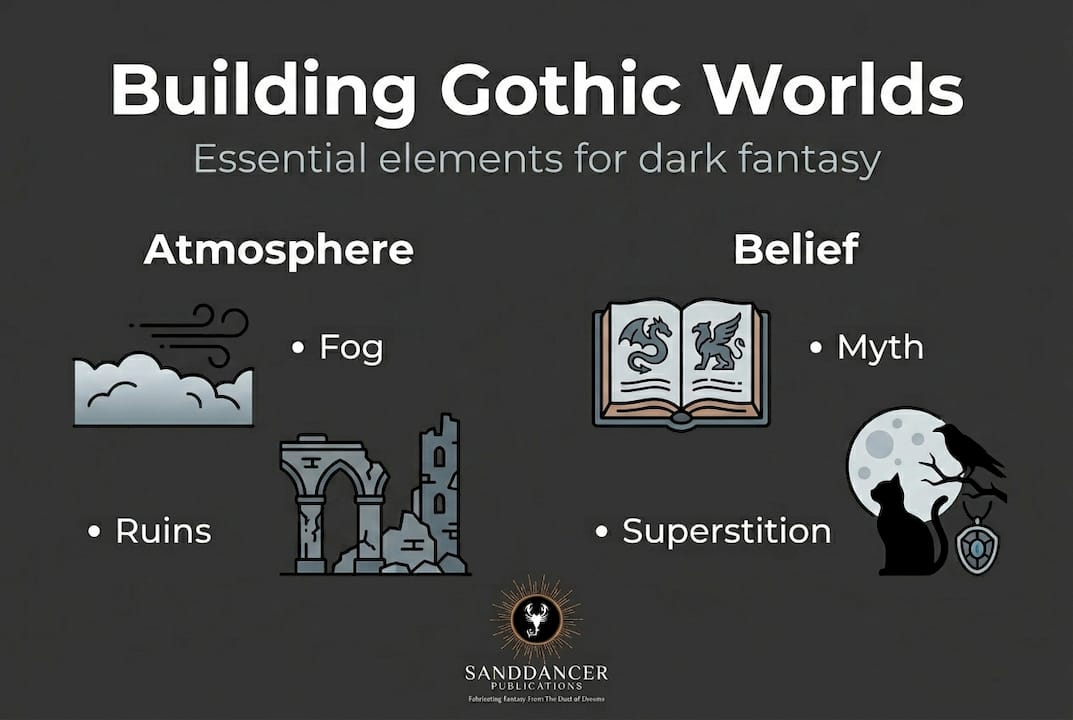
Gothic elements are your best friends here. Think persistent fog that makes familiar streets feel predatory. Think buildings that look like they're slowly returning to the earth. Think looming mountains that seem to watch. These aren't just decorations. They're mood-setters that tell readers what kind of story this is before a single monster shows up.
Now here's where a lot of writers skip a crucial layer: belief systems. Anchoring your world in myth, religion, and superstition is a powerful way to showcase societal corruption and deepen the sense that something is fundamentally wrong with this world. When a village burns offerings to appease a god that may or may not care, when priests hold power through fear rather than faith, when old superstitions turn out to be accurate warnings, you create a texture of darkness that feels real and earned.
Take the Gothika series as an example. The worlds in those stories don't just have scary things in them. They feel soaked in centuries of wrong choices and darker bargains. That layering takes work, but it's what separates memorable dark fantasy from a generic spooky adventure.
| Atmosphere element | Narrative effect |
|---|---|
| Decaying architecture | Signals decline, moral rot, lost glory |
| Persistent fog or storms | Creates uncertainty and isolation |
| Religious corruption | Builds societal tension and moral ambiguity |
| Barren landscapes | Reinforces hopelessness and danger |
Pro Tip: Build a mood board and a playlist specifically for your book's atmosphere. Spend five minutes with both before each writing session. It sounds a little extra, but it genuinely anchors your brain in the right headspace before the words start flowing.
Characters with depth: Moral ambiguity and motivation
Once your world's darkness is set, it's time to breathe life into characters who thrive or suffer within it. And in dark fantasy, the most compelling characters are almost never clean heroes or mustache-twirling villains. They're something messier and far more interesting.
Emphasizing moral ambiguity and gray characters over black-and-white morality is what gives dark fantasy its distinctive depth. When readers can see themselves in a character who does terrible things for understandable reasons, the story stops being entertainment and starts being an experience. That's the goal.
Building that moral complexity starts with backstory. Not backstory as a data dump in chapter two, but as a slow reveal that recontextualizes behavior. Why does your anti-hero distrust healers? Because the last one sold his sister's location to a warlord. That kind of detail transforms a character flaw into something readers understand, even if they don't condone it.
Developing dark characters with backstories, motivations, fears, and gray areas is essential to avoid the trap of underdeveloped villains and flat protagonists. Every character in your story, even secondary ones, should want something and fear something. That tension is what makes their choices feel real.
"Gray characters allow readers to question their own values and assumptions."
That quote is worth sitting with. When your character has to choose between saving one life and saving many, and neither option is clean, readers stop being passive observers. They're suddenly in the story with you, wrestling with the same impossible weight. That's the magic of moral ambiguity done right.
Pro Tip: Write a moral dilemma scene for your protagonist that has no good answer. Not for the book necessarily, just as a character exercise. See what they choose and, more importantly, see how they justify it to themselves. What you discover will shape every major decision they make in the actual story.
You can see this kind of layered character work in the Gothika series, where characters carry their histories like open wounds. It's not comfortable. That's exactly the point.
Crafting a compelling magic system: Logic, cost, and consequence
With complex characters in play, let's explore how magical forces shape their journeys. Magic in dark fantasy isn't a party trick. It's a burden, a temptation, and often a mirror for the character's worst impulses.
Designing magic systems with real costs like blood or sanity loss, and focusing on consequences to the caster, creates genuinely terrifying effects. When magic hurts the person using it, every spell becomes a character moment. Does your mage use the dark power anyway? What does that tell us about their desperation, their arrogance, or their love for the person they're trying to save?
Maintaining internal logic in magic and world rules prevents the kind of inconsistencies that break reader trust. Once you establish that blood magic ages the caster by a year per use, you cannot conveniently forget that rule when you need a big heroic moment. Readers remember. They will notice.
Here's a simple approach to building your system from the ground up:
- Define the source of power (blood, emotional trauma, stolen life force, ancient contracts).
- Establish what it can and cannot do, and be specific.
- Assign a cost that is personal and meaningful to the character.
- Decide how knowledge of this magic is gatekept, and by whom.
- Ask how this system has shaped the society around it over centuries.
| Magic system type | Strengths for storytelling | Weaknesses |
|---|---|---|
| Rule-less magic | Creates awe and fear | Difficult to build stakes |
| Logic-based magic | Clear cause and effect | Can feel mechanical if overexplained |
| Cost-based dark magic | Builds character depth and tension | Requires careful plotting |
Pro Tip: The best use of magic in dark fantasy isn't to solve problems. It's to reveal them. If your character reaches for dark power the moment things get hard, that impulse tells us something deeply important about who they are. Let magic expose the cracks, not patch them.
Gothic flavor: Monsters, artifacts, and striking locations
With your foundation set, characters and magic poised, it's time to layer in gothic elements for maximum atmosphere. This is where dark fantasy gets to be genuinely fun, in the best, most unsettling way possible.

Populating your world with unique monsters and artifacts that reflect the world's darkness and tie into plot progression is far more effective than dropping in a generic creature for a fight scene. The best monsters in dark fantasy are metaphors made flesh. A creature born from collective grief. A beast that only hunts those who've broken sacred oaths. A predator that looks exactly like someone your character trusted. When your monsters mean something, they become unforgettable.
Gothic elements like isolated sublime locations, dilapidated buildings, dark secrets, betrayals, and supernatural connections are your toolkit for evoking that particular flavor of dread that makes the genre so addictive. Think of an abandoned monastery on a cliff over a black sea. Think of a library full of books that scream when opened. Think of a market town where no one will tell you what happened to the last outsider who asked questions.
Artifacts deserve special attention. A cursed sword that whispers its kill count. A locket that shows the last moment of its previous owner's life. A crown that grants the wearer perfect clarity and perfect despair simultaneously. Good artifacts carry story in their design. They don't need much explanation because their history is implied by what they are.
For visual inspiration on what that gothic fantasy imagery can look like, sometimes the best thing you can do is surround yourself with art that matches your story's mood.
| Gothic location | Narrative effect |
|---|---|
| Crumbling castle | Power, decay, and lost legacy |
| Haunted forest | Danger, transformation, primal fear |
| Underground city | Secrecy, survival, buried history |
| Fog-covered port town | Isolation, smuggled truths, moral greyness |
Location as character is a concept worth taking seriously. The Blood Tithe setting doesn't just exist behind the story. It presses in on every scene, shaping choices and mood in ways that feel almost alive.
Blending darkness with humanity: Contrast, emotion, and purpose
Having built your gothic world, let's make sure your story resonates emotionally and doesn't drown in hopelessness. This is where a lot of dark fantasy writers hit a wall. More darkness, they think. More death, more suffering. But relentless bleakness is actually less scary than targeted bleakness. We promise.
Showing ordinary life persisting amid darkness heightens immersion and contrast in ways that pure grimness simply cannot. When your characters have a quiet moment, a shared meal, a stupid argument about who forgot to buy candles, it makes everything around that moment feel more dangerous. Readers care about what might be lost. Give them something to lose.
Avoiding brutality for shock value and instead ensuring that dark moments reveal character, heighten conflict, and explore theme is the difference between a book that disturbs meaningfully and one that just exhausts readers. Violence and tragedy should cost something. They should change someone. If a character can watch something horrific and move on unfazed, you've wasted a perfectly good emotional turning point.
"The most memorable darkness comes from what's lost, not just what's shown."
Some of the most effective emotional techniques for dark fantasy include psychological tension, where readers feel something wrong before they know what it is. Inner conflict that doesn't resolve cleanly. Forbidden love that both characters know will hurt them and pursues it anyway. Small kindnesses in brutal settings that make readers want to weep. These tools create resonance without requiring a single drop of blood.
Raise the Dead is a solid example of how contrast works in practice. Moments of human warmth set against creeping darkness make both feel more real and more immediate.
Our take: Why writing dark fantasy is more than just adding gloom
Here's the thing we've seen again and again in the dark fantasy community. Writers come in thinking the genre is about turning up the grim dial to maximum and hoping readers feel appropriately disturbed. And then they wonder why their story doesn't land the way they expected.
The honest truth is that grimdark and meaningful dark fantasy are not the same thing. Grimdark piles on suffering to signal that the world is harsh. Meaningful dark fantasy uses suffering the same way good surgery uses a scalpel: precisely, purposefully, to get to something vital underneath. The best dark fiction we've encountered, and the kind we try to write ourselves in the Gothika series, treats darkness as a lens for exploring humanity, not a substitute for it.
What separates a story readers return to from one they abandon halfway through is almost always emotional stakes and atmospheric integrity. Not word count. Not how many characters die. When your world feels real, your characters feel like people with skin in the game, and your darkness serves a genuine thematic purpose, readers will follow you into genuinely terrifying places. That's the craft. Everything else is just window dressing.
Level up your dark fantasy writing journey
If these tips got your creative engine running, we'd love to see where you take them. Seeing dark fantasy principles in action through actual published fiction is one of the fastest ways to sharpen your own instincts as a writer.

Take a look at Blood Tithe, one of our award-winning gothic novels that puts many of these exact techniques on the page. Or if you want to browse a wider selection, explore more dark fantasy titles across our full catalog and see how atmosphere, moral ambiguity, and purposeful darkness work together in completed stories. And if you're not ready to commit just yet, check out some free gothic fantasy reads to get a feel for the genre at its best. Your next dark world is waiting.
Frequently asked questions
What sets dark fantasy apart from traditional fantasy?
Dark fantasy blends supernatural and fantastical elements with horror, leaning into gray morality, unsettling atmospheres, and ambiguous heroes rather than clean heroics. As the genre emphasizes, moral ambiguity over black-and-white morality is what gives it that distinctive, haunting depth.
How do I avoid clichés in my gothic fantasy novel?
Focus on original characters, layered motivations, and locations with real narrative purpose rather than copying familiar gothic tropes. Using isolated sublime locations, dark secrets, and supernatural connections in fresh combinations is the key to feeling original while honoring the tradition.
What's the best way to design a dark magic system?
Build your system on clear rules and costs that matter personally to your characters, so every use of magic carries real dramatic weight. Magic costs like blood or sanity loss work especially well because they force characters to pay a price the reader can feel.
Should dark fantasy always avoid happy endings?
Not at all. What matters is that your ending feels earned and purposeful rather than forced into either tragedy or false hope. The goal is meaningful resolution, not guaranteed despair.
How do I create emotional impact without graphic violence?
Psychological tension, strong personal relationships, and inner conflict that doesn't resolve neatly are some of the most powerful tools available. Ensuring dark moments reveal character and explore themes rather than existing for shock will always land harder with readers than pure spectacle.