

Gothic elements in literature for deeper storytelling
Gothic literature gets a bad rap. People hear “Gothic” and immediately picture dusty cobwebs, brooding men in capes, and heroines fainting on staircases. But here’s the thing: Gothic fiction is so much richer than that. At its core, it’s a genre built to hold the things society doesn’t want to look at directly. Fear, desire, identity, the monstrous, the marginalized. For women and queer readers especially, Gothic literature has always offered something rare: a space where outsider experiences aren’t just acknowledged, they’re central to the story. That’s why these elements keep showing up in the dark fantasy we love today.
What defines gothic elements: themes and atmosphere
So what actually makes something Gothic? It’s not just a vibe, though the vibe is definitely part of it. Gothic fiction is built from a specific set of ingredients that work together to create psychological unease, emotional intensity, and a sense that the world is not quite what it seems.
The foundational building blocks are well established. Gothic elements include dark, decaying settings like crumbling castles and fog-soaked ruins, an atmosphere of dread and suspense, and supernatural phenomena ranging from ghosts to vampires. But the setting isn’t just a backdrop. It’s doing real emotional work. A rotting estate isn’t just spooky scenery. It’s a symbol of inherited trauma, of systems that refuse to die even when they should.
Themes in Gothic fiction tend to cluster around isolation, forbidden passion, physical and psychological terror, and the anxieties of gender and social expectation. These aren’t random choices. Gothic fiction emerged partly as a reaction to the rigid social structures of the 18th and 19th centuries, and it gave writers a way to voice what couldn’t be said plainly. The monster at the door was often a stand-in for the thing society feared most: the woman who wanted too much, the man who loved differently, the person who refused to fit neatly into a category.
This is why Gothic fiction has always resonated so deeply with people who live on the margins. The genre is structurally built around “the Other.” The outsider, the uncanny, the figure who doesn’t belong. That’s not a bug. That’s the whole point.
One of the most fascinating patterns in literary history is that Gothic surges during social unrest, shaping what we now call modern dark fantasy. Think about it: Gothic fiction peaked during the Industrial Revolution, then again during the Cold War, and it’s having a massive moment right now. When the world feels unstable, people reach for stories that name the dread they’re already feeling. Gothic fiction does that better than almost any other genre. You can find these same gothic elements in entertainment media today, from prestige TV to the dark fantasy novels flying off shelves.
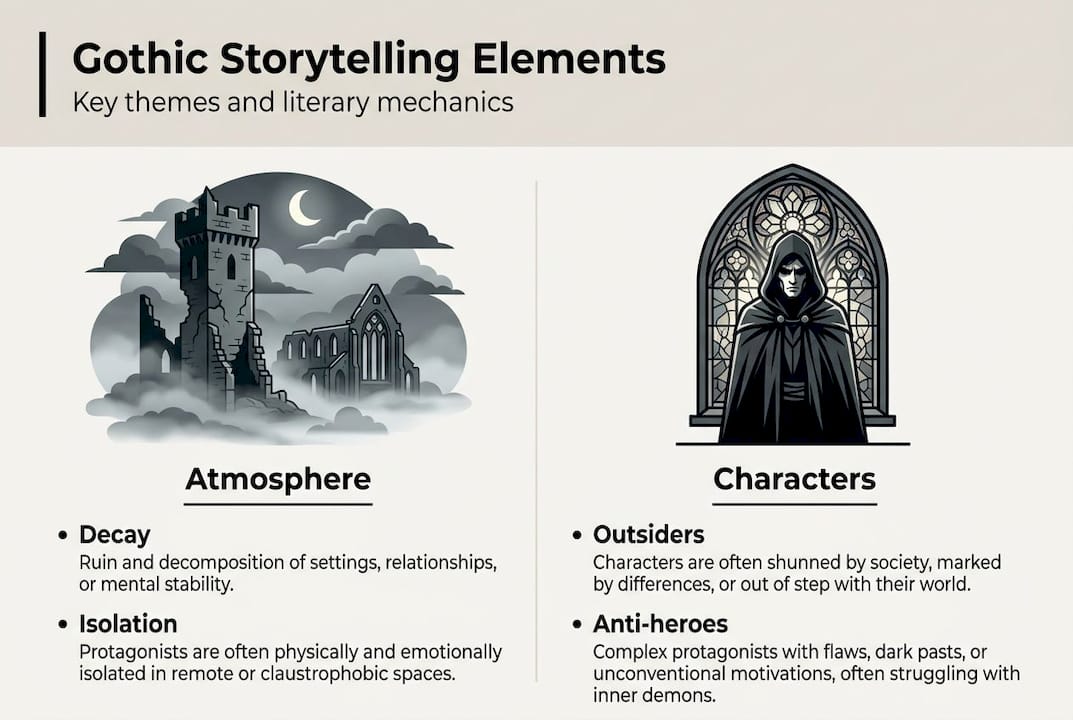
The atmosphere itself is a character. Gothic writers use sensory language, shadow and light, sound and silence, cold stone and warm blood, to make readers feel the story in their bodies. That’s not an accident. It’s craft.
Core characters and tropes in Gothic literature
Once you understand the thematic DNA of Gothic fiction, the characters start to make a lot more sense. Gothic literature has a roster of archetypes that show up again and again, but the interesting thing is how much room those archetypes have to evolve.
The tormented protagonist and the persecuted heroine are probably the most recognizable. The tormented protagonist, often called the “persecuted heroine” in the Female Gothic tradition, is typically a woman trapped by circumstance, by a man, by a house, by society itself, who must navigate her situation using intelligence and emotional resilience rather than brute force. This character type was genuinely radical when it appeared. She wasn’t passive. She was surviving.
Then there’s the classic vs. modern gothic character split, which is where things get really exciting:
| Classic gothic character | Modern gothic character |
|—|—|
| The brooding, morally ambiguous lord | A queer anti-hero navigating power and desire |
| The persecuted, helpless heroine | A woman who weaponizes her outsider status |
| The supernatural villain | A complex antagonist shaped by systemic trauma |
| The rational male rescuer | A community of marginalized people finding agency together |
Modern dark fantasy has taken these archetypes and done genuinely interesting things with them. Writers are flipping the script on who gets to be the monster, who gets to be the hero, and what “salvation” even means. Contemporary dark fantasy is full of protagonists whose queerness, gender, or outsider identity is the source of their power rather than their weakness.
Pro tip: If you’re writing Gothic-influenced fiction, resist the urge to “fix” your morally gray characters. The tension and ambiguity are the point. A character who is both sympathetic and genuinely dangerous is far more Gothic than a straightforward villain.
The tropes themselves, the forbidden romance, the haunted past, the secret hidden in the walls, aren’t clichés when they’re used intentionally. They’re a shared language between author and reader. When you see a locked room in a Gothic story, you already feel the dread before the door opens. That’s the power of a well-used trope.
How Gothic mechanics shape storytelling
Knowing the themes and characters is one thing. Understanding how Gothic writers actually build that experience on the page is where craft gets genuinely interesting.
Atmosphere in Gothic fiction isn’t just description. It’s a technical tool. Gothic atmosphere is built through vivid sensory language, pathetic fallacy (where the environment mirrors a character’s emotional state), foreshadowing, unreliable narrators, nested tales within tales, and layered symbolism. Each of these does a specific job.
Pathetic fallacy is one of the most effective tools in the Gothic kit. When the storm breaks just as the protagonist discovers a terrible secret, that’s not a coincidence. The weather is doing emotional work. It externalizes internal states in a way that feels visceral rather than told.
Unreliable narration is equally powerful. Gothic fiction loves a narrator who may or may not be trustworthy, who may or may not be imagining things. This creates a reading experience where you’re constantly asking: is this real? That question is deeply uncomfortable, and discomfort is the whole point. Modern Gothic works use fragmented narratives to the same effect, making the reader feel the instability of the protagonist’s world.
Here’s a quick look at how these mechanics translate to storytelling impact:
| Gothic technique | What it does for the reader |
|—|—|
| pathetic fallacy | Makes setting feel emotionally alive and threatening |
| unreliable narration | Creates psychological unease and reader investment |
| symbolism (mirrors, blood, ruins) | layers meaning without over-explaining |
| foreshadowing | builds dread through anticipation |
| nested narratives | Creates distance and intimacy simultaneously |
Pro tip: The best Gothic writers leave things unexplained. Not every shadow needs a source. Not every dread needs a name. Strategic ambiguity is what makes a Gothic story linger in your head long after you’ve put it down. Over-explaining kills the atmosphere faster than anything.
These mechanics aren’t just historical curiosities. They’re actively shaping contemporary gothic works today. The tools are the same. The stories being told with them are brand new.
Gothic’s spectrum: subgenres, rational vs. supernatural, and modern echoes
One of the most useful things to understand about Gothic fiction is that it’s not a monolith. There’s a whole spectrum, and where a story falls on that spectrum changes its emotional texture significantly.
The most foundational split is between what scholars call “explained” and “unexplained” supernatural. Ann Radcliffe’s rational terror represents the explained end: the ghost turns out to be a man in a sheet, and the strange sounds have a logical source. The horror was real, but it was human. Matthew Lewis, on the other hand, gave us demons and miracles and events that cannot be rationalized away. Both approaches are valid. Both create completely different reading experiences.
This distinction matters because it reflects a deeper philosophical question that Gothic fiction has always wrestled with: Gothic as a reaction to the Enlightenment versus Romanticism. Is the world ultimately knowable and rational? Or are there forces that reason simply cannot contain? For marginalized readers, this question has a particular resonance. Systems of oppression often present themselves as rational and inevitable. Gothic fiction that refuses rationalization is, in a way, a refusal to accept those systems as natural.
The Female Gothic deserves its own moment here. This subgenre centers on women’s psychological experience, the conflict between sensibility and reason, the terror of domestic entrapment, and the horror of having your perception dismissed as hysteria. It’s not a subgenre that’s aged out of relevance. If anything, it feels more urgent now.
For queer readers, Gothic fiction offers something similar. The genre’s obsession with fluid identities, with figures who exist between categories, with desire that transgresses social boundaries, makes it a natural home for queer gothic narratives. The vampire who is neither living nor dead, the shapeshifter who refuses a fixed form: these aren’t just monsters. They’re metaphors that have always spoken to people whose identities exceed the boxes society offers.
Gothic also differs from horror in a way worth naming. Gothic prioritizes psychological dread and atmosphere. Horror, particularly modern horror, often leans into explicit violence and visceral shock. Both are valid. But Gothic’s power comes from what it implies rather than what it shows.
Why gothic literature still matters: an inclusive perspective
Here’s what we think conventional readings of Gothic fiction consistently miss: this genre was never really about haunted houses. It was always about haunted people. And the people who have historically been most haunted by society, women, queer folks, anyone whose identity made them “other,” have always found the most truth in these stories.
We’ve watched readers connect with Raise the Dead’s approach to identity in ways that go beyond entertainment. Gothic fiction gives you permission to sit with the uncomfortable, to find beauty in the dark, to recognize that your fears and desires are valid even when they’re messy. That’s not a small thing.
The genre’s moral ambiguity is a feature, not a flaw. Life for marginalized people rarely comes with clean heroes and obvious villains. Gothic fiction honors that complexity. It says: you can love something that hurts you, you can be monstrous and sympathetic, you can live in the in-between. That’s not nihilism. That’s honesty.
Gothic elements aren’t relics of the past. They’re tools for the present.
Explore gothic stories with SandDancer Publications!
If this has you ready to fall headfirst into some genuinely good Gothic fiction, we have exactly what you need. SandDancer Books publishes dark fantasy and gothic adventure written with women and queer readers at the center, not as an afterthought.
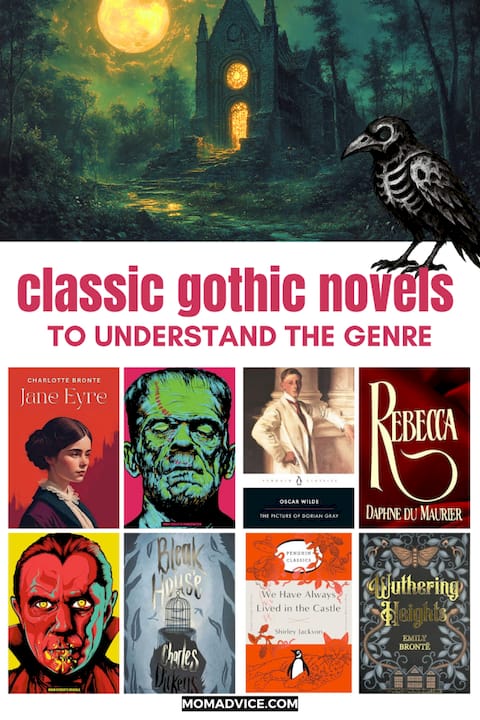
Our romantasy collection is a great place to start if you love the intersection of romance and dark atmosphere. If you want to go deep on Gothic dark fantasy, the gothika series is built from the ground up with these elements woven through every page. Come find your next obsession. 🖤
Frequently asked questions
What are the main Gothic elements in literature?
Gothic elements include decaying settings, suspenseful atmospheres, supernatural phenomena, psychological complexity, and blurred lines between reality and fantasy. These work together to create emotional unease and thematic depth.
How is Gothic literature different from horror fiction?
Gothic literature focuses on psychological terror and atmosphere, while horror often leans into explicit violence and visceral fear. Gothic prioritizes psychological dread over gore.
How do Gothic narratives support women and lgbtq perspectives?
Gothic stories center on outsider experiences, fluid identities, and emotional complexity, giving marginalized voices space to explore isolation, desire, and identity outside mainstream norms.
What is the difference between explained and unexplained supernatural?
explained supernatural rationalizes strange events as having human or natural causes, while unexplained supernatural embraces overtly magical or demonic occurrences that defy reason entirely.