

How to build immersive dark fantasy settings that haunt
TL;DR:
- Dark fantasy emphasizes atmosphere, real stakes, and ordinary life to create pervasive dread.
- Immersive locations use unique geography, thematic materials, and storytelling details to evoke tone.
- Balancing despair with moments of hope and agency deepens emotional impact and engagement.
Most fantasy worlds feel like a stage set. Pretty backdrop, lots of place names, zero dread. You walk through the tavern, grab a quest, and nothing about the world itself makes your skin prickle. That's the gap between generic fantasy and a truly dark fantasy setting. The difference isn't just adding more monsters or painting everything gray. It's about building a world where the atmosphere, the rules, and the consequences all work together to make readers or players feel like something terrible is always just around the corner. Let's dig into how we do that.
Key Takeaways
| Point | Details |
|---|---|
| Atmosphere and morality | A bleak setting anchored by ambiguous morality and costly magic creates authentic dark fantasy. |
| Immersive locations | Unique geography, features, and adventure hooks make your setting memorable for readers and players. |
| Rules and history | Establishing supernatural laws and a layered history gives your world depth and consistency. |
| Mechanics and mood | Carefully chosen mechanics and sensory details sustain the tension and emotional impact of your setting. |
| Purposeful despair | Balance bleakness with moments of agency or hope for maximum impact, avoiding empty futility. |
Understand the essentials of dark fantasy worldbuilding
Before you sketch a single haunted forest or cursed city, you need to understand what makes dark fantasy tick at a foundational level. It's a genre with a very specific flavor, and if you skip the groundwork, you end up with a setting that's just grimdark wallpaper.
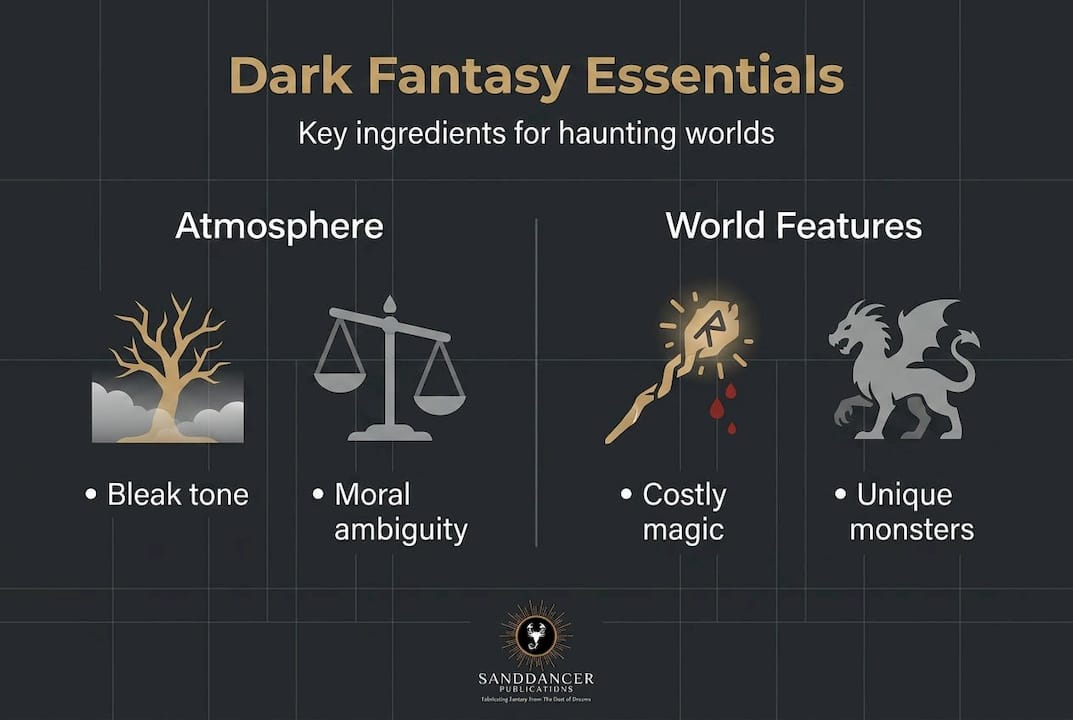
The core building blocks of a dark fantasy world are atmosphere, belief systems, rules of magic, monsters, artifacts, and ordinary life. Yes, ordinary life. That last one surprises people, but it's critical. When readers see how regular people exist amid the horror, the despair hits harder. A farmer trying to harvest crops while corpse-lights drift through the field at dusk is far more unsettling than another description of a ruined castle. It's the contrast that sells the darkness.
The genre also sits in a specific spot between epic fantasy and horror, and it's worth knowing exactly where. Dark fantasy features visceral action and tangible threats in fictional worlds with real magic costs, while gothic horror leans contemplative and symbolic, usually set in historical or quasi-historical spaces. Both are gorgeous traditions, but they call for different tools. In dark fantasy, your undead knight is a physical threat with rules and a backstory. In gothic horror, that same figure might be a symbol of guilt or repression. Knowing which lane you're in shapes every decision you make.
Moral ambiguity is non-negotiable in this genre. Good versus evil works in high fantasy. In dark fantasy, you want choices that cost something no matter which way the character goes. A paladin who must burn down a village to stop a necromantic plague isn't evil, but she's not clean either. That weight is what gives the genre its teeth. Consequence is the engine. Magic should have a price, victories should leave scars, and betrayal should feel genuinely devastating rather than plot-convenient.
Here's a quick comparison to keep your genre bearings straight:
| Feature | Dark fantasy | Gothic horror |
|---|---|---|
| Setting | Fictional worlds with invented history | Historical or quasi-historical settings |
| Threats | Tangible monsters, costly magic | Symbolic, psychological, atmospheric |
| Pacing | Action-driven, high stakes | Contemplative, dread-focused |
| Tone | Bleak but visceral | Melancholy and symbolic |
| Magic | Concrete rules with real costs | Ambiguous or implied |
Pro Tip: Hope is your secret weapon. Use it sparingly and then crush it, and the bleakness lands ten times harder. One small moment of genuine warmth before a devastating loss does more for dark atmosphere than fifty grim descriptions. Check out how Raise The Dead handles this balance for a masterclass in using contrast to amplify dread.
Create immersive locations and geography
Once you have your genre foundations locked in, you need somewhere for your story or campaign to actually live. And “a dark forest” or “a ruined city” isn't enough. Specificity is everything.
The most memorable dark fantasy locations have a few things in common. They use unique geography and strong themes, creative materials that signal tone immediately, and built-in adventure hooks that make the place interactive rather than decorative. A swamp that smells of copper and old prayers is more evocative than a generic bog. An obsidian city whose towers were melted during a war nobody wants to talk about does more narrative work than “a ruined metropolis.” Every location should tell a story before a single character speaks.
Think about biomes with a dark twist. Haunted coastlines where the tide brings in pieces of ships that have been missing for decades. Fungal wastelands where the spores are mildly hallucinogenic and the visions they cause are always true, but always too late. Frozen mountain passes where travelers freeze mid-step and stand as statues for centuries. These aren't just set dressing. They're world-building that communicates history, rules, and danger all at once.
Architecture matters enormously and is often underused. What materials people build with, and why, tells you about their fears and their values. A city built from the bones of a dead god communicates a very different belief system than one built from black volcanic stone. Add thematic decorations and sublocations. A cathedral isn't just a cathedral. It has a reliquary beneath the altar, a bellkeeper who hasn't come down in thirty years, and a confession booth where the priest is rumored to eat the sins he hears. Now it's a location.
Here's a simple framework for building locations that stick:
| Element | Generic version | Dark fantasy version |
|---|---|---|
| Geography | Rolling hills near a river | Ash plains above a submerged ancient city |
| Architecture | Stone keep with towers | Towers fused from iron and crystallized screams |
| Feature | A well in the town square | A well that whispers names of the drowning |
| Hook | Bandits on the road | A merchant convoy frozen in perfect stillness |
You can find worldbuilding inspiration for your own settings over on our blog, where we dig into the craft regularly.
Pro Tip: Take a real place you love and twist it. Venice but the canals run with something thicker than water at certain tides. New Orleans but the jazz district is haunted by musicians who sold their deaths, not their souls. The End of The Line setting does exactly this, drawing on real urban textures and wrapping them in gothic unease. Real geography gives readers and players an anchor, and then you pull that anchor loose at exactly the right moment.
Establish rules, stakes, and a living timeline
A setting without rules is just vibes. And vibes alone don't sustain a story or a campaign through three sessions or three hundred pages. You need supernatural laws, power structures, and a timeline that makes the world feel like it was running before your characters showed up and will keep running after they're gone.
Start with your supernatural rules and scope, specifically the properties that differ from real-world logic. Magic fueled by blood is an old idea, but it becomes fresh when you define whose blood, how much, and what happens when someone takes a shortcut. Necromancy powered by the necromancer's own lifespan creates completely different story possibilities than necromancy powered by sacrifice. The rules shape the stories automatically.
Power structures and belief systems are just as important. Who controls magic, who fears it, and who profits from that fear? A church that secretly runs the black market in cursed artifacts. A thieves' guild that enforces its contracts with bound spirits. A nobility class that practices ritual bloodletting to maintain their political alliances. These aren't just flavor, they're friction, and friction drives plot.
History is where most creators underinvest. Setting the mood in a dark fantasy world depends heavily on the weight of past events sitting on the present. Grimdark settings specifically are shaped by bleak moral alignments and low character agency, and that weight comes from history. A war that nobody won but everyone claimed to. A god that went silent two hundred years ago and whose priests still perform the rituals, hoping. A plague that was cured but left behind children who can see things others can't. Layer these events across a simple timeline and your world immediately feels like it has depth.
"Layered history isn't just backstory. It's the difference between a world that feels lived-in and a world that feels like a backdrop." A living timeline means your world has current conflicts, recent wounds, and things that are still unresolved. That's where your characters, readers, or players find their purchase.
You can visualize some of these gothic fantasy elements and get inspired through our fine art prints, which capture exactly the kind of mood we're talking about here.
Focus on three to five key world-defining points rather than trying to document everything. Brain dump your ideas first, then narrow to what directly affects your story or campaign. Recent events matter most. A coup that happened last week creates different energy than one that happened last century.
Integrate mechanics and mood for stories and RPGs
This section is where writers and game masters often part ways, but actually the tools overlap more than you'd think. Both need to deliver experience, not just description. And experience in dark fantasy comes from stakes that feel real and consequences that actually land.
For RPG campaigns, some of the best mechanical models come from sourcebooks like the Ravenloft Domains of Dread, which gives game masters concrete tools for Fear and Despair mechanics, horror subtypes including gothic, cosmic, and dark fantasy, safety tools like the X-Card, pacing techniques for building tension, and Dark Gifts that offer real benefits with genuinely deadly costs. The Dark Gifts mechanic alone is a masterclass in how to make corruption feel like a meaningful choice rather than a punishment.
For writers, the equivalent is building consequence into your magic and monster systems from the ground up. A curse that gives your protagonist perfect memory but erases their ability to recognize faces. A monster born from a broken oath that can only be destroyed by an act of the same kind of betrayal that created it. These aren't just cool ideas. They create narrative structure by forcing characters into impossible positions.
Curating your character options also shapes tone dramatically. In a dark fantasy D&D campaign, running a human-dominant world where the available classes skew toward fighters, paladins, rogues, and warlocks reinforces moral ambiguity and survival themes far more effectively than a setting where every exotic species and subclass is available. Constraint creates atmosphere. When everybody is essentially human and essentially fragile, the monsters become genuinely terrifying.
"Agency is the antidote to grimdark fatigue. Give characters real choices with real costs, and even the bleakest setting stays engaging. Remove all agency and you just have suffering theater."
Pacing is everything. Build tension across sessions or chapters, not just in individual scenes. Use quiet moments to let dread accumulate before you release it. A meal scene where the food is slightly wrong. A child who doesn't blink. A locked door that nobody mentions. Then, when the horror arrives, it lands like a hammer. See how Blood Tithe manages its narrative mechanics for a strong example of how pacing and consequence work together across a full-length story.
Expert perspective: Why balancing despair and agency is the soul of dark fantasy
Here's the honest truth that a lot of dark fantasy advice skips over. Relentless misery is boring. We've seen it. We've played campaigns where every hope got stomped and every character choice led to ruin, and after a while the table just went numb. That's not horror. That's endurance.
The grimdark excess problem is real, and the worldbuilding community talks about it more than you'd expect. When darkness serves only shock value, it stops meaning anything. The goal isn't to make your audience feel hopeless. It's to make them feel like hope is dangerous. That's a completely different thing.
The settings that stay with us, the ones we still talk about years later, all have moments of unexpected warmth, irony, or small victory tucked inside the bleakness. A villain who genuinely loves their child. A betrayal that makes complete sense from both sides. A small act of kindness that costs the character everything. These moments don't soften the darkness. They make it hurt more, because suddenly there was something worth losing.
We think contrasts in Raise The Dead demonstrate this beautifully. The horror hits harder because the characters are recognizably human in their small joys before the darkness closes in. That's the craft worth chasing.
Explore more dark fantasy worlds and resources
If this has your imagination running in gloriously dark directions, we'd love to point you somewhere useful. 😊 The Gothika series is a great place to see immersive dark fantasy worldbuilding in action, with layered history, costly magic, and settings that feel genuinely haunted rather than just aesthetically spooky.

Not sure where to start? We have free dark fantasy ebooks available so you can dive in without commitment. And if you like your darkness with a little romance woven through, our romantasy dark fantasy collection brings that emotional complexity we've been talking about right to the surface. Good worldbuilding is best experienced, not just studied.
Frequently asked questions
What are essential elements of a dark fantasy setting?
Key elements include a bleak or brooding atmosphere, corrupt belief systems, magic with real costs, unique monsters, and cursed artifacts, all grounded in the texture of ordinary life to make the darkness feel real.
How do you avoid grimdark becoming just shock value?
Balance is everything, and the worldbuilding community agrees. Mix moments of genuine hope, character agency, and varied stakes into the darkness to keep it meaningful rather than nihilistic.
How do you make locations immersive in dark fantasy?
Use unique geography, strong themes, evocative materials, and built-in adventure hooks, drawing on real-world places twisted by dark fantasy logic for maximum impact and novelty.
How can I integrate horror mechanics into an RPG campaign?
The Ravenloft sourcebook approach offers proven tools including Fear and Despair mechanics, Dark Gifts with real costs, safety tools like the X-Card, and careful pacing to build and release tension effectively.
What makes dark fantasy different from gothic horror?
Dark fantasy is action-driven with tangible threats and defined magic systems in fictional worlds, while gothic horror is contemplative, symbolic, and usually rooted in historical settings where the horror is often psychological.