

How to Create Fantasy Lore That Captivates Readers
TL;DR:
- Effective worldbuilding layers lore subtly, revealing only what enhances the story and character development.
- Use the iceberg method by showing cultural details through actions and artifacts, not direct exposition.
- Focus on lore that resonates emotionally, prioritizing feeling over exhaustive fact accumulation.
You've spent months building your world. You've named the mountains, sketched the political factions, invented a religion with seventeen gods. Then a beta reader says the world feels hollow. That stings, and honestly, it's one of the most common gut-punches indie fantasy authors face. Many authors struggle to weave deep lore into their stories without overwhelming readers, and that tension between too much and too little is where most worldbuilding falls apart. This guide is your practical framework for layering lore naturally, whether you're writing dark fantasy, epic fantasy, gothic adventure, or romantasy. We'll walk through the prep work, the core method, and the most common traps, so your world feels ancient, alive, and real.
Key Takeaways
| Point | Details |
|---|---|
| Start with strong foundations | Anchor your lore in clear story goals and established genre elements for consistency. |
| Use the iceberg method | Reveal only what your reader needs, implying deeper world history beneath the surface. |
| Invent history, myth, and culture | Create layered societies with unique events, beliefs, and customs to enrich your world. |
| Avoid overloading your audience | Use natural story moments, not exposition dumps, to deliver essential background. |
| Focus on emotional resonance | Story-driven lore that shapes characters and plot is more memorable than exhaustive detail. |
What You Need Before Building Lore
Before you write a single rune on a fictional cave wall, let's get organized. You need more than inspiration. You need a system.
Start by clarifying your story's core themes and genre conventions. Dark fantasy lore tends to lean into corruption, moral ambiguity, and ancient curses. Epic fantasy often demands sprawling histories and competing empires. Gothic adventure thrives on secrets buried under crumbling estates. And romantasy? It wants lore that feels intimate, emotionally charged, and tied to the fates of your leads. The lore you build should serve the genre you're writing, not fight against it.
Next, gather your inspiration sources. Real-world history and mythology are gold here. Fantasy lore gains depth when rooted in world history, mythology, and implied layers, so raid actual historical records, folklore databases, and comparative religion texts without shame. Study how popular fantasy works handle it too. Notice when you feel the world breathing versus when you feel the author explaining.
Then, create what most experienced worldbuilders call a lore bible. This is just a dedicated document where you track every invented fact: timelines, rulers, religious texts, creation myths, wars, and cultural quirks. It doesn't have to be beautiful. It just has to be consistent.
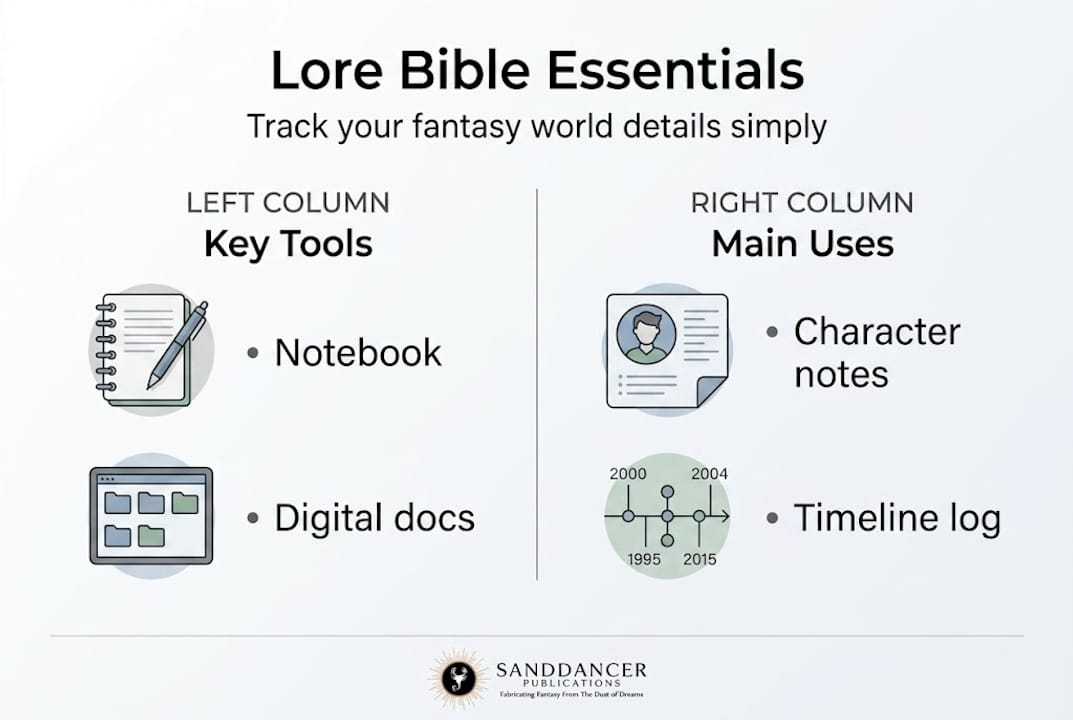
Here's a quick look at tools that can help:
| Tool | Best For | Cost |
|---|---|---|
| World Anvil | Full lore bibles and wikis | Free / paid tiers |
| Google Drive | Simple, shareable docs | Free |
| iA Writer | Clean distraction-free writing | One-time purchase |
| Pinterest boards | Visual mood and culture reference | Free |
| Index cards / paper | Quick plotting and lore mapping | Very cheap |
Pro tip: Start a map even if it's embarrassingly rough. A hand-drawn sketch of your continent, with regions labeled and borders marked, will save you from accidentally having your characters teleport through geography. Same goes for a basic family tree for major bloodlines. These aren't final products. They're thinking tools.
If you're exploring enriching fantasy universes as a creative project, building these foundational documents first will make every later decision easier and more coherent.
The Iceberg Method for Compelling Lore
With your toolkit in place, it's time to learn the storytelling foundation that separates memorable lore from flat worldbuilding.
The iceberg theory, first popularized in literary circles, says that only a fraction of what you know about your world should appear on the page. The rest sits below the surface, invisible but felt. When readers sense that history exists beyond what they're told, the world feels real. When everything gets explained, it feels like a textbook.
Here's how to actually apply it. Surface lore works best when shown through stories, artifacts, rituals, and dialogue rather than direct exposition. So instead of a paragraph explaining why your culture fears the color red, you show a character flinching when they see a red door, and a companion muttering an old saying about blood-painted thresholds. The reader fills in the gap. That's the magic.
Let's compare shallow versus deep lore techniques:
| Shallow Lore | Deep Lore |
|---|---|
| A narrator explains the history in a prologue | A character swears by a god no one has mentioned yet |
| Magic rules are listed in a glossary | A spell goes wrong in ways that reference forgotten law |
| One culture is described in full detail upfront | Two cultures argue over the same event with different names |
| A war is summarized | Veterans carry scars they never explain |
"The danger of infodumping is not that it overwhelms readers, it's that it removes their imagination from the equation entirely. The reader becomes a passive recipient instead of an active participant."
To put the iceberg method into practice, try this sequence. First, write out the full version of your lore event in your lore bible. Second, identify one sensory or emotional detail from that event that a character might carry. Third, plant that detail in a scene, through dialogue, an object, or a behavior. Fourth, trust that the reader will feel the weight even without the full story. That restraint is what makes readers finish a chapter and immediately flip to the next.
Examples of layered worldbuilding in published dark fantasy show this again and again. The most haunting moments are almost always the ones that suggest rather than explain.
Building Blocks of Fantasy Lore: History, Myth, and Culture
Once you've chosen your approach to layering information, it's time to populate your world's deeper past and society.
History first. Every compelling fantasy world has at least one catastrophic event in its past. A war that reshaped borders. A revolution that burned the old gods. A lost age that nobody fully remembers but everyone references in hushed tones. World history and myth can be modeled to deepen fictional lore, meaning you don't have to invent from scratch. Look at how real civilizations processed trauma through ritual, myth, and revisionist storytelling. Your fictional societies will do the same.

Myths and legends are next, and honestly they might be the most fun part. A myth is what your people believe happened, whether or not it's true. That gap between myth and historical fact is where some of the richest dramatic tension lives. Maybe the founding hero your empire worships was actually a villain. Maybe the monster in the old stories was misunderstood. Let your myths lie, exaggerate, and contradict each other.
Culture holds all of this together. Think about festivals that mark historical trauma. Think about food taboos that trace back to a forgotten plague. Think about which professions are considered noble and why. Most acclaimed fantasy worlds feature at least three to five distinct visible cultures, and that variety creates the friction that makes politics, war, and romance feel earned.
Pro tip: Let your cultures disagree theologically. When two groups worship the same deity but interpret that deity's will in opposing ways, you've just handed yourself an entire book's worth of conflict without writing a single battle scene. Religious tension is plot tension.
For raw fantasy story inspiration, look at how cultures in published works argue over shared history. That's the texture you're after.
Avoiding Clichés and Overwhelming Your Reader
As you flesh out your mythology and culture, be mindful of these common traps that can dilute or distract from your story's impact.
The biggest offender is the infodump. We've all done it. You know so much cool stuff about your world that you want to share it all, right now, in chapter two. But integrating lore via dialogue and rituals, rather than blocks of exposition, is what keeps readers inside the story instead of skimming.
Other common mistakes include building monolithic cultures where every member of a group thinks and acts identically, leaning on genre stereotypes like brooding dark lords with no motivation, and inventing lore that has no connection to your characters' personal stakes.
When something isn't working, try this troubleshooting process. First, find the lore passage that feels clunky. Second, ask whether it's there because the story needs it or because you love it. Third, cut it from the narrative and drop it into your lore bible. Fourth, see if you can replace it with a single image, gesture, or line of dialogue that implies the same thing. Fifth, if a piece of lore has no impact on a character's decisions or the world's tension, move it. Don't delete it, just move it below the surface.
"The lore you never show is not wasted. It's the foundation. The reader feels its weight even when they never see it directly."
Your editing checklist should include three core questions. Does this lore moment serve a character's emotional arc? Does it raise a question the reader will want answered? Does it feel like something that happened, not something the author invented to explain a plot point? If the answer to all three is yes, keep it. If not, it belongs in the bible, not the book. And check subtle lore integration examples from authors who do this well.
The Real Secret to Memorable Fantasy Lore
Here's the thing nobody says out loud in worldbuilding discussions: most fantasy writers overestimate how much lore actually matters to readers.
We've seen authors spend six months building a fully realized monetary system, complete with exchange rates between seventeen city-states, only to have readers fall in love with a single line of dialogue about a dead grandmother's ring. That's not a failure of the monetary system. That's just how human beings work. We connect to feeling, not to facts.
The real secret is this: memorable lore is not the lore you invented. It's the lore that resonates in the moment it's needed. A myth that explains why your protagonist can't go home. A cultural taboo that makes the love interest's choice devastating. A historical wound that surfaces in the final confrontation. Genre-defining lore approaches always prioritize emotional payoff over encyclopedic coverage.
Trust your instincts. Not every detail needs to make it to the page. The world bible is for you. The story is for the reader. Build as much as you need to write with confidence, then give readers only what moves them forward.
Bring Your Fantasy Worlds to Life with SandDancer
If you want to see these techniques in action rather than just on paper, SandDancer Books is a great place to start. The novels published through SandDancer are built on exactly the kind of layered, emotionally resonant lore this guide covers.

The romantasy collection is a perfect starting point if you want to study how intimate lore and high-stakes romance can coexist. Blood Tithe is a masterclass in gothic dark fantasy atmosphere, where history bleeds into every scene without ever announcing itself. And Tribute shows how ritual, myth, and cultural tension drive romantasy plot momentum. Read them as a fan first, then revisit with your author brain switched on. You'll see the iceberg.
Frequently Asked Questions
What is the easiest way to create original fantasy lore?
Start by combining real-world history and myth, then add a unique twist that fits your story's themes. Fantasy lore gains depth when anchored in recognizable human experience with a creative angle that makes it feel fresh.
How much lore should appear in the final story?
Only reveal details essential to character action and setting mood. Most lore should stay beneath the surface, with the iceberg theory guiding you to imply rather than explain wherever possible.
What are common mistakes when creating fantasy lore?
Over-explaining, using generic tropes, and neglecting cultural conflict are the most frequent errors. Common pitfalls include infodumps and genre stereotypes that flatten what could be nuanced, living societies.
How do you organize complex lore for an ongoing series?
Keep a dedicated lore document or bible and update it as you write. When plot developments change the rules, revise the document immediately so continuity stays clean across books.
Recommended
- SandDancer Publications – SandDancer Books
- House of Cards | Urban Fantasy Las Vegas Vampire Shapeshifter Ebook – SandDancer Books
- Romantasy Ebooks – Dark Romance Fantasy Titles | SandDancer Books
- Heart of Hanwi Gothic Fantasy Wall Art | Dark Fantasy Book Cover Print – SandDancer Books
- The Art of Storytelling: What Makes a Book Impossible to Put Down | Mark Watson Books