

How to plan a fantasy series: step-by-step guide
TL;DR:
- A thorough series bible ensures consistency and maintains reader trust in dark fantasy series.
- Use simple digital or physical tools to track characters, world rules, and plot threads effectively.
- Balance planning with discovery to keep atmosphere and organic growth central to gothic horror stories.
You’re three books into your gothic horror series when a reader emails you: the vampire lord you killed off in book one just showed up very much alive in book three. Cue the cold sweat. We’ve all been there, or we know someone who has, and it’s the kind of contradiction that can unravel a reader’s trust faster than a poorly placed silver stake. Planning a dark fantasy or gothic horror series without a solid structure is a little like building a haunted mansion with no blueprints. Spooky atmosphere aside, the whole thing tends to collapse. This guide walks you through a practical, battle-tested process to organize your series, maintain consistency, and keep your readers turning pages well into book five and beyond.
Key Takeaways
| Point | Details |
|---|---|
| Start with essentials | Focus on character, rules, and plot basics when organizing your series planning from the start. |
| Choose functional tools | Simple systems like Notion or Google Docs work best for a living, referenceable series bible. |
| Follow a proven process | Structure your planning with defined steps for plot, world, and character arcs across books. |
| Balance structure and discovery | Leave room in your planning for surprises and organic story growth to keep your series engaging. |
| Update and verify | Regularly maintain your series bible to prevent contradictions and keep your world consistent. |
Why you need a fantasy series plan
Let’s be real. Dark fantasy and gothic horror are not forgiving genres when it comes to loose ends. Your readers are sharp, passionate, and absolutely will notice if your magic system changes rules between books or if a character’s eye color shifts from amber to steel gray for no narrative reason. These contradictions don’t just annoy readers. They break immersion, and immersion is literally everything in these genres.
Without a plan, subplot bloat becomes a genuine threat. You introduce a mysterious cult in book two, forget to resolve it, and by book four it’s just sort of haunting the background of your story like an uninvited ghost. That might work for atmosphere, but not for plot. Readers invest emotionally in threads you set up, and dropping them feels like a breach of contract.
The core structured approach to planning a fantasy series involves creating a series bible that documents characters, world rules, timelines, and plot threads to ensure consistency across books. Think of your series bible as the single source of truth for your fictional world. It doesn’t have to be beautiful. It just has to be thorough and searchable.
The short-term pain of setting up a planning system is absolutely worth it. Spending a few hours building your foundation now saves you weeks of continuity editing later. For dark fantasy in particular, where world rules around magic, curses, and supernatural creatures need to stay internally consistent, a series bible is less of a luxury and more of a survival tool.
Essential tools and materials for planning
Now that we’ve made the case for planning, let’s talk about what you actually need to make it happen. Good news: you don’t need anything fancy. Bad news: you do need to commit to something, because a plan that lives entirely in your head is just a daydream with pretensions.
On the digital side, tools like Notion, Google Docs, Scrivener, and even a well-organized spreadsheet can do the heavy lifting. Notion is great if you enjoy linking pages together and building relational databases of your characters and lore. Google Docs is perfect if you prefer simplicity and want everything searchable without setup overhead. Scrivener has dedicated series management features and works beautifully for writers who like to draft and plan in the same environment.
Analog tools still have a place too. A dedicated notebook for worldbuilding sketches, index cards for scene mapping, or a binder divided by book and chapter can feel satisfying in a way that screens sometimes can’t match. Some writers keep a physical character sheet taped above their desk. Whatever gets you referencing your plan regularly is the right choice.
According to practical series bible priority tiers, you should think in two layers: Tier 1 covers the essentials you’ll reference constantly, things like character names, ages, key timelines, and world rules. Tier 2 handles backstories, recurring subplot threads, and secondary character details. You update Tier 1 constantly during drafting, and you revisit Tier 2 whenever it becomes plot-relevant.
Here’s a quick comparison to help you choose your setup:
| Tool | Best for | Search-friendly | Cost |
|---|---|---|---|
| Notion | Complex, linked worldbuilding | Yes | Free tier available |
| Google Docs | Simple, shareable documents | Yes | Free |
| Scrivener | Draft and plan together | Limited | Paid |
| Physical binder | Tactile thinkers, quick sketches | No | Low |
Pro Tip: Start with the simplest tool that actually gets used. A half-finished Notion database is worth less than a complete Google Doc. Overcomplicated systems become procrastination in disguise.
Step-by-step fantasy series planning process
With your tools in hand, here’s how to actually build your series plan from the ground up. This is where the fun starts, we promise.
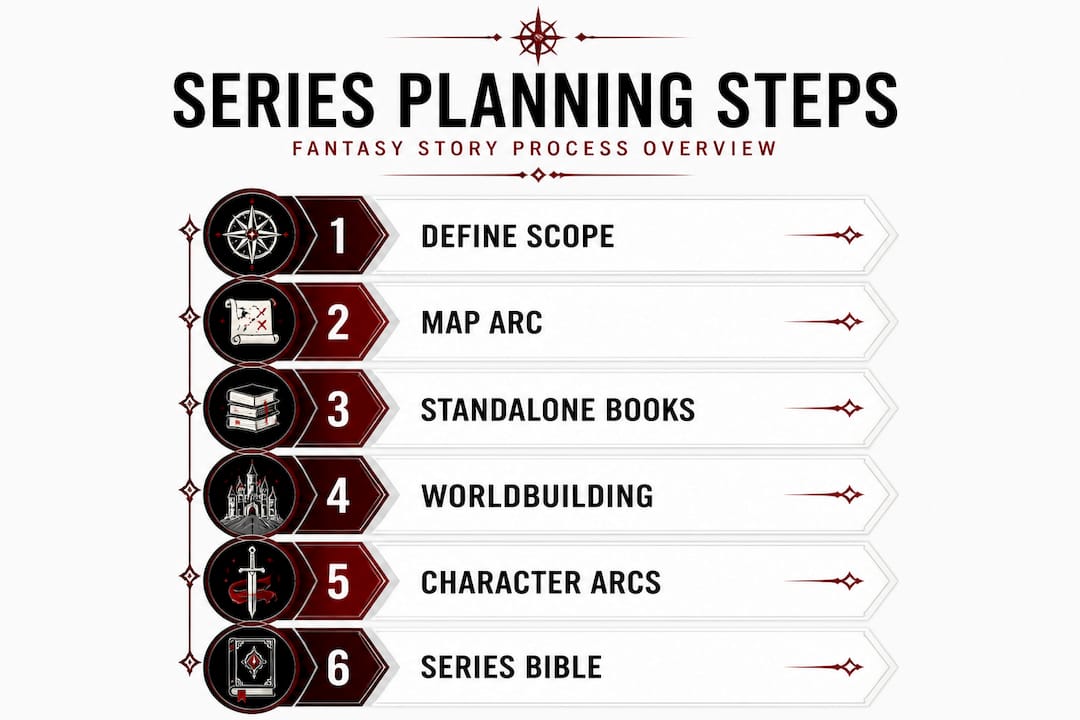
Step 1: Define your series scope. Before you write a single scene, decide whether you’re writing a duology, trilogy, or longer run. This shapes everything, from how much plot you seed in book one to how long your character arcs can breathe. A key step for fantasy series planning is to define your overarching plot and the number of books upfront so you’re not winging the finish line halfway through book three.

Step 2: Map your overarching story arc. What is the big question your entire series is trying to answer? In gothic horror, it might be whether your protagonist can escape a generational curse. In dark fantasy, it might be whether the cost of power ever justifies the sacrifice. Your overarching arc is the spine. Every book is a vertebra.
Step 3: Build satisfying standalone entries. Each book in your series needs to deliver a complete emotional experience while also advancing the larger arc. Readers who pick up book two without reading book one should still feel something by the end, even if they’re missing context. This is harder than it sounds, and it’s worth outlining each book’s internal story structure separately before you start drafting.
Step 4: Build your worldbuilding roadmap. This is where dark fantasy writers really get to dig in. A strong worldbuilding methodology starts with your core “what if” premise, then layers in physical geography, history, cultures, magic systems with defined costs and limits, and economic structures. The 80/20 rule applies here: focus 80% of your worldbuilding energy on the 20% of details that directly shape your plot and characters.
Step 5: Map your character arcs across the series. Your protagonist in book one should not be the same person by book four. Chart where each major character starts emotionally, what they want versus what they need, and what moments across the series force them to grow or break. This is especially powerful in gothic horror, where psychological transformation is often the whole point.
Step 6: Build your series bible. Pull everything above into a single, organized reference document. Name your files clearly. Use headers. Color code if that helps your brain. The goal is to be able to find any fact about your world in under two minutes.
Pro Tip: At the end of every drafting session, spend five minutes updating your series bible with any new details you introduced. This tiny habit prevents massive contradictions later.
Here’s a simple planning timeline to keep in mind:
| Phase | Task | Estimated time |
|---|---|---|
| Pre-draft | Series scope, arc, worldbuilding | 4 to 8 hours |
| Drafting | Scene-by-scene bible updates | 5 min per session |
| Post-draft | Continuity review, Tier 2 updates | 2 to 3 hours |
Troubleshooting common mistakes: over-planning, contradictions, and evolving worlds
No process is flawless, especially when you’re writing gothic horror and the story keeps wanting to go somewhere you didn’t expect. Here’s how to catch and fix the most common planning problems before they compromise your series.
The first warning sign of over-planning is when your planning starts replacing your writing. If you’ve spent three months building elaborate wiki entries with full genealogy charts for characters who appear in two scenes, that’s procrastination wearing a productivity costume. Research confirms that functional series bibles built in two to four hours of initial setup and updated weekly outperform elaborate wikis that eat your writing time. Keep it lean and referenceable.
Contradictions are the other big monster under the bed. The best way to prevent them is a pre-scene fact check. Before you write a major scene, take sixty seconds to verify relevant details in your bible: character ages at this point in the timeline, which characters know which information, what the current state of your world’s politics or power structures is. It sounds tedious. It saves enormous pain in editing.
One of the most nuanced worldbuilding bible insights is that your world should be allowed to evolve organically, but your core rules must stay fixed. Politics can shift. Alliances can crumble. A character’s reputation can change. But if your magic system requires blood sacrifice in book one, it can’t conveniently stop requiring it in book three just because your protagonist needs an easy win. Core rules anchor reader trust. Let everything else breathe.
Finally, balance depth in your bible with clarity on the page. A good rule of thumb: 90% of your worldbuilding belongs in your bible, not in your prose. Readers don’t need a full history of your fictional kingdom to enjoy a tense throne-room confrontation. They need just enough to feel grounded and curious.
What most guides miss: planning for discovery and organic growth
Here’s the thing most structured planning guides won’t tell you, and we feel it’s worth saying plainly: rigid planning isn’t always better. In fact, for mood-heavy, atmospheric genres like dark gothic fantasy, too much structure can actually work against you.
There’s a real tension between plotters and discovery writers in the craft community. Plotters love detailed roadmaps: three-act structures, nine-point plans, full scene-by-scene outlines. Discovery writers prefer a minimal “lamp” approach, knowing just enough to move forward and letting the story reveal itself. Neither is wrong. The magic is in knowing which mode suits you and which mode suits your genre.
Gothic horror in particular rewards discovery. The atmosphere, the dread, the creeping sense that something is wrong often emerges when you’re surprising yourself as much as your reader. If every twist is pre-planned to the quarter turn, you risk writing something that feels mechanical rather than alive. Some of our best dark moments happened because we followed a character into a scene without knowing exactly how they’d get out.
A flexible bible solves this beautifully. Instead of a rigid blueprint, think of your planning materials as a living document. You update it as you discover things. You let characters make unexpected choices and then record those choices. You follow the story’s instincts while keeping the guardrails of your core rules in place. Your series can grow and shift organically without losing its spine.
Embrace unexpected turning points. Sometimes the subplot you planted almost by accident turns into the emotional core of book three. Sometimes a minor character demands more page time and earns it. A good series plan gives you enough structure to stay consistent without strangling the creative energy that made you want to write this world in the first place.
Ready to bring your dark fantasy series to life?
If all of this has you itching to dive into your series planning documents, we love that for you. And if you’re looking for real-world examples of how a structured dark fantasy world comes together across multiple books, look no further than the Gothika series. These are books built with exactly the kind of layered worldbuilding and character depth we’ve been talking about.

You can also grab Blood Tithe, the second Gothika novel, to see how a continuing series maintains momentum and consistency while deepening its mythology. And if you want to explore adjacent dark fantasy worlds with a romantic edge, our romantasy ebook collection is a great place to find inspiration for your own genre blend. Good books don’t just entertain. They teach you how great series are built.
Frequently asked questions
What is a series bible and why is it important?
A series bible is a central document tracking characters, rules, timelines, and major plot points, and it’s essential for keeping a multi-book series consistent. Without one, contradictions creep in that can confuse and frustrate even your most loyal readers.
How detailed should my series plan be?
Focus on the essentials: names, world rules, and character arcs, updating regularly as you draft rather than trying to plan everything upfront. Overly elaborate bibles built before you start writing often become procrastination in disguise.
What’s the best format for a series bible?
Digital tools like Notion or Google Docs work best because they’re searchable and easy to update as your series grows. The best format is honestly the one you’ll actually open every time you sit down to write.
How do I avoid info-dumping in my series?
Keep roughly 90% of your worldbuilding inside your series bible and only bring details onto the page when they’re directly relevant to the scene or character moment. If you’re explaining your world’s history when your character is running from a demon, something has gone sideways.