

Master the romantasy worldbuilding process: a step-by-step guide
Building a romantasy world is one of those things that sounds dreamy until you're three chapters in and realize your magic system contradicts your political structure, your romance feels like it's happening in a void, and your readers are drowning in lore they didn't ask for. We've been there. The challenge isn't just creating a rich fantasy world. It's making that world feel like the reason the love story exists. As community discussion highlights, the goal is to reveal your world gradually through character experience, avoid clichés, and ensure the world feels lived-in without overwhelming the romance. That's exactly what this guide walks you through.
Before you start: laying the groundwork for your romantasy world
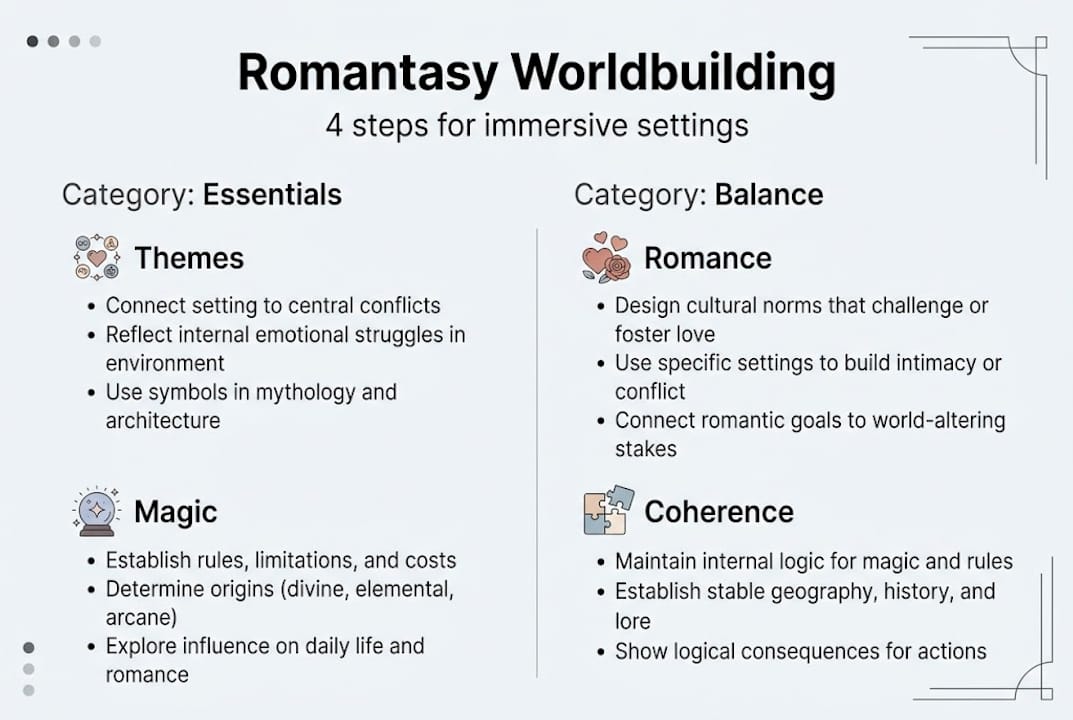
Before you write a single scene, you need to know what kind of story you're actually telling. Is this a romance with fantasy trimmings, or an epic fantasy where love is the emotional core? That ratio matters more than most writing guides admit. It shapes everything from how much page time your magic system gets to whether your readers feel satisfied or cheated at the end.
Start by pinning down your central themes. Are you writing about power and liberation? Found family and forbidden love? Political intrigue wrapped in a slow burn? Your themes are the skeleton your world hangs on. Once you know them, you can start pulling inspiration from romantasy books that do it well. Think about what drew you to those stories and why the worlds felt real. Was it the texture of daily life? The way magic had real costs? The way culture shaped what the characters could and couldn't want from each other?
As this reader discussion puts it, “lived-in” worlds matter more than window dressing. Your world needs to feel like it existed before your protagonists showed up and will keep existing after. That means thinking about food, labor, religion, and social hierarchies, not just the cool magic and the dramatic scenery.
Here’s a simple prep table to get you started:
| Planning Element | Questions to Answer | Why It Matters |
|---|---|---|
| Romance-fantasy balance | What’s your ratio? | Sets reader expectations |
| Core themes | What is the story really about? | Everything else grows from this |
| World uniqueness | What’s different here? | Makes your book stand out on the shelf |
Pro tip: Before you draft anything, identify at least two things that make your world genuinely different in the romantasy space. An unusual setting, a cultural twist on courtship, a magic system tied to emotional vulnerability. These details are what readers will remember and what will make your romantasy books feel fresh rather than familiar.
Gather your worldbuilding templates and reference materials before you start drafting. A simple document tracking your world’s rules, geography, and social systems will save you enormous headaches in revision. SandDancer Publications is a great place to see how indie authors handle this balance in finished, polished work.
Building blocks: crafting a world that serves both romance and fantasy
With your foundations in place, you can now shape the essential structures and rules that define your world. The most common mistake here is building the world in isolation, designing politics and magic as if the romance is something you'll add later like a garnish. It isn’t. It’s the main dish.
Start with your core setting. Where are we, and what does it feel like to be there? Not just visually, but emotionally and socially. Then layer in your magical rules. Magic in romantasy works best when it has real stakes and personal costs, especially when those costs intersect with your characters’ relationship. Finally, weave in your social and political systems. These are the structures that create obstacles, forbidden dynamics, and the kind of tension that makes readers stay up too late.

Here’s a quick comparison of two common approaches:
| Style | Focus | Risk | Best For |
|---|---|---|---|
| Politics-heavy | Deep lore, factions, power | Romance feels secondary | Epic romantasy with ensemble casts |
| Romance-centric | Character emotion, intimate world | World feels thin | Character-driven slow burns |
As community readers note, the contrast between deep lore and vivid romance-supporting details is what separates memorable worlds from forgettable ones. You don’t have to choose one or the other. You just have to make sure each element earns its place.
Look at how House of Cards handles this. Political tension and intimate emotional stakes aren’t competing. They’re feeding each other. That’s the sweet spot you’re aiming for.
Pro tip: For every world element you design, ask yourself one question: how does this affect what my characters can want, fear, or feel for each other? If it doesn’t touch the relationship in some way, it might not belong on the page.
Execution: revealing your world naturally through character experience
With your world’s architecture designed, it’s time to consider how you reveal it in the story’s actual pages. This is where a lot of romantasy drafts fall apart. The world is rich and detailed in the author’s head, but on the page, it arrives as giant blocks of description that stall the romance cold.
The fix is simpler than it sounds. Let your characters live in the world rather than explain it. A character who grew up under a particular magical law doesn’t think “as everyone knows, the binding law states…” She just feels the pull of it in her chest when she looks at someone she’s not supposed to want. That’s worldbuilding through character experience, and it’s infinitely more compelling.
Integrate world details into dialogue, into small physical actions, into the texture of romantic tension. What does your world smell like when two people are nervous around each other? What cultural rules govern how close they can stand? What magic, if any, makes their feelings visible or dangerous? These details do double duty. They build the world and the relationship at the same time.
Show, don’t tell, but let your world shape the love story.
Subverting familiar tropes works especially well here. Let unexpected world details surface during romantic moments. Maybe the cultural gesture for comfort is something that reads as threatening in another region. Maybe a magical ability activates inconveniently during emotional vulnerability. As readers consistently emphasize, revealing the world gradually through a character’s lens, without overwhelming the romance with setting, is the craft skill that separates good romantasy from great romantasy. You can also show the world through a character’s perspective in ways that feel earned rather than forced.
Pro tip: Build your romantic obstacles directly out of your world’s culture, magic, or politics. If the obstacle could exist in any generic fantasy setting, it’s not doing enough work for your specific story.
Verification: testing and maintaining coherence in your romantasy world
As your story starts to take shape, it’s vital to make sure your world stands up to scrutiny and delivers both emotional and immersive payoff. This is the part most writers rush, and it shows in the final product.
Start with a consistency checklist. Go through your draft and flag every mention of your magical rules, your geography, your cultural norms, and your romantic subplot beats. Do they all line up? Does your magic system behave the same way in chapter two as it does in chapter eighteen? Does the political situation your characters are navigating actually affect their choices, or does it fade into the background after the first act?
Here’s a simple revision tracking table:
| Review Area | What to Check | Flag for Revision? |
|---|---|---|
| Magic system | Rules consistent throughout? | Yes / No |
| Geography | Travel times, locations logical? | Yes / No |
| Culture | Social norms applied consistently? | Yes / No |
| Romance arc | World obstacles still present? | Yes / No |
| Info-dumping | Any passages that stall the story? | Yes / No |
As this community thread confirms, consistency and a lived-in feel are essential for readers to become invested. If your world shifts its own rules, readers feel it even if they can’t name it. It breaks the spell.
Beta readers are invaluable here, especially fellow romantasy authors who know the genre’s expectations. They’ll catch the moments where your world logic collapses or where the romance gets buried under too much setting. For more romantasy inspiration and to see how published indie authors handle these issues, browsing finished work in the genre is one of the fastest ways to calibrate your instincts.
Our take: real talk about worldbuilding as marginalized indie authors
Here’s something most worldbuilding guides won’t tell you: the mainstream advice was largely written by and for a very specific kind of author. And while craft is craft, the why behind your world matters enormously when you’re writing from a marginalized perspective.
Romantasy gives us something genuinely powerful. It lets us reclaim and redefine tropes that have historically excluded us or flattened our experiences into stereotypes. When you build a world as a queer author, as a woman who has navigated power structures that weren’t designed for her, you bring a texture to social systems and forbidden dynamics that no amount of research can fake. That’s not a limitation. That’s your superpower.
The strongest romantasy worlds we’ve read reflect real struggles and real joys filtered through the author’s own lens. They feel true in a way that purely technical worldbuilding never does. So yes, learn the craft. Use the checklists. But don’t sand down what makes your perspective specific in the name of appealing to everyone. The authentic queer stories that resonate most deeply are the ones where the author clearly had something personal at stake in the world they built.
Ready for more? explore SandDancer’s dark romantasy
If you want to see how unique worlds and diverse romance collide in finished books, we invite you to discover what we’ve been building at SandDancer.
Our catalog is full of dark fantasy and romantasy that puts representation, emotional depth, and immersive worldbuilding front and center. If you’re looking for inspiration or just want to see how other indie authors are handling the balance between world and romance, browse our romantasy collection and spend some time with stories that were written with exactly these challenges in mind. Our novel House of Cards is a great starting point if you want to see political tension and romance woven together without either one losing its edge. Come hang out with us. We’re building something good here. 🖤
frequently asked questions
How do I avoid info-dumping in my romantasy worldbuilding?
Reveal your world gradually through character experience, using dialogue and conflict rather than large blocks of description. Character-lens worldbuilding keeps readers immersed without overwhelming the romance.
What’s the best way to balance romance and worldbuilding?
Prioritize emotional stakes and make sure your setting details support rather than overshadow the romantic plot. As readers point out, the world should feel like the reason the love story is possible, not a distraction from it.
How do I know if my worldbuilding is consistent?
Regularly review your story for logical gaps and maintain a reference guide for your world’s rules, geography, and culture. A lived-in feel anchors readers and keeps them trusting your story.
Can a romantasy be successful with minimal worldbuilding?
Yes, as long as the world feels authentic and enhances the romance. As some readers prefer, evocative touches over deep lore can absolutely work when they serve the emotional story.