

Ebook vs Print Cost: A Budget Guide for Indie Authors
For most indie authors, an ebook is the cheapest, fastest format to publish. Print makes sense when you want a collectible product, bookstore shelf presence, or higher dollars-per-sale once you clear a specific price threshold. Here’s the math in one breath: Kindle Direct Publishing pays a 70% ebook royalty between $2.99 and $9.99, while a print-on-demand paperback nets you a smaller cut after fixed and per-page printing costs get subtracted. Sanddancer leans ebook-first for fiction launches, then adds signed print runs once a title has proven that readers want it.
Here’s how the verdict breaks down by goal:
- Go ebook-only if: you’re testing a new series, working with a tight budget, or want the fastest path to market.
- Go ebook-only if: your readers are digital-first (romantasy and dark fantasy audiences buy heavily on Kindle Unlimited and Kindle store).
- Go print-only if: you’re producing a collectible or gift edition where physical quality is the entire point.
- Go print-only if: you have events, signings, or a local bookstore relationship where physical stock matters more than margin.
Ebook vs Print Cost Compared Side by Side
Here’s the whole picture in one table, because you deserve to see the tradeoffs without hunting through five separate blog posts.
| Dimension | Ebook | Print (POD) |
|---|---|---|
| Upfront production cost | Lower (formatting typically costs a few hundred dollars depending on complexity) | Higher (formatting $250–$3,000+) |
| Per-unit cost | Near zero after formatting | Fixed + per-page cost, deducted per sale |
| Distribution fees & royalties | 70% royalty in $2.99–$9.99 band, minus delivery fee | ~60% gross minus printing cost; expanded distribution can drop it to 40% |
| Time to publish | Fast, often live within a day | Slower, requires proof approval |
| Control & quality | High, easy to update | Fixed once printed, corrections cost money |
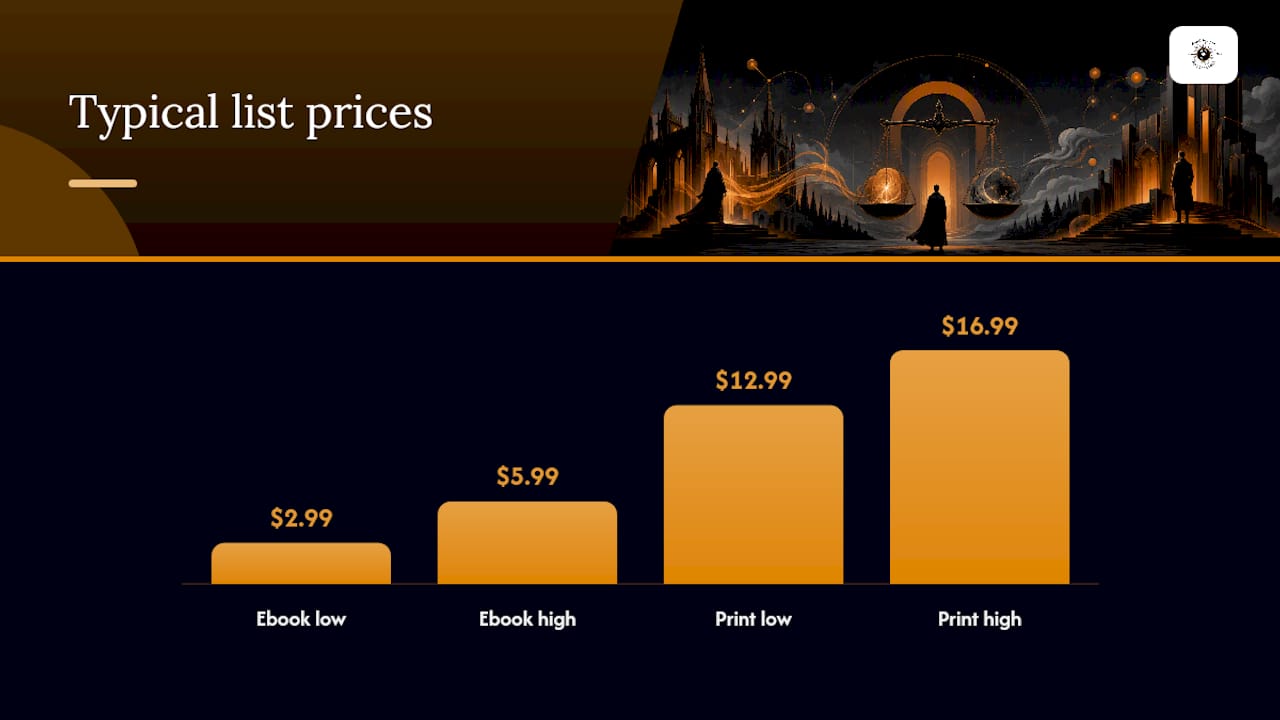
| Typical price & profit per sale | $2.99–$5.99, low cost per unit | $12.99–$16.99, higher revenue but slimmer margin |
| Ongoing costs | Minimal | Returns, author copies, storage if not POD |
The strategic takeaway: ebooks generally offer higher margin percentages, while print books can generate higher absolute dollars per sale when priced well once your price clears your printing cost by a healthy margin. Platform choice changes this math further. IngramSpark opens bookstore and library channels that KDP doesn’t reach, while aggregators like Draft2Digital and Lulu simplify wide distribution at the cost of an extra royalty split.
What Does Book Production Actually Cost Upfront?
Let’s talk numbers, because “it depends” isn’t a budget. Reedsy pegs a solid self-publishing production package somewhere between $2,940 and $5,660 for a baseline novel, covering editing, cover art, and formatting. That range shifts depending on genre complexity and how much you outsource.
Here’s where that money tends to go:
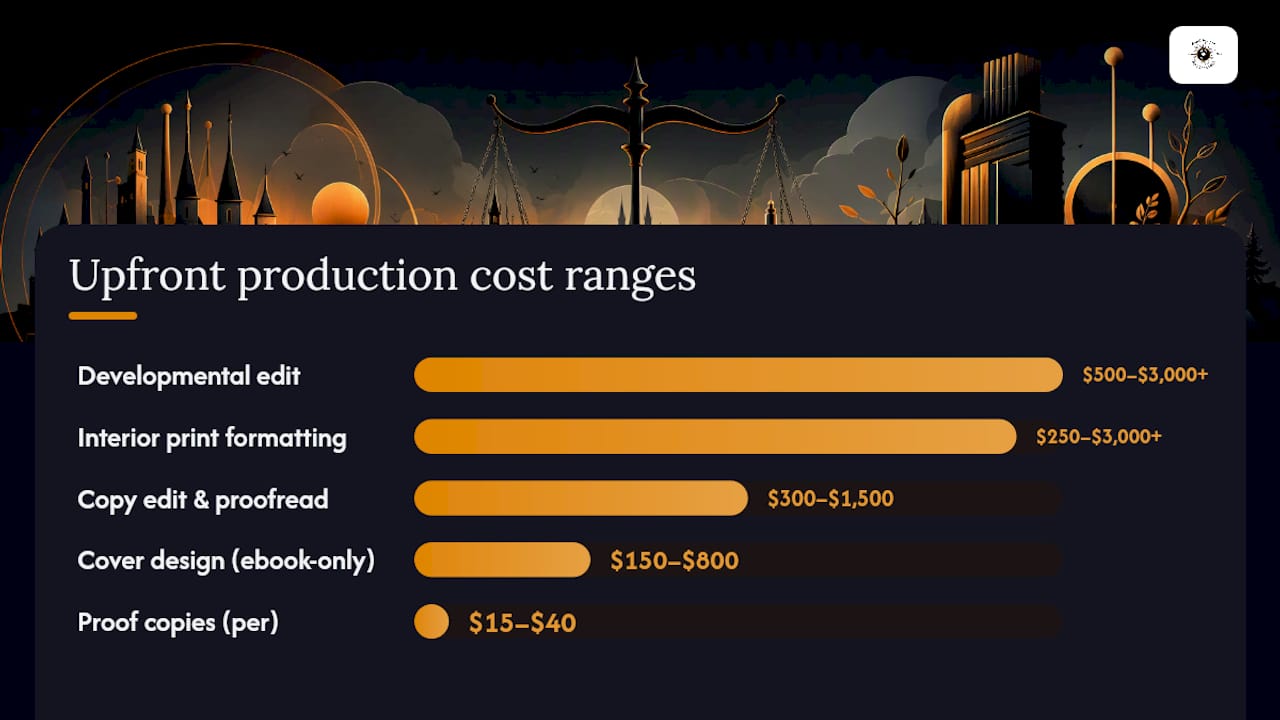
- Developmental edit: $500–$3,000+, depending on manuscript length and how much structural work it needs.
- Copy edit and proofread: $300–$1,500 combined for a standard novel.
- Cover design: $150–$800 for ebook-only; add more for a print wrap with spine and back copy.
- Interior formatting: print formatting runs $250 to $3,000+ depending on complexity, while ebook formatting tends to cost a lower several hundred dollars range, since there’s no fixed page layout to wrestle with.
- ISBNs and barcodes: free from KDP if you don’t mind their imprint listed as publisher, or roughly $125 for a single ISBN if you buy your own. We’ve written about why free ISBNs cost you more later than the sticker price suggests.
- Proof copies: $15–$40 per proof plus shipping, and you’ll usually order at least two rounds.
Pro Tip: If you know you’re doing both formats, order your ebook and print formatting together. Bundling typically saves you 20 to 35 percent versus hiring two separate freelancers on two separate timelines.
Tools like Vellum and Atticus let you DIY both formats for a one-time software cost instead of a per-project fee, but they demand a learning curve and won’t catch every widow-and-orphan line issue a professional formatter will.
How Much Does Each Copy Cost to Print and Sell?
This is the part that trips up new authors the most, because ebooks and print don’t share a cost structure at all. Ebooks cost you nothing per copy sold once the file exists. Print costs you something every single time.
On KDP, ebook royalties sit at 70% for books priced between $2.99 and $9.99, minus a small delivery fee based on file size. Price outside that band, and you drop to 35%. That delivery fee matters more than authors expect if your ebook has embedded images or a heavy formatted layout.
Print works differently. KDP’s paperback formula is roughly a fixed cost plus a per-page charge, commonly cited around $0.85 fixed plus $0.012 per page for standard black-and-white US printing. That number gets subtracted from your 60% gross royalty before you see a dime, and enrolling in expanded distribution can knock your gross percentage down to 40%.
Here’s a real comparison: a 300-page paperback priced at $14.99 might net you $2 to $4 per sale after printing costs and retailer cuts. A $4.99 ebook at 70% royalty nets around $3.35 minus delivery fees. Suddenly the “cheaper” format is competitive on margin, even though print looks flashier on the shelf.
Color-heavy books make this worse. A $24.99 illustrated paperback can net barely anything once color printing costs are subtracted, which is exactly why cookbook and children’s book authors often look at offset runs instead of POD.
How Do You Calculate Your Breakeven Point?
Breakeven math isn’t scary. It’s one formula: production cost ÷ net profit per sale = number of sales needed to break even.
- Estimate total production cost. Say you spend $3,500 on editing, cover, and formatting for a dark fantasy novel, right in Reedsy’s typical baseline range.
- Calculate net profit per ebook sale. At $4.99 and 70% royalty minus a small delivery fee, you’re netting roughly $3.35 per copy.
- Divide. $3,500 ÷ $3.35 = roughly 1,045 ebook sales to break even.
- Repeat for print. At $14.99 with a $3 net per copy, you’d need about 1,167 print sales, but each of those sales also carries higher perceived value for signings and gift purchases.
Pricing guidance for common categories: novels typically sell best at $3.99–$5.99 (ebook) and $12.99–$16.99 (print), nonfiction can support $6.99–$9.99 (ebook) and $16.99–$21.99 (print), and illustrated works need premium pricing to survive color printing costs. Advertising changes this equation too. A higher per-unit profit on print gives you more room to bid on ads without eating your margin, while ebook’s lower per-copy cost means you can absorb thinner ad returns and still profit.
Should You Publish Ebook-Only, Print-Only, or Both?
Ask yourself these questions before you spend a dollar:
- Is your primary goal reach, revenue, or a collectible product?
- What’s your actual budget floor, not your ideal one?
- Do you need bookstore or library placement, which usually means IngramSpark over KDP-only?
- Are you planning signings or conventions where physical stock matters?
- Will you revise this book after launch?
That last question matters more than authors think. Ebook revisions on KDP cost you nothing but time. A corrected print run, on the other hand, means a new proof, possibly a new ISBN, and shipping costs all over again.
- If reach and speed matter most, go ebook-only first.
- If you have events and want signed copies in hand, add a small print run through POD.
- If you want both discoverability and a premium product, launch ebook first, then add print once sales validate the story.
Sanddancer’s own investment guidance for authors leans toward spending your first dollars on editing and cover, then deciding format second.
What Does This Look Like from a Publisher’s Chair?
When we budgeted for Tribute, we made ebook the priority release because it let readers find the story fast and cheap, with zero per-copy cost eating into a debut title’s tight margins. We added a signed print run afterward, once we knew readers wanted a physical copy to hold, and we budgeted author copies and proof shipping as a separate line item from day one, not an afterthought.
Our advice for fellow dark-fantasy authors: don’t let a gorgeous cover convince you to skip the ebook. Discoverability lives in digital first, and margin math almost always favors it early. We also use AI tools sparingly and transparently in our production workflow, mainly for early proofreading passes, never for generating prose that readers believe is ours. If you want more on the ISBN side of this decision, our post on pay-to-publish models is worth a read before you sign anything.
Ready to Launch Your Own Ebook and Print Edition?
Sanddancer skips the guesswork agencies charge you for. We handle formatting, POD setup, and signed print runs in-house, so you’re not paying three separate vendors to get one book into readers’ hands.
If you’re weighing an ebook-plus-print launch the way we did with Tribute, look at how we packaged our Gothika series. Blood Tithe and Raise the Dead both sell as ebook and signed print editions from the same product page, which is the exact bundle structure we recommend to authors weighing this decision. Not ready to commit to a purchase yet? Browse our free-to-read titles first and see how we handle formatting and pacing before you decide what your own budget should look like.
Sources
- How Much Does It Cost to Publish a Book in 2026? - Reedsy
- Interior Book Formatting Cost Print vs. eBook Comparison - Oscar Ghostwriting
- KDP Print vs. eBook Royalties: Which Format Makes You More Money? - ZenEbookAI