

How to Write Fantasy Romance: A Guide for Indie Authors
TL;DR:
- Fantasy romance centers on a love-driven plot with a guaranteed happy ending, unlike romantic fantasy’s external conflicts.
- Developing authentic, multi-dimensional characters and organically weaving worldbuilding into charged scenes are key to creating compelling stories.
- Using a four-act structure ensures emotional and plot peaks align, deepening reader engagement throughout the novel.
Fantasy romance is one of the most exciting genres to write, and also one of the trickiest to pull off. When you’re learning how to write fantasy romance, you’re essentially signing up to master two genres at once: the emotional push and pull of a great love story, and the richly imagined world of fantasy fiction. Get the balance right, and readers will devour every page. Get it wrong, and they’ll feel like they’re reading two separate books crammed into one. We’ve been there. This guide walks you through everything, from defining the genre to pacing your climax, so you can write the fantasy love story you’ve been dreaming about.
How to Write Fantasy Romance: Genre Basics First
Before you write a single scene, you need to know exactly what kind of story you’re telling. And here’s where a lot of new writers get tripped up. Fantasy romance and romantic fantasy sound interchangeable, but they’re actually pretty different animals.
Fantasy romance centers the romantic relationship as the primary plot engine. The love story is not a side quest. It is the quest. That means your story absolutely must end with a happily ever after (HEA) or a happy for now (HFN) resolution. Readers in this genre come in with that expectation locked in, and breaking it is the literary equivalent of pulling the rug out from under someone who trusted you.
Romantic fantasy, on the other hand, has a big external conflict at its center, think overthrowing a dark empire or surviving a magical apocalypse, with the romance woven in as a meaningful but secondary thread. Both are valid and wonderful. But knowing which one you’re writing shapes every single decision you make afterward.
Here’s a quick look at the core differences to keep them straight:
| Feature | Fantasy Romance | Romantic Fantasy |
|---|---|---|
| Primary plot | The romantic relationship | External fantasy conflict |
| Required ending | HEA or HFN | Open or resolved conflict |
| Reader expectation | Love story first | World/conflict first |
| Example focus | Two characters finding love through magical obstacles | Hero saving the world, falling in love along the way |
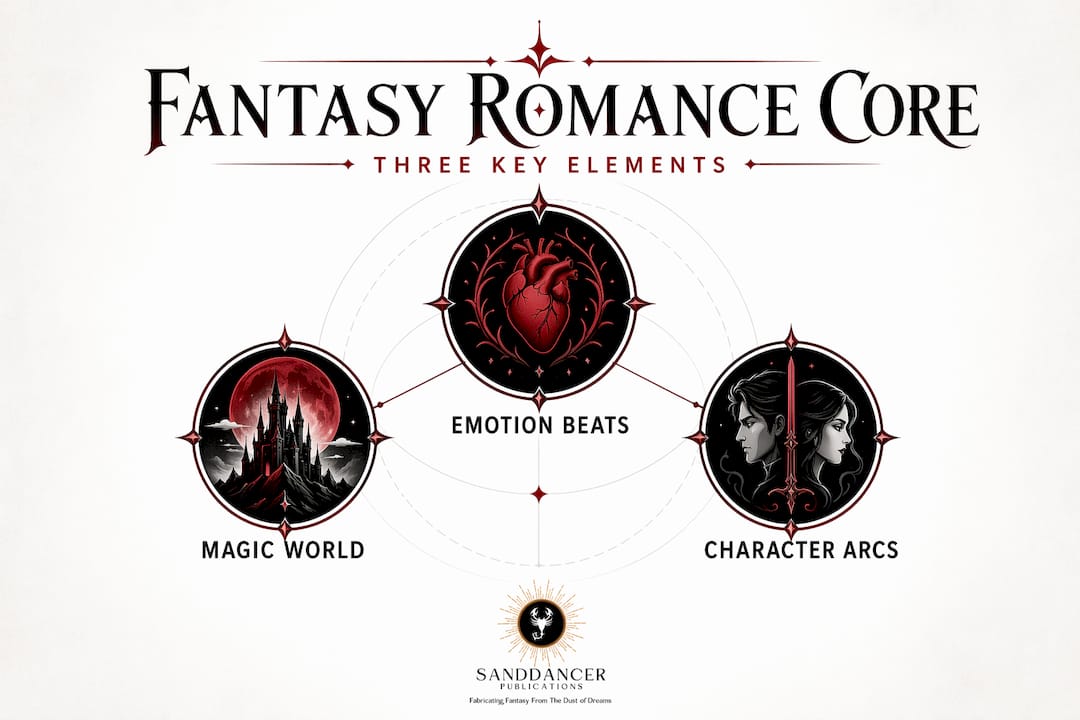
Once you know which camp you’re in, the essential elements of fantasy romance become much clearer: emotional beats, fantasy stakes, and a romance arc that drives the entire story forward.
Building Characters Your Readers Will Root For
Here’s the honest truth: no amount of dragons, spell systems, or beautifully described cities will save a story with flat characters. When we set out to create romantic fantasy tales, the first thing we do is build our leads as complete people before they ever interact with each other.

Fully developed characters with distinct goals and flaws create authentic relationship development that readers can believe in. Give your protagonist a wound. Give your love interest a secret fear. Give them both something they want that feels completely out of reach, and then put them in each other’s way. That friction is gold.
One pitfall we see constantly in fantasy romance is the “you complete me” trap. Your characters should challenge and change each other, not exist to fix each other’s broken pieces. A warrior who learns vulnerability is more compelling than one who is simply healed by love. Effective romantic couples grow stronger by the chapter, exploring how love propels or challenges their destinies rather than resolves all their damage overnight.
Relationship chemistry also lives in the small moments. A loaded glance across a throne room. An argument that ends in an accidental confession. The tension of two people who are terrified of what they feel but cannot stop feeling it. These moments build emotional investment, and emotional investment is what keeps your reader up until 2 a.m.
Pro Tip: Write a short character backstory for each of your leads before drafting chapter one. Include their greatest fear, their deepest want, and one thing they believe about love that is completely wrong. That last one will fuel your entire romance arc.
Authentic character growth is what separates a memorable fantasy romance from a forgettable one. Build real people first. The sparks will follow.
Weaving Your World into the Love Story
This is the part of fantasy romance writing that makes people want to pull their hair out. And we get it. You’ve spent weeks building a magic system, mapping a kingdom, and designing a political intrigue so complex it has its own spreadsheet. The temptation to show all of that upfront is very real. Resist it.
Magic systems, politics, and world rules should actively push your characters together or apart. If your worldbuilding is not touching the romance, it’s decoration. Pretty, sure. But ultimately unnecessary. A forbidden magic bond that forces two enemies to feel each other’s emotions? That’s worldbuilding doing work. A lengthy history of the realm’s five ruling houses that exists entirely in a prologue? That’s a reader skipping ahead.
Here’s a practical approach for integrating your world into your romance organically:
- Start with the obstacle. Ask yourself: what world rule, law, or magical reality makes this love story harder? Forbidden union between rival clans. A curse that prevents physical touch. A prophecy that names your love interest as the enemy. Build your world outward from that core tension.
- Blend exposition into charged scenes. When your characters are in conflict or in their feelings, that’s the perfect moment to reveal world details. Your reader is emotionally engaged, so the information lands instead of feeling like homework.
- Let social norms create longing. A world where women cannot inherit power makes a high-born woman falling for a low-born soldier electric. Cultural expectations are some of the best romantic obstacles you can write.
- Use the magic to mirror emotional states. If your character’s power flares when she’s afraid, let it flare when she’s near him. The metaphor carries itself.
Successful romantasy blends romance and fantasy plotlines within the same scenes rather than alternating between “romance chapters” and “action chapters.” That alternating approach creates a choppy, disconnected feel. Weave them together, and your story feels alive. For a deeper look at the craft of building worlds that serve your plot, the romantasy worldbuilding guide over at SandDancer is worth your time.
Structuring Your Story for Maximum Emotional Impact
Pacing is where a lot of otherwise solid fantasy romance manuscripts fall apart. Too much romance up front and the tension collapses. Too much fantasy plot with no emotional payoff and readers disengage. The good news is that there’s a framework that works beautifully for this genre.
A four-act structure allocating roughly 25% of your story to each phase gives you a clean architecture to hang everything on. Here’s how to apply it:
- Act One: Setup (0 to 25%). Introduce your leads, establish the fantasy world and its central conflict, and plant the romantic tension. They should meet, clash, or connect in a way that makes the reader feel something. End this act with a choice or event that pulls them into each other’s orbit whether they like it or not.
- Act Two: Deepening (25 to 50%). This is where trust builds, chemistry deepens, and the fantasy stakes become clearer. Let them work together, disagree badly, and slowly let their walls down. At the midpoint, introduce a new complication. A secret revealed. A threat that changes everything. Adding new conflicts at the midpoint prevents the dreaded “sagging middle” and ramps up emotional investment right when readers need it most.
- Act Three: The Black Moment (50 to 75%). Everything falls apart. The romance hits its lowest point, usually tied directly to the fantasy conflict reaching a crisis. This is the section that earns your HEA. If the black moment doesn’t genuinely hurt, the resolution won’t genuinely satisfy.
- Act Four: Climax and Resolution (75 to 100%). Here’s where romantic resolution and plot resolution become inseparable. Your characters cannot defeat the external threat without the growth they’ve found through loving each other. The fantasy climax and the romantic reunion should feel like two parts of the same moment.
Pro Tip: If your characters could solve the fantasy conflict without any help from their relationship, your romance is running parallel to the plot instead of through it. Push them to a place where love is literally part of the solution.
For a detailed breakdown of how this structure works specifically in dark fantasy magic settings, the romantasy plot structure guide at SandDancer goes deep on this.
Common Mistakes and How to Sidestep Them
Even writers with solid instincts stumble in fantasy romance. Knowing the common traps before you fall into them saves you a painful revision.
The biggest one we see? Overloading the worldbuilding at the expense of the romance. It usually happens around chapters three through six, where a writer gets so excited about the world they built that the leads barely interact for fifty pages. High stakes and believable world tensions are crucial, but they must serve the love story, not crowd it out.
Another frequent stumble is forcing the romance to happen before the characters have given the reader a reason to care. Two strangers falling deeply in love by page thirty works only if the chemistry is so crackling, so specific, so layered with tension that it feels earned rather than rushed.
Misusing tropes is also a real risk. Tropes like “forbidden love” and “slow burn” are beloved for a reason. They work. But a trope without a fresh angle or a character-specific reason for existing just feels like a formula. Ask yourself: why does this trope apply to these specific people in this specific world? The answer should be unique to your story.
“If removing the romance doesn’t significantly change your fantasy plot, then the story isn’t truly a fantasy romance. The love story must be load-bearing.”
Neglecting to build meaningful conflict into the fantasy side of your story creates another problem. Readers of this genre want antagonists with believable motivations and a world with real teeth. A soft, consequence-free fantasy setting deflates the stakes for everyone, including the romance.
Our Take: What Writing Fantasy Romance Has Taught Us
I’ve been thinking about this question for a while now, because writing fantasy romance is genuinely one of the most vulnerable creative acts I know. You’re not just building a world. You’re asking readers to care about two people finding each other in it.
What I’ve learned, sometimes the hard way, is that the romance has to be the reason the story exists. Not an accessory to a cool magic system. Not a subplot glued onto an epic quest. When I started treating the emotional relationship between my leads as the beating heart of the story, and letting every fantasy element either threaten it or deepen it, the writing got better fast.
I’ve also learned that authentic characters are non-negotiable. You can get away with a lot in fantasy: unreliable magic, shaky world logic, a villain who needs more page time. But readers will close a book the moment they stop believing in your romantic leads as real people with real feelings. Write them like you know them. Write their love like it matters. Because to your reader, it will.
My advice to anyone starting out? Give yourself permission to be messy in the first draft. Get the bones of the story down. Then in revision, ask: does every scene either advance the romance or the fantasy conflict, preferably both? That question will sharpen everything.
— C.S.
Start Writing with Some Great Dark Fantasy Inspiration
If you’re ready to put these tips into practice, there’s no better fuel than reading the genre you want to write. At SandDancer, we’ve built a catalog of dark fantasy and gothic fiction that shows what happens when worldbuilding and emotional storytelling genuinely fuse.

Whether you’re looking for character inspiration, plot ideas, or just want to see how experienced indie authors handle romantic tension against a dark fantasy backdrop, explore our full catalog and find your next read. Our Gothika series, including titles like Tenebroso and Blood Tithe, offers a masterclass in weaving tension, darkness, and relationship stakes into a story that pulls readers through to the last page. Great fantasy romance starts with reading great fantasy. Come find yours.
Frequently Asked Questions
What is the difference between fantasy romance and romantic fantasy?
Fantasy romance places the love story as the central plot and requires a happily ever after or happy for now ending. Romantic fantasy centers a larger external conflict, with romance as an important but secondary element.
How do I develop believable chemistry in a fantasy romance?
Build each character as a fully realized individual with distinct goals and flaws before they interact. Chemistry grows from two specific people who challenge each other, not characters who exist only to complete the other person.
How do I avoid info-dumping my fantasy worldbuilding?
Weave world details into emotionally charged scenes rather than explaining them in blocks of exposition. When characters are in conflict or falling for each other, readers absorb world information naturally without feeling lectured.
What structure works best for a fantasy romance novel?
A four-act structure works well, with roughly 25% of your story dedicated to setup, deepening, the black moment, and climax. The romantic arc and the fantasy conflict should reach their peaks at the same time for the most satisfying resolution.
How do I use fantasy romance tropes without being formulaic?
Start with a classic trope like slow burn or forbidden love, then ground it in something specific to your characters and your world. Ask why this trope is uniquely true for these people, and your story will feel fresh rather than predictable.
Recommended
- Master the Romantasy Worldbuilding Process: A Step-by-Step Guide – SandDancer Books
- Step-by-Step Guide to Inclusive Dark Fantasy Storytelling – SandDancer Books
- Craft Romantasy Plot Structure for Dark Fantasy Magic – SandDancer Books
- Gothic Fantasy Themes: A How-To Guide for Readers and Writers – SandDancer Books