

LGBTQ fantasy worldbuilding: techniques for richer dark fiction
TL;DR:
- Queer influence in worldbuilding should be inherent in cultural, geographic, and systemic layers rather than superficial markers.
- Authentic inclusion shapes relationships, power, and mythos, creating worlds that genuinely reflect LGBTQ experience and diversity.
Most writers know they want their dark fantasy or gothic horror world to feel genuinely inclusive. The problem is that “inclusive” often gets flattened into a single question: is same-sex love accepted in this society, or isn’t it? That’s it. That’s the whole worldbuilding effort. And honestly, we get it because that question feels like the obvious place to start. But stopping there is like building a cathedral and only painting the front door. Queering fantasy worldbuilding goes much deeper, and this guide is your practical toolkit for doing exactly that across dark fantasy, gothic horror, and urban fantasy.
Key Takeaways
| Point | Details |
|---|---|
| Beyond social acceptance | True LGBTQ worldbuilding goes deeper than social structures, embedding queer perspectives across geography, coalitions, and motifs. |
| Avoiding structural harm | Careful craft analysis and intersectional character construction help prevent unintended harmful tropes. |
| Narrative layers matter | Let queer dynamics shape alliances, recurring motifs, and the emotional architecture of fantasy settings for memorable storytelling. |
| Authenticity in urban fantasy | Intersect real social dynamics with magic to create genuinely inclusive and compelling urban fantasy worlds. |
| Iterate and verify | Continuously check for authenticity using sensitivity readers and feedback loops to refine inclusive worldbuilding. |
Understanding the foundations of LGBTQ-inclusive worldbuilding
Think of queerness as worldbuilding DNA. It doesn’t just live in your laws and marriage customs. It can shape the geometry of a haunted city, the way resistance movements form, the recurring symbols that ghost through your setting. When queerness becomes structural rather than decorative, your world stops featuring LGBTQ characters and starts being informed by LGBTQ experience.
According to a detailed exploration of inclusive dark fantasy storytelling, the richest worlds treat identity not as a costume but as a force that reshapes relationships, power dynamics, and narrative geography. That distinction matters more than most craft guides admit.
Here’s a quick look at how each layer of your world can carry queer meaning:
| World design layer | Ways queerness can live here |
|---|---|
| Culture and law | Traditions, chosen-family structures, coded ceremonies |
| Geography and setting | Hidden spaces, coded architecture, sanctuary districts |
| Coalitions and alliances | Resistance networks, cross-faction bonds, chosen kin |
| Recurring motifs | Artifacts, symbols, colors that signal queer presence |
| Mechanics and systems | How secrecy, surveillance, and disclosure function |
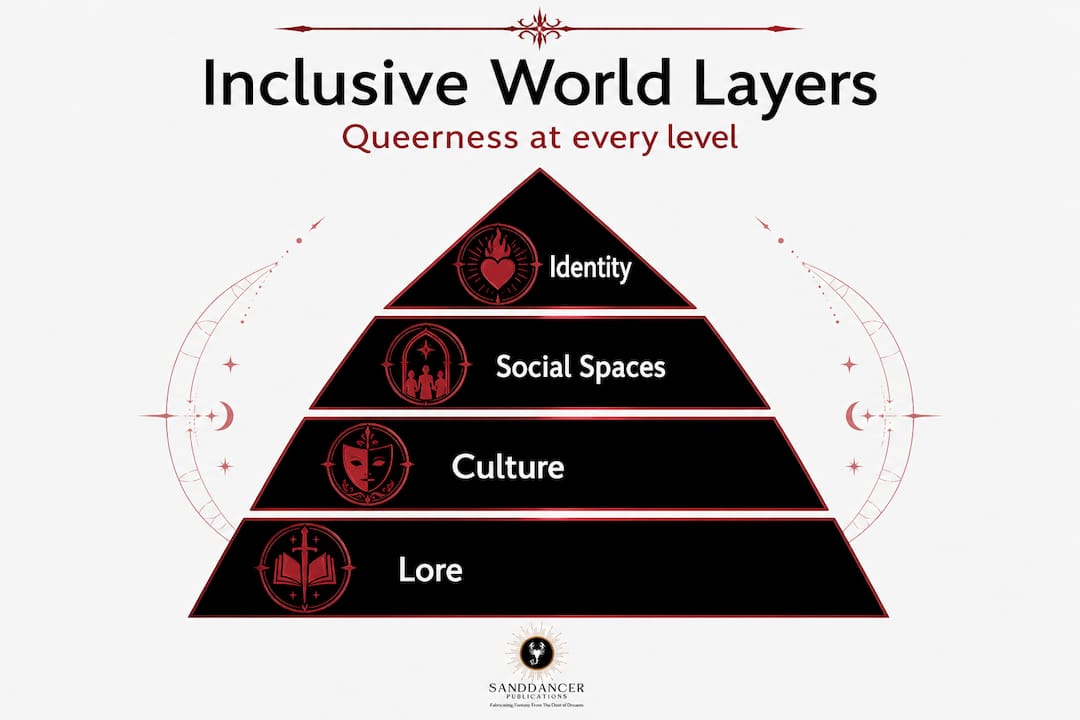
Some of the most common mistakes writers make are completely understandable. Focusing only on social acceptance or rejection is probably the biggest one. Writing token LGBTQ characters who exist to signal diversity without shaping the plot is another. Placing queerness exclusively in subtext, so it’s “there if you look” but never actually there, is a third. And treating LGBTQ experience as monolithic, as if every queer character faces the same challenges, flattens the complexity that makes fiction feel real.
Our gothic fantasy themes guide digs into how gothic conventions already carry subversive energy that pairs beautifully with queer worldbuilding. The hidden room, the forbidden archive, the figure who doesn’t fit the household’s expectations. These are queer spaces waiting to be named.
Preparation: Building your toolbox for inclusive dark fantasy settings
Before you start placing queer characters in your world, it helps to do some honest homework. Not because you’re a bad writer. Because harmful tropes are structurally familiar, and they sneak in whether we intend them or not. A craft guide focused on speculative worldbuilding makes the point clearly: structural harm shows up in manuscripts even when writers have the best intentions, because those patterns are baked into the stories we’ve all consumed.
Knowing that means you can get ahead of it. Here’s a comparison of tropes to leave behind versus approaches worth building toward:
| Harmful trope | Healthier alternative |
|---|---|
| Queer character introduced only to be threatened | Queer character with complex goals unrelated to their identity |
| Same-sex couple as proof of “acceptance” without further depth | Queerness that informs alliances, secrets, and plot architecture |
| Trans character as punchline or tragedy arc | Trans character with full interiority, humor, and narrative agency |
| LGBTQ identity resolved by the end | Identity as an ongoing, contextual lived reality |
| “Magical cure” for queerness or gender | Magic that reflects queer experience instead of erasing it |
Pro Tip: Before you write a single LGBTQ character into your dark fantasy manuscript, ask yourself: does this person’s identity actually do something in the world? Not necessarily in a political sense, but narratively. Do they form alliances differently because of it? Do they navigate certain spaces differently? Do they carry knowledge or access that other characters don’t? If the honest answer is no, that’s your next draft revision waiting to happen.
Intersectional construction is where this gets genuinely exciting. When you consider how sexuality, gender identity, race, class, and disability overlap in your characters, you stop writing representative types and start writing people. A bisexual, working-class necromancer in a gothic city reads and feels completely differently than a bisexual aristocrat in the same city, even though both are “LGBTQ representation.”
For visual inspiration on how distinct aesthetic layers can create cohesive identity across a design space, gothic block harmony builds offer a surprisingly useful parallel: every structural element contributes to tone, and nothing is accidental. That same intentionality applies to LGBTQ worldbuilding.
Our essential tips for writing dark fantasy gothic covers how to handle the aesthetic scaffolding of your world, and the same principles apply here. Structure first, embellishment second.
Execution: Step-by-step techniques for embedding LGBTQ dynamics
Alright, let’s get hands-on. Here’s a practical sequence for actually layering queerness into your world rather than layering it onto it.

Step 1: Map your setting for hidden and sanctuary spaces. Queer experience across history has always involved geography, the bar with the unmarked door, the back room at the apothecary, the grove outside town. Identify three locations in your setting that function as unofficial queer spaces, even if only subtly. Let those spaces have their own logic, their own risks, their own regular faces.
Step 2: Build your coalitions before your politics. Coalition is central to queer experience in ways that single-nation or single-faction fantasy structures miss completely. Consider which groups in your world are marginalized, in overlapping ways, and let those overlaps generate alliances. A resistance cell composed of queer magic users, immigrants, and people with disabilities is far more historically resonant than a single unified “queer community.”
Step 3: Design your worldmotes. A key nuance of LGBTQ fantasy worldbuilding is deciding deliberately where queerness lives: in cultures and laws, yes, but also in setting geometry, narrative coalitions, and recurring motifs. Worldmotes are the recurring artifacts or hidden references that make LGBTQ presence feel woven in rather than added on. A particular flower that appears in three scenes. A color code used in correspondence. A hand gesture that means something specific to those who know it. These details reward attentive readers and give your world texture.
Pro Tip: Worldmotes work best when they have a history. Why does the gesture exist? Who invented it and why? If you can answer that backstory in one sentence, your worldmote already has more depth than most explicit representation.
Step 4: Let mechanics reflect experience. In gothic horror especially, the mechanics of secrecy, surveillance, and disclosure can map directly onto LGBTQ experience. Who has to hide what? Who gets to be open and why? What are the costs of disclosure in your world, and who pays them unevenly? These aren’t just social questions. They’re structural ones that shape plot, tension, and stakes.
Coalition-building is not a side story in queer experience. It is the main architecture. When your fantasy world reflects that truth, the narrative stops being about tolerance and starts being about survival, solidarity, and power.
Our guide on building immersive dark fantasy settings walks through how setting design creates emotional atmosphere, and all of these queer worldbuilding layers plug directly into that framework. Similarly, if you want queerness to generate real narrative tension, our piece on crafting dark fantasy conflict is worth keeping close.
Verification: Troubleshooting, avoiding mistakes, and ensuring authenticity
Here’s the honest part: even with the best toolkit, things go sideways. Tokenism is sneaky. You can have twelve LGBTQ characters and still have tokenism if they all serve the same narrative function, or if their identities exist entirely in subtext that you alone can see.
Urban fantasy worldbuilding practice centers on balancing how open or hidden magic is, setting real stakes for power, and integrating marginalized community dynamics into the collision between supernatural and contemporary urban realities. When that integration is shallow, the whole modern-magical collision falls apart. Worse, it can make LGBTQ characters feel like accessories rather than architects of the world’s tension.
Studies of contemporary urban fantasy suggest that a significant portion of published works fail to let marginalized community dynamics actually drive plot, relying instead on diversity as backdrop rather than as narrative engine. That’s the gap you want to close.
In urban fantasy specifically, LGBTQ characters work best when the city’s real social dynamics, race, class, and politics, are allowed to intersect with magic and institutions. Otherwise the world feels like a fantasy city with diversity window dressing rather than a living place where power and identity genuinely collide.
Practical things to check before you consider a draft done: Does each LGBTQ character’s queerness affect at least one major plot decision? Does your world treat LGBTQ experience as having history, not just current status? Have you varied the experiences across your queer characters so they’re not all navigating the same challenges? Have you sought at least one sensitivity reader with lived experience relevant to your characters?
Your dark fantasy editing process is where a lot of this verification happens. Revision is where you catch what first-draft enthusiasm missed. Make space in your editing pass specifically for these questions. You’ll be glad you did.
Also worth revisiting: your world’s fantasy lore and how it captivates readers. Lore that includes the history of LGBTQ coalitions, coded traditions, or resistance movements adds depth that readers feel even when they can’t name it.
A fresh perspective: What most fantasy guides miss about true inclusivity
Here’s the thing we don’t see said often enough: surface inclusion and narrative-level queerness are not on the same spectrum. They’re different things entirely. Surface inclusion is adding characters. Narrative-level queerness is letting those characters’ experiences reshape the architecture of your story.
Most diversity guides treat inclusion like a checklist because checklists are measurable. Did you include an LGBTQ character? Check. Did they survive to the end? Check. But the most haunting, resonant fantasy worlds resist the checklist entirely. They’re built from the inside out, with queerness shaping not just who appears on the page but how space, allegiance, secrecy, and belonging actually function in the story.
We think about this a lot when developing our own romantasy worldbuilding process. The question that moves us forward isn’t “have we included enough?” It’s “does this world’s logic carry queer experience in its bones?”
Coalition-building is the concept that changes this most profoundly. Queer history is coalition history, and when your fantasy world reflects that, something clicks into place emotionally for readers. Not because they’re checking a box but because they feel the truth of chosen family, of solidarity built under pressure, of finding safety in the spaces between official structures.
The most haunting worlds are mosaics, built not from conformity, but from living coalition.
That’s what we’re after. Not a world that tolerates queerness, but a world that is shaped by it in ways that produce richer narrative tension, more surprising alliances, and deeper character motivation. That’s the version worth writing.
Explore inclusive dark fantasy with SandDancer Books
If this guide lit something up for you creatively, we’d love to point you toward fiction that actually does this work on the page.
At SandDancer Publications, we’re genuinely passionate about dark fantasy, gothic horror, and urban fantasy that doesn’t flatten identity into tropes. Our catalog features award-winning fiction where atmosphere, character, and world design work together to create something immersive and real. If you want to see how queer dynamics and gothic storytelling can weave together in ways that feel earned rather than added, check out Raise the Dead: Gothika for a vivid example. And if you’re still building your TBR and want a low-commitment entry point, our free gothic fantasy ebooks are waiting for you. Come find your next obsession. We’ll be here.
Frequently asked questions
How can I avoid harmful LGBTQ tropes in my fantasy worldbuilding?
Review your draft specifically for structural patterns, like queer characters introduced primarily to face threat, and use exercise-driven craft tools to identify those familiar structures before they become habits. Sensitivity reads from people with lived experience are one of the most reliable final checks you can build into your process.
What are “worldmotes” and how do they help queer worldbuilding?
Worldmotes are recurring artifacts, symbols, or hidden references that signal queer presence organically throughout a setting, and according to research on queering worldbuilding, they make LGBTQ inclusion feel woven into the world rather than applied on top of it. Think a recurring flower, a coded color, or a gesture with a secret history.
How can urban fantasy address LGBTQ dynamics authentically?
Let the city’s real social forces, including race, class, and political power, actually intersect with your magic systems and supernatural institutions, because authentic urban fantasy integration requires that collision to have genuine stakes. When those dynamics just coexist without friction, the representation stays shallow.
What genres benefit most from deep LGBTQ-inclusive worldbuilding?
Dark fantasy, gothic horror, and urban fantasy all gain tremendous depth when LGBTQ identities shape coalitions, motifs, and power dynamics at every level, and integrating marginalized community dynamics into the mechanics of magic and secrecy is particularly powerful in urban settings where real social tensions already run high.
Recommended
- Essential Tips for Writing a Dark Fantasy Novel with Gothic Flair – SandDancer Books
- How to Build Immersive Dark Fantasy Settings That Haunt – SandDancer Books
- Step-by-Step Guide to Inclusive Dark Fantasy Storytelling – SandDancer Books
- How to edit dark fantasy manuscripts for vivid gothic storytelling – SandDancer Books