

How to Blend Romance and Adventure in Your Fiction
TL;DR:
- Blending romance and adventure requires integrating both arcs so that they depend on each other and resolve simultaneously.
- Every scene should serve dual purposes by advancing external plot and revealing emotional or trust-based character development.
If you've ever stared at a chapter and thought, “Is this a love story or an action sequence? Pick a lane,” you already know the core tension. Figuring out how to blend romance and adventure is one of the trickiest creative puzzles in genre fiction, especially in fantasy, gothic, and new adult stories where the emotional stakes are sky-high and the world itself wants to kill everyone. Tony and I have wrestled with this balance more times than we can count, and we’re here to share what actually works, what blows up in your face, and how to write stories where the sword fights and the heartache are completely inseparable.
How to blend romance and adventure from the ground up
Before you write a single scene, you need to understand one foundational rule: neither the romance nor the adventure can exist as a side dish. They have to be the whole meal together. If you can remove the love story without changing the plot, the blend has failed. Full stop. Same goes the other direction. If the adventure can run on rails without affecting the relationship at all, you’ve got two separate books sharing a cover.
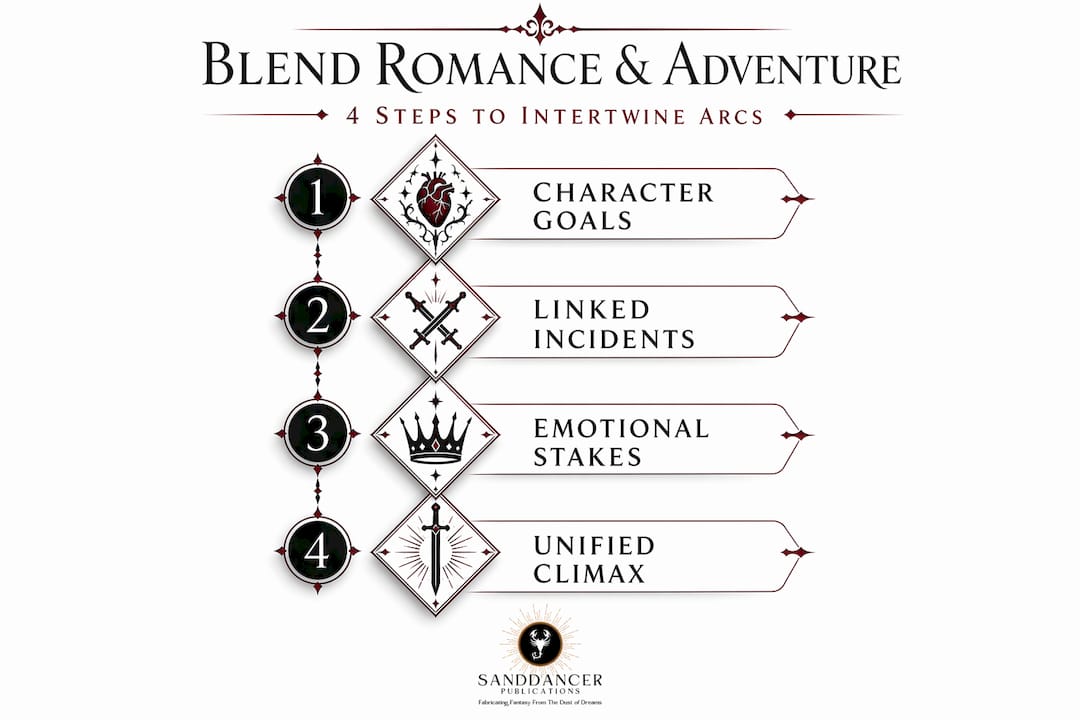
The structure that works best for this is a four-part framework where both arcs develop in lockstep. Think of it this way: both arcs develop simultaneously across four equal story segments, each one carrying weight for the romance and the adventure. Your Act One introduces the external threat and the romantic pull at the same time. Your midpoint deepens both. Your black moment breaks both. Your climax resolves both. Simultaneously. That’s the discipline.
Character dynamics are where this gets interesting. Your characters’ external conflicts need to mirror their internal emotional stakes. Say your protagonist is terrified of trusting anyone. The adventure plot should put them in situations where trusting their love interest is the only way to survive. The emotional wound and the story problem feed each other, which means solving one requires solving the other.
| Story element | Romance function | Adventure function |
|---|---|---|
| Inciting incident | Sparks attraction or forced proximity | Launches external danger or quest |
| Midpoint shift | Deepens emotional vulnerability | Raises external stakes dramatically |
| Black moment | Trust is broken or love feels impossible | The mission appears to be lost |
| Climax | Characters choose love over safety | Final confrontation or resolution |
Pro Tip: Before drafting, write one sentence for your romance arc and one for your adventure arc, then check that each sentence references the same characters facing the same central pressure. If they feel unrelated, rethink your world rules.
Making every scene pull double duty
This is where the real craft lives. Every scene in your story should be doing at least two things at once. Not every chapter, every scene. An escape sequence doesn’t just get your characters out of danger. It also reveals something about how much they trust each other, or surfaces a wound, or forces one of them to admit they care. Craft each action event to simultaneously reveal character growth and change the trust dynamic between your leads.
Here’s a simple method we come back to constantly:
- Write the action scene as you normally would, getting all the external beats down.
- Go back and ask: what does this moment cost emotionally? Does one character have to rely on the other? Does someone reveal a fear they’ve been hiding? Does someone almost die and the other person realizes how much they care?
- Add the emotional layer into the action, not after it. The emotional revelation should happen during the sword fight, not in a quiet debrief scene afterward.
- Check your pacing. Slow-burn romantic arcs work best when romantic tension escalates in small, charged moments scattered across your high-stakes sequences, not in dedicated romance chapters that pause the adventure.
- Watch your cliffhangers. End chapters on either an action hook or an emotional revelation, but the best endings do both at the same time.
The trap most writers fall into is what we call the alternating chapter problem. You write an action chapter, then a romance chapter, then an action chapter. It reads like two separate stories taking turns. Avoid alternating chapters by making sure even your quieter emotional scenes carry a ticking clock or an unresolved external threat in the background.
Pro Tip: Read your last five chapters and mark each one as “A” for adventure-focused or “R” for romance-focused. If you see three or more same-letter chapters in a row, you’ve got a siloing problem worth fixing now rather than in edits.

Using atmosphere and setting as your secret weapon
Here’s something gothic fiction does better than almost any other genre: it uses setting as a character. The environment doesn’t just provide backdrop. It pressures the relationship. It reflects the emotional state of your leads. It does something to every scene it’s part of.
The five-beat gothic romance structure makes this concrete. The beats are attraction, refusal, proximity, rupture, and choice. What makes gothic work is the “setting rule” attached to each chapter: fog, sound, and candlelight at specific moments create a mood that the characters have to emotionally respond to. The setting isn’t decorating the scene. It’s creating conditions the romance has to survive.
Magic systems and political structures can do the same thing. A magic system that requires emotional bonding to work forces your characters into proximity and vulnerability. A political ban on the relationship creates stakes that make every romantic moment dangerous. When your world rules actively push your lovers together or tear them apart, the romance feels organic rather than bolted on.
Sensory anchors are another tool worth stealing. Recurring motifs like broken mirrors or wilted roses placed at key plot points do two things. They make your setting feel alive and intentional, and they train your reader to feel something the moment those images appear. By the third time a character smells rain before a betrayal, your reader feels the dread without being told to. That’s atmosphere doing narrative work.
“The biggest error in blending is treating fantasy separately from the relationship. World rules and magic must pressure the romance.” — Insight from How to Write Romantasy
For gothic and horror-adjacent stories, scheduling reality blurs at intervals, such as dreams, visions, or ambiguous supernatural events, keeps your reader questioning while also creating emotional consequences for the romance. If a dream reveals something about the love interest, it changes how the protagonist feels and what they suspect. One event, two effects. That’s the pattern you want everywhere. You can also draw on gothic elements for deeper storytelling by grounding your atmospheric choices in the tradition’s proven emotional toolkit.
Common mistakes that break the blend
Even experienced writers hit these walls. Knowing them ahead of time saves you a significant rewrite.
The most common mistake is worldbuilding overload. You’ve built an intricate magic system and a political history spanning three dynasties, and you’re so excited about it that the romance gets maybe fifteen pages in a 400-page book. Overloading worldbuilding while neglecting romance leaves readers emotionally disconnected, no matter how cool your lore is.
The opposite problem is just as real. Some writers are so committed to the love story that the adventure plot feels thin and obligatory, existing only to give the characters something to do between meaningful glances. Both arcs need weight and consequence.
Forced romance is another one. When two characters get together because the plot needs them to, readers feel it. Familiar tropes like forbidden love remain powerful only when they’re twisted and grounded in the specific backstory of your characters. Generic forbidden love that could happen in any story feels like wallpaper. The same trope personalized to these two people with these wounds feels inevitable.
Pro Tip: Ask this about every romantic development in your draft: “Would this happen if the adventure plot didn’t exist?” If the answer is yes, you need to tie the two together more tightly. The romance should be impossible without the adventure, and vice versa.
Pacing collapse is the last big one. If you pile on three major adventure sequences back-to-back without letting the relationship breathe, readers feel emotionally exhausted and disconnected from the romance. Space your emotional beats so tension and release alternate. Not romance chapters vs. action chapters, but emotional intimacy woven into moments of danger, rest, and revelation throughout.
How to know when it’s actually working
You need benchmarks, not just vibes. Here’s a useful self-editing table to run your manuscript through before you send it out.
| Check | What you’re looking for | Red flag |
|---|---|---|
| Remove the romance | Does the adventure plot collapse or lose meaning? | Plot survives unchanged |
| Remove the adventure | Does the romance lose its tension and urgency? | Romance still works fine alone |
| Climax check | Do both arcs resolve in the same scene or sequence? | Separate resolutions feel tacked on |
| Character choice | Does the protagonist’s final decision involve both love and stakes? | Decision only serves one arc |
| Emotional payoff | Does the reader feel both thrilled and emotionally satisfied? | One feeling dominates or neither lands |
Using gothic tropes effectively means every trope you deploy should connect directly to a character motivation and a plot consequence. A curse that forces a decision. A family secret that complicates trust. If you can’t explain why that trope exists in terms of both the romance and the adventure, cut it or rework it.
The climax is your most important benchmark. Everything your characters have learned, lost, and fought for should converge in one scene where the adventure resolution and the romantic resolution are completely tangled together. If you can read your climax and skip either arc without losing anything, the integration isn’t there yet.
Our honest take on getting this right
When Tony and I were writing Gothika, the hardest thing wasn’t the horror or the fantasy mythology. It was trusting that the emotional stakes between characters were strong enough to carry weight alongside the action. My instinct was to separate them. Keep the scary stuff scary, keep the tender stuff tender. That instinct is wrong, and it took a few ugly drafts to learn it.
What actually worked was building the world so that the characters couldn’t avoid their feelings even when they were fighting for their lives. The danger forced honesty. The relationship made the danger personal. Once those two things were genuinely inseparable on the page, the story started to sing.
If you’re struggling with this right now, that’s not a sign you’re bad at this. It’s a sign you’re working on something that has real emotional ambition. The authors we admire most in gothic and dark fantasy are the ones who refused to let either the romance or the adventure feel like a concession to genre. You can write stories where every kiss matters as much as every battle. That’s the goal. You’ve got this.
— C.S.
Dark fiction where romance and adventure already live together
If you want to see what this craft looks like fully realized, we’d point you straight to the Gothika series at SandDancer. These are stories where the gothic atmosphere, the emotional relationships between characters, and the dark fantasy action are built from the same material. Reading them as a writer is as useful as any craft guide.

Raise the Dead opens the series and puts you right inside a story where the romantic tension and the supernatural danger are completely impossible to untangle, which is exactly the goal we’ve been talking about. Blood Tithe takes everything a step further, with relationships under pressure from forces that are as much emotional as they are otherworldly. Both are available as instant-download ebooks, and both are the kind of read you can study and enjoy. Come find your next favorite dark story, and maybe your next creative breakthrough, at SandDancer Publications.
FAQ
What does it mean to blend romance and adventure in fiction?
Blending romance and adventure means structuring your story so that the romantic arc and the adventure plot are interdependent. Neither can be removed without collapsing the other, and both reach their resolution together at the climax.
How do you avoid writing romance and adventure as separate storylines?
Make every major plot event shift the relationship dynamic in some way. A near-death escape should change the trust or emotional vulnerability between your leads, not just advance the external quest.
What structure works best for romantic adventure stories?
A four-act framework where romance and adventure develop simultaneously in equal segments works well, with the black moment and climax resolving both arcs at the same time.
How does gothic atmosphere support romantic adventure storytelling?
Gothic setting elements like fog, candlelight, recurring motifs, and scheduled reality blurs create emotional pressure that forces characters to confront their feelings, making the environment an active participant in both the romance and the danger.
What is the most common mistake when combining love and adventure?
The biggest mistake is treating the fantasy world or adventure plot as separate from the relationship. When world rules and magic don’t actively pressure the romance, the two elements feel like they belong in different books.
Recommended
- Craft romantasy plot structure for dark fantasy magic – SandDancer Books
- Master the romantasy worldbuilding process: a step-by-step guide – SandDancer Books
- Essential Tips for Writing a Dark Fantasy Novel with Gothic Flair – SandDancer Books
- Craft dark fantasy conflict that haunts your readers – SandDancer Books