

Plotting Romantasy Adventures That Hook Readers Fast
TL;DR:
- Effective romantasy writing requires integrating character goals, worldbuilding, and conflict so both romance and fantasy naturally influence each other.
- Using a combined 3-act and 5-beat structure helps ensure that romantic and fantasy arcs develop and resolve simultaneously, creating a cohesive narrative.
So you’ve got this incredible idea. There’s a warrior with a dark secret, a love interest who might be the enemy, and a world where magic literally bleeds into politics. You sit down to write it, and three chapters in, the romance has completely taken over and the fantasy stakes feel like set dressing. Or the opposite happens. Your hero is out saving the world, and the love story gets shoved into awkward pauses between battle scenes. Plotting romantasy adventures is one of the trickiest creative challenges in fiction today, and honestly? That’s exactly why we love talking about it. This guide walks you through a real, practical framework for blending romance and fantasy so neither one feels like an afterthought.
Plotting Romantasy Adventures: What You Need Before You Start
Before you ever touch a plot outline, you need three things locked down. Character depth, a world that generates romantic friction, and a conflict that refuses to stay in one lane. Skip any of these and your story will fight you the entire way through.
Character development first. Your protagonist and love interest cannot just be attractive people who happen to be in the same dangerous place. They need goals, flaws, and fears that are specific enough to collide. Maybe your heroine wants freedom from a magical obligation, and the love interest represents exactly the kind of binding she’s trying to escape. That’s tension you can build an entire story around. Creating romantasy characters means giving each person a wound that the fantasy world made worse and a need that only the relationship can heal.

Worldbuilding with romantic stakes. This is where so many new indie authors miss a big opportunity. Your fantasy world should not just be a cool backdrop. It should be the reason the romance is complicated. Romantasy readers expect immersive worlds where the rules, the politics, and the magic actively shape who your characters can love and how. A forbidden bond tied to a magical curse hits completely differently than two people who just met at a gala. The world itself should make intimacy feel riskier and more meaningful.
Here’s a quick reference for building those foundational pieces before you plot a single scene:
| Foundation Piece | What It Does for Your Story | Quick Check |
|---|---|---|
| Character goals and flaws | Creates internal conflict that romance complicates | Can each character fail without the other? |
| World rules and politics | Generates external pressure on the relationship | Does your world make love harder or easier? |
| Dual conflict structure | Keeps fantasy and romance stakes linked | Does solving one problem worsen the other? |
| Shared history or first meeting | Anchors romantic tension in a specific moment | Is there a scene you can call the “Meet”? |
Pro Tip: Before you outline, write a single paragraph from your world’s perspective. What does this world think about love? Is it a weapon, a weakness, or a currency? That answer will shape every romantic complication in your story.
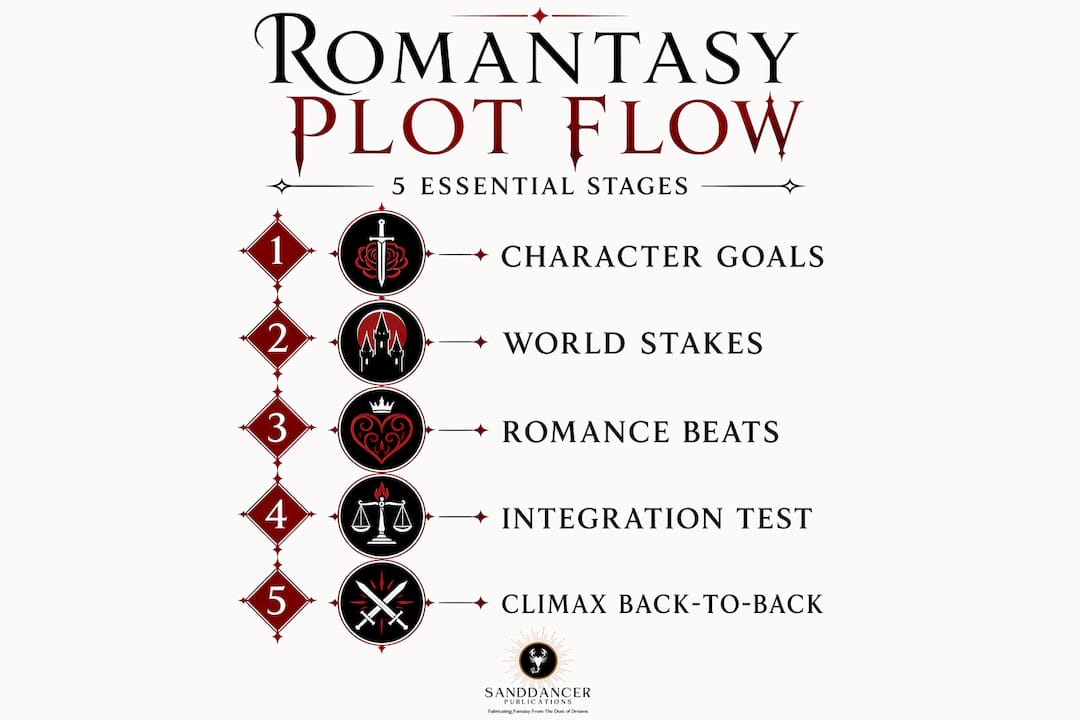
Fantasy world elements like forbidden relationships or magic tied to emotional bonds raise romantic stakes inherently. Build those mechanics in early and they will pay off for you through every act.
The Plotting Framework That Actually Works
Here’s the honest truth: you are building two stories at once, and they need to move together. The framework that works best for romantic fantasy stories uses a 3-act structure combined with a 5-beat romance arc, and mapping them side by side before you write a word will save you enormous headaches later.
The 3-act breakdown is straightforward. Act One covers roughly the first 25% of your story and sets up both the fantasy conflict and the initial romantic spark. Act Two runs from about 25% to 75% and is where both arcs develop and complicate each other. Act Three handles the final 25%, where everything converges and both storylines resolve. Each act needs to carry weight for both the romance and the adventure.
The 5-beat romance arc sits inside that structure like this:
- Meet. Your protagonists encounter each other in a way shaped by the fantasy world. Not a coffee shop accident. A politically charged negotiation, a magical accident with consequences, a forced alliance.
- Force Together. The world’s conflict makes it impossible for them to walk away from each other. They are stuck on the same side whether they like it or not.
- Almost Together. The emotional connection deepens right around the midpoint, often through a moment of shared vulnerability during a high-stakes adventure scene.
- Black Moment. At roughly the 75% point, something tears them apart. This must connect directly to the fantasy conflict, not feel like a manufactured misunderstanding.
- Reckoning. Both the external threat and the relationship crisis demand resolution, ideally at the same time or in rapid succession.
The magic of this framework is that every fantasy adventure themes scene you plan can do double duty. Think about how your characters reveal emotional truths during dangerous moments. A scene where two characters survive an ambush together is also a scene where walls come down. That’s not wasted page space. That’s integration.
Pro Tip: Map your 5 romance beats onto your plot outline before you write. If you can’t place each beat within an existing fantasy scene, your story structure has a gap worth fixing now rather than in revision.
Here’s how the two structures compare when you lay them side by side:
| Story Point | 3-Act Fantasy Position | 5-Beat Romance Position |
|---|---|---|
| Opening conflict introduced | Act One (0–25%) | Meet |
| Forced proximity or alliance | Early Act Two (25–40%) | Force Together |
| Midpoint revelation | Mid Act Two (~50%) | Almost Together |
| Crisis and separation | Late Act Two (~75%) | Black Moment |
| Final confrontation and resolution | Act Three (75–100%) | Reckoning |
When those columns align, you know your story is working as a unit rather than two separate narratives awkwardly sharing a book.
Making Romance and Fantasy Work Together, Not Against Each Other
Here’s the test that will tell you everything: if you removed the romance from your story, would the plot still work? If yes, you have a problem. Romance and fantasy elements must be inseparable for a successful romantasy story. Not decorative. Structural.
The principle we call “integration not alternation” is what separates a satisfying romantasy from one that frustrates readers. Alternation is when your hero goes on a quest, then has a romantic moment, then goes back to questing, as if the two things exist in separate rooms. Integration is when the quest itself is what brings them together, pulls them apart, and tests whether their bond can survive the cost of saving the world.
One concrete way to do this: use your world’s rules as relationship obstacles. If magic in your story requires emotional sacrifice, then falling in love has a literal price. If the politics of your kingdom forbid alliances across certain factions, then choosing love means choosing treason. Fantasy elements like forbidden bonds tied to world rules do more heavy lifting in a single scene than ten pages of internal monologue about feelings.
Romantic moments should also advance plot or reveal character. Every time your leads share a quiet moment, ask yourself: what does the reader learn about the external stakes here, too? If the answer is nothing, reshape the scene.
The best romantasy scenes work like a double helix. Pull on the romance thread and the fantasy stakes tighten. Pull on the fantasy thread and the relationship shifts. Neither strand exists alone.
A common mistake we see from new writers is designing a fantasy world that simply does not affect the romance at all. The magic is cool, the villain is menacing, but none of it touches the love story in any structural way. That’s where the integration of world and relationship breaks down, and readers feel it even if they can’t name exactly what’s wrong.
Pro Tip: After drafting any romantic scene, run through this quick check: Does this moment change the plot? Does it reveal something new about the fantasy stakes? If it doesn’t do at least one of those things, it needs a rewrite, not just a polish.
Writing the Black Moment and Your Ending Right
The Black Moment is where your story either earns its ending or falls apart. Placed at roughly the 75% mark, this is the scene where both the romantic relationship and the fantasy conflict hit their lowest point simultaneously. Not sequentially. Together. A stronger Black Moment leads directly to more satisfying resolutions for readers, and that’s not an accident of craft. It’s a structural requirement.
What makes a great Black Moment in romantasy? It has to feel like a genuine consequence of the story’s specific world and relationship, not a general crisis that could happen in any genre. If your leads are separated because one of them chose the mission over the relationship, that separation must be made harder by the fantasy stakes around it. The world should make reunion feel almost impossible.
Think about what each character loses in this moment. The protagonist loses both the love interest and the hope of defeating the external threat. The reader needs to feel that weight on both levels or the climax will not land. Genre convention expects roughly equal weight given to romantic and plot resolution, and the Black Moment is your last chance to build enough pressure for both payoffs to feel earned.
A few things worth keeping in mind as you plan your final act. Do not resolve the romance before the fantasy climax. If your characters patch things up and then go defeat the villain together as a happy team, the ending loses its teeth. Let the resolution happen in proximity to the final conflict. Let it cost something. And make sure the emotional payoff feels proportional to what the reader has invested in both threads throughout the whole story.
The climax resolutions that satisfy romantasy readers are the ones that happen back to back with equal weight. One thread cannot overshadow the other in the final pages. Plan your ending so that defeating the external villain and choosing each other feel like two halves of the same decision.
From Our Writing Table: What We Actually Learned
I’ll be straight with you. The first time I tried to write a romantasy, I thought the romance was the “easy part.” Ha. I figured I’d get the plot structure figured out and the love story would just… happen naturally. It didn’t. What I ended up with was a fantasy adventure with a romance bolted on like an accessory, and my beta readers noticed immediately. The feedback wasn’t “the romance is weak.” It was “I didn’t care about the relationship.” Those are very different problems, and the second one is structural, not emotional.
What actually changed my approach was forcing myself to plan the romance arc and the fantasy arc at exactly the same time, on the same document, side by side. The moment I saw them on the same page, I could immediately spot where they weren’t talking to each other. A fantasy plot point would hit with no romantic consequence. A romantic moment would land in a vacuum with no adventure pressure around it. Fixing those gaps before I wrote a single draft scene saved me what would have been months of revision.
My honest advice? Build your romantasy plot structure with both arcs visible from the very beginning. Commit fully to both. Your readers will know if you hedged.
— C.S.
See Romantasy Done Right with SandDancer
If you want to see fantasy adventure themes put into practice with real stakes, dark worlds, and relationships that cost something, we have exactly that waiting for you.

At SandDancer, we write and publish the kind of dark romantasy that refuses to let either thread off the hook. The Gothika series starts with Raise the Dead and keeps the romantic and fantasy stakes locked together through every chapter. House of Cards brings that same integration into an urban fantasy setting with Las Vegas, vampires, and a love story that is genuinely dangerous. Browse everything we have over at SandDancer Books and use these titles as both entertainment and a masterclass in how the structure we talked about actually plays out on the page.
Frequently Asked Questions
What is the best structure for a romantasy plot?
A hybrid 3-act and 5-beat structure works best, aligning fantasy plot points with romance milestones so both arcs develop and resolve together rather than separately.
How much of a romantasy should be romance vs. fantasy?
Roughly 45% romance and 45% fantasy, with the remaining space used for world-building and pacing. Neither element should dominate the other in a true romantasy.
How do I know if my romance and fantasy are integrated well?
Ask yourself: if you removed the romance, would the fantasy plot still work the same way? If yes, the integration has failed and the two arcs need to be structurally reconnected.
When should the Black Moment happen in a romantasy?
The Black Moment lands at roughly the 75% mark and should bring both the romantic relationship and the fantasy conflict to their crisis point at the same time, not one after the other.
How do I use worldbuilding to strengthen my romance?
Design your world’s rules, magic, and politics so they create obstacles for the romance directly. Forbidden bonds, magic tied to emotion, and political stakes that punish love all make intimacy feel riskier and more meaningful to readers.