

Craft authentic dialogue in dark fantasy worlds
TL;DR:
- Authentic fantasy dialogue emphasizes character-specific speech, subtext, and purposeful lines over realism to deepen immersion.
- Building distinct voices for each character and understanding world norms prevent cuts of the dialogue from feeling flat or anachronistic.
You know that feeling when a scene is going perfectly, the atmosphere is thick, the stakes are real, and then a character opens their mouth and says something that sounds like it belongs in a group chat, not a crumbling gothic manor? Yeah. We’ve been there. Bad dialogue doesn’t just feel off, it shatters the whole spell you’ve spent chapters casting. The good news is that authentic fantasy dialogue isn’t about transcribing how people actually talk. It’s about making every line feel purposeful, character-specific, and soaked in the world you’ve built.
Key Takeaways
| Point | Details |
|---|---|
| Purposeful dialogue | Every line reveals character or advances the plot, never just filling space. |
| Distinct voices | Characters speak with their own rhythms, slang, and emotional tones. |
| Genre awareness | Dialogue fits the world’s era, rules, and supernatural layers without anachronism. |
| Action beats matter | Physical reactions and pauses enrich conversation and immersion. |
| Edit for authenticity | Cut filler and repetitive tags, and refine until every line feels true to your world. |
Set the foundation: What authentic dialogue in fantasy means
Before you write a single line of conversation, it helps to understand what “authentic” actually means in a fantasy context. Because here’s the thing: authentic doesn’t mean realistic. Real people say “um” and “like” and trail off mid-thought. Your gothic vampire lord cannot do that. Well, he could, but you’d lose every reader in chapter two.
Authentic fantasy dialogue prioritizes character-specific speech patterns, subtext, and natural rhythms over verbatim realism, making every line purposeful for plot advancement and character revelation. That’s the core idea. Every line earns its place. No filler. No noise.
One of the biggest pitfalls we see in early dark fantasy drafts is what we call “authorial bleed.” This is when all the characters sound vaguely like the same person, probably the author typing fast at 11pm. It happens. But readers notice instantly when a medieval necromancer talks with the same cadence as a modern street witch. As the folks at Dialogue Writing Techniques put it, authentic dialogue means “rebellion against authorial voice via diverse character tenors.” Each voice should feel like a distinct personality with its own rhythms and vocabulary.
Another killer is anachronism. Slipping contemporary slang into a gothic horror setting pulls readers out of the world faster than a typo in the opening paragraph. Your characters need to speak from their world, not ours. We’ll cover how to manage that in detail shortly.
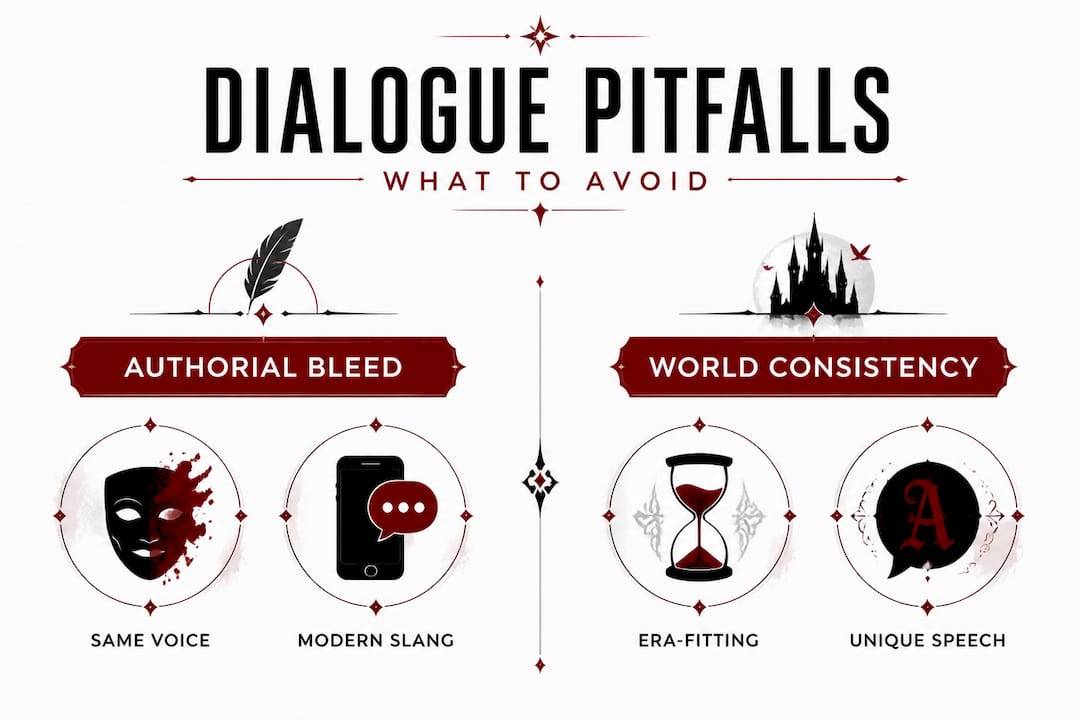
Dialogue also has to do real work for your worldbuilding. Think of it as a sneaky delivery system. A single exchange between two characters can reveal social hierarchies, cultural taboos, regional accents, and power dynamics, all without a single paragraph of exposition. Getting dark fantasy voice tips right from the start means your world feels lived-in rather than explained-at. That’s the difference between immersion and a history lecture.
| Common dialogue pitfall | Why it hurts immersion | Better approach |
|---|---|---|
| Filler words (“um,” “like”) | Slows pace, breaks atmosphere | Use deliberate pauses or action beats |
| Modern slang in period settings | Snaps believability instantly | Research era-specific phrasing |
| All characters sounding the same | Flattens emotional landscape | Build distinct voice profiles |
| Overlong exposition in dialogue | Feels unnatural and forced | Weave facts into subtext or conflict |
“The goal isn’t to make characters speak the way people do in real life. The goal is to make them speak the way they must, given who they are and where they live.” — A rule we keep pinned above our desks.
Gather your materials: Understand your characters and setting
With the core principles locked in, you need to build your toolkit. And the most important tool isn’t a style guide. It’s deep character knowledge. Before you can write convincing dialogue, you need to know your characters the way you know an old friend, including the stuff they’d never say out loud.
Think about where your character grew up, what they feared, who raised them, and what social codes shaped their speech. A half-blood street thief in an urban fantasy city is going to talk very differently from a high council warlock who spent three centuries in an arcane library. Both exist in your world. Neither should sound like the other, even in moments of agreement.

Urban fantasy dialogue benefits from distinct character voices that blend snark, wit, and modern conversational tone with supernatural elements, revealed through action rather than exposition. That’s a huge unlock, honestly. Instead of having a character explain that she’s been hunting demons for decades, show her dismissiveness about things that terrify everyone else. Let her voice carry the history.
Gothic horror, on the other hand, tends toward archaic formality, careful word choice, and a certain weight to every sentence. Characters in that space often communicate through what they don’t say. Silence, deflection, and overly polite phrasing can be just as terrifying as a direct threat. Studying both registers helps you navigate the full spectrum of your genre.
| Genre | Dialogue style | Example tone |
|---|---|---|
| Urban fantasy | Snappy, sarcastic, modern-adjacent | “Great. Another demon. Right on schedule.” |
| Gothic horror | Formal, layered, ominous undertone | “You are most welcome here. As long as you remain… agreeable.” |
| Dark fantasy | World-specific, often bleak or mythic | “The stones remember what the living choose to forget.” |
A strong practical move is to build a quick-reference sheet for each major character. Note their favorite expressions, speech rhythm (do they speak in long sentences or short bursts?), topics they avoid, and how they change their language when they’re scared, angry, or hiding something. Keeping this immersive fantasy setting reference close while drafting keeps voices consistent across a whole manuscript.
Pro Tip: Give each character one specific verbal quirk, whether that’s a recurring phrase, a habit of interrupting, or a refusal to use contractions, and use it sparingly. Like seasoning. Just enough to flavor, not so much it becomes a parody.
The romantasy worldbuilding process also applies here: the more you understand your world’s social norms, the more naturally your characters will navigate and push against them in conversation.
Write the dialogue: Steps for crafting immersive conversations
Once you’ve done the groundwork, the actual writing becomes a lot less terrifying. Here’s the process we come back to every time a scene feels flat or false.
Step one: Draft the purposeful line. Ask yourself what this exchange is actually accomplishing. Is it revealing character? Advancing plot? Deepening dark fantasy conflict? If a line does none of those things, it probably doesn’t belong in the scene. Be ruthless here. Friendly ruthless, but still ruthless.
Step two: Match the voice. Run each line through your character reference sheet. Would this character, with this background and these wounds, actually say this? If the answer is “maybe,” rewrite until it’s a definitive yes. Voice consistency is what makes readers trust a character across hundreds of pages.
Step three: Cut the filler. Go back through your draft and remove anything that doesn’t earn its place. Small pleasantries, repeated information, and lines that exist purely to “sound like a conversation” all slow the pace and dilute tension. Authentic fantasy dialogue balances dialogue with action beats and narration, because in immersive storytelling, dialogue drives character arcs while avoiding narrative stalls.
Step four: Add action beats. This one is a game-changer. Action beats, those small physical details tucked into or around dialogue, tell the reader what a character is doing while they speak, and that often reveals more than the words themselves. “He smiled” is fine. “He straightened the candlestick before answering” is a whole story. These beats ground conversation in physical space and hint at subtext without spelling it out.
Step five: Layer in subtext. This is where gothic elements really sing. What is your character not saying? What are they dancing around? Great dark fantasy dialogue is often a game of surfaces and depths, with tension building not from what’s spoken but from what’s avoided. A character who refuses to answer a direct question tells us more than one who explains everything.
Thinking about integrating fantasy for immersion in visual storytelling is a useful parallel: it’s the layering of the unexpected beneath the familiar that makes something feel magical. The same principle applies to what lives beneath the surface of a spoken line.
Pro Tip: Read every page of dialogue aloud. Your ear will catch awkward rhythms and unnatural phrasing that your eyes completely skip over. If you stumble reading it, your reader will feel it too.
Troubleshoot and refine: Testing, editing, and avoiding common pitfalls
You’ve drafted your dialogue. Excellent. Now comes the part that separates a good draft from a great manuscript: the editing pass specifically for conversation.
The first thing to check is tonal consistency. Does your character’s voice drift between scenes? A stoic warrior should not suddenly become chatty in chapter twelve unless you’ve deliberately written that shift as character growth. Readers track this stuff, even when they’re not consciously aware of it. Any unexpected shift pulls them out of the story.
Next, look for accidental anachronism. We all have pet phrases and modern habits that sneak into our drafts. Fantasy-specific adaptation means no contemporary slang like “adulting” in medieval settings, and yes, we have absolutely caught ourselves writing that kind of thing in a first draft. More than once. No judgment. Just flag it and fix it.
“Every character in your story should sound like they couldn’t possibly be anyone else.” — This is the bar. Set it high.
Then do a “cover your eyes” test. If you removed all the dialogue tags and action beats, could you still tell which character is speaking? If not, you’ve got voice blending to fix. Each character should have such a distinct rhythm and vocabulary that they’re recognizable even without a label.
Beta readers are genuinely invaluable at this stage. Ask them specifically to flag moments where the dialogue felt awkward, unbelievable, or out of character. And if you’re working alone, text-to-speech tools can read your dialogue back to you. It’s uncomfortable to hear, honestly, but deeply useful. Leaning into inclusive storytelling practices also means checking whether your dialogue represents varied speech patterns across different characters and backgrounds, not just one default “fantasy voice” painted in different colors.
Confirm the magic: Signs your dialogue brings your world to life
With your dialogue edited and tuned, the final step is to confirm it truly enhances your dark or urban fantasy setting. How do you know it’s actually working?
The clearest sign is that your world feels inhabited. Not described, inhabited. When dialogue naturally carries cultural details, when characters reference things the reader pieces together without being told, when disagreements are shaped by the rules of your world rather than generic human conflict, that’s the magic happening. Authentic fantasy dialogue prioritizes character-specific speech patterns, subtext, and natural rhythms that make a world feel lived-in and consistent.
Here’s a quick evaluation table to run your dialogue through before you call a scene done:
| Check | What to look for | Passing sign |
|---|---|---|
| Voice distinctness | Can you identify speakers without tags? | Yes, immediately |
| Subtext presence | Is there meaning beneath the surface? | Characters hint, don’t explain |
| World integration | Does speech reflect the setting? | References to world-specific details |
| Mood contribution | Does dialogue heighten atmosphere? | Tension, dread, or wonder intensifies |
| Plot function | Does every line do something? | Scene feels tighter, not longer |
Another strong confirming signal: your beta readers quote lines back at you. When someone messages to say “that bit where she said X gave me chills,” you’ve nailed it. Fantasy characters that linger in memory long after the last page are almost always defined as much by how they speak as by what they do.
If dialogue heightens mood, reveals character, and makes your world feel consistent and complex, you’re there. It really is that satisfying when it clicks.
One lesson from writing haunted conversations
Here’s the thing that took us a while to figure out, and we wish someone had told us earlier: trying to make dialogue sound “real” is often what kills the atmosphere you’re working so hard to build.
We spent a lot of early drafts chasing naturalism. Every exchange felt plausible, technically. Characters asked clarifying questions, responded proportionately, behaved like sensible people. And the pages felt dead. Because dark fantasy isn’t about sensible people having plausible conversations. It’s about fractured souls navigating impossible worlds, and that calls for language that’s slightly too sharp, slightly too poetic, slightly too weighted with what isn’t being said.
The real turning point came when we started letting characters break our own rules. The quiet one suddenly had too much to say. The eloquent villain stumbled. Those moments of rupture told us more about the characters than pages of careful, “correct” dialogue ever did. Exploring how fantasy lore shapes the way characters speak and think can unlock that same kind of rupture for you.
Trust your instincts when a line feels oddly right even if it breaks your character sheet rules. Sometimes the best dialogue is the line you almost deleted.
Discover more dark fantasy worlds where dialogue breathes
Reading great dialogue is one of the fastest ways to level up your own. When you see it done well in a story you’re genuinely hooked on, you absorb the rhythms and the craft without even trying.

If you want to see authentic, atmospheric dialogue at work in dark fantasy fiction, we’d love for you to explore what we’ve been building over here. Blood Tithe is a gothic novel packed with the kind of tense, layered conversation we’ve been talking about throughout this article. House of Cards brings a different flavor but the same commitment to voice-driven storytelling. And if you want to sample before you commit, our free gothic fantasy ebooks are a great place to start. Come see what dialogue that haunts actually looks like on the page. 👻
Frequently asked questions
How do I avoid anachronisms in fantasy dialogue?
Filter out modern slang and tech references, then research expressions and speech patterns that fit your world’s era and culture, because fantasy-specific adaptation means keeping contemporary language like “adulting” out of medieval settings entirely.
What if all my characters sound the same?
Distinguish each voice with unique speech rhythms, vocabulary levels, and sentence lengths rooted in that character’s specific background, since authentic dialogue requires rebellion against a single authorial voice through genuinely diverse character tenors.
Should I write dialogue exactly as people speak?
No, cut filler words and focus every line on revealing character or moving the plot, because authentic fantasy dialogue prioritizes speech patterns and natural rhythms over verbatim realism.
How can dialogue enhance worldbuilding in dark fantasy?
Dialogue can reveal social structures, cultural taboos, and power dynamics in ways that feel organic rather than expository, making your world feel consistent and genuinely inhabited, which is exactly what immersive storytelling demands.
What role does subtext play in fantasy conversations?
Subtext deepens every exchange by hinting at secrets, tension, or buried emotion beneath the surface meaning, and great dark fantasy dialogue almost always works on at least two levels at once.
Recommended
- How to Build Immersive Dark Fantasy Settings That Haunt – SandDancer Books
- Craft dark fantasy conflict that haunts your readers – SandDancer Books
- Essential Tips for Writing a Dark Fantasy Novel with Gothic Flair – SandDancer Books
- Step-by-Step Guide to Inclusive Dark Fantasy Storytelling – SandDancer Books