

The Art of Storytelling: A Practice-First Guide for Writers
TL;DR: Strong storytelling connects a character’s goal to meaningful consequences. Build your craft with ten minutes of daily scene practice, a weekly structural pass, and regular feedback. Focus on clear cause and effect, specific character desires, sensory detail, and scenes that change something.

The art of storytelling is the craft of sequencing events around a goal-driven character so cause leads to effect and the audience feels something real by the end. That's it. That's the whole definition, backed by research on narrative cognition showing that concrete, causal event chains stick in memory far better than abstract description. The three engines that make this work are transportation (getting lost in the world), identification (caring about who it happens to), and meaning-making (walking away with something), a framework psychological researchers have studied for decades.
Here's the fastest path to getting better at it, and we mean starting today:
| Practice | What to do |
|---|---|
| Daily micro-practice. | Ten minutes, one scene, no editing. |
| A structural pass. | Once a week, check whether your scenes actually build. |
| A feedback pass. | Every few weeks, hand pages to someone who'll tell you the truth. |
Try this right now: write a hook (one line), one story beat (what happens next), and one sensory detail (something the reader can smell, hear, or touch). Ten minutes. Go.
Pro Tip: Set a timer. The goal isn't a polished paragraph, it's proof that you can generate a hook and a beat on demand instead of waiting around for inspiration to knock.
The Art of Storytelling Starts With Seven Core Elements
Every story, whether it's a three-page flash fiction piece or a 400-page dark fantasy epic, is built from the same handful of parts. Master these individually and you'll start seeing them work together instead of fighting each other on the page.
| Core element | How it works |
|---|---|
| Plot | Plot is the sequence of causally linked events. Practice it by writing a one-sentence version of your story using only "and then" and "but" and "therefore," a trick screenwriters use to catch plots that are just things happening rather than things causing other things. |
| Character | Character is what a person wants and what stands in their way. Test yours by writing a scene where they get exactly what they want and see if it's satisfying or hollow. Hollow means the want wasn't specific enough. |
| Point of view | Point of view decides what information reaches the reader and when. Rewrite one scene from a second character's perspective and watch how much changes. |
| Setting | Setting does more than paint scenery. It should apply pressure. A haunted moor isn't just atmosphere, it's a threat. |
| Conflict | Conflict is friction between what a character wants and what's stopping them, and it works at every scale from a single argument to a war. |
| Theme | Theme is the question your story keeps circling. You rarely start with it. You find it in draft two. |
| Style and word choice | Style and word choice are the fingerprint. Sentence length, rhythm, and diction decisions add up to the reason readers can tell your writing from anyone else's. |
These elements interact constantly. Change your point of view and your conflict reads differently, because the audience now knows things your protagonist doesn't, or vice versa. That's dramatic irony, and it's one of the cheapest, most effective tools in the box.
Pro Tip: Pick your POV based on intimacy and information, not habit. First person creates closeness but limits what the reader can know. Close third gives you a little more room to maneuver while still living inside one head. Choose based on what the story needs to hide or reveal, not what feels comfortable to write.
Practical Story Structures You Can Use Today
You don't need to reinvent structure. You need a template flexible enough to hold your ideas and rigid enough to keep you from wandering for 200 pages with no destination.
The three-act shape, compressed for practical use:
- Act One (roughly 25%): Establish the world, introduce the protagonist's want, and hit your inciting incident, the event that makes turning back impossible.
- Act Two (roughly 50%): Escalate obstacles, hit a midpoint that changes the game (a reveal, a reversal, a raised stake), and drive toward the low point where everything looks lost.
- Act Three (roughly 25%): Climax, where the protagonist confronts the central conflict directly, followed by a resolution that shows the new normal.
For short-form work, compress this into a beat sheet: hook, want, obstacle, turn, resolution. Five beats, five paragraphs, one flash fiction piece.
Take a story almost everyone knows: a young farm hand discovers a hidden power, loses a mentor at the midpoint, and confronts the villain in the climax after nearly giving up. Swap the specifics and that skeleton fits half the fantasy novels on shelves right now, including plenty of gothic and dark fantasy work that layers dread on top of the same bones.
Structure exists to control information flow, deciding what the reader knows and when they know it. That's exactly why breaking the structure on purpose (starting mid-battle, then rewinding) can work beautifully. You're not ignoring the template, you're using it to create suspense through withheld information, a technique narrative craft guides point to again and again in stories that hook readers fast.
If you're working specifically in romantasy or dark fantasy, our piece on romantasy plot structure walks through how magic systems and romantic tension complicate a standard beat sheet.
Narrative Techniques That Control Pace and Perspective
Techniques are tools, not decorations. Each one exists to solve a specific pacing or perspective problem, and using one without knowing why is how you end up with a gimmick instead of a good scene.
| Technique | How it works |
|---|---|
| In medias res | In medias res drops readers into the middle of action before context arrives. It creates an immediate hook, but only works if you deliver the missing backstory soon enough that confusion doesn't curdle into frustration. |
| Flashback | Flashback interrupts present action to reveal past events. Use it to answer a question the reader is already asking, never to dump exposition they haven't earned yet. |
| Foreshadowing | Foreshadowing plants a detail that pays off later. The test: if you removed it, would the ending feel cheaper? If not, it's not foreshadowing, it's just a detail. |
| Unreliable narrator | Unreliable narrator filters events through a voice the reader shouldn't fully trust. It works when the gap between what's said and what's true creates meaning, not just confusion. |
| Subtext | Subtext is what characters mean but don't say. Dialogue with zero subtext reads flat because real people almost never say exactly what they feel. |
| Show vs. tell | Show vs. tell means dramatizing an emotion through action and detail instead of naming it. "She was furious" tells. "She snapped the pencil in half and smiled anyway" shows. |
Craft guides on narrative technique consistently point to the same rule: pick your technique based on what the story needs, not what sounds impressive in a workshop.
Run your opening line through this checklist: does it raise a question, introduce a voice, or create tension? If it does none of the three, it's not a hook yet, it's a warm-up.
Building Characters Readers Actually Care About


Characters get remembered for what they want and what it costs them to get it, not for their eye color or their tragic backstory paragraph. Build yours from four ingredients: desire (specific, not vague), flaw (something that actively sabotages the desire), stakes (what happens if they fail), and small behavioral details that show personality without a single line of exposition.
Two exercises worth running this week:
- Write a one-page, first-person monologue where your character explains a decision they're ashamed of. Don't let them justify it too cleanly.
- Write a dialogue-only scene, no action tags, no interiority, between two characters in conflict. See how much personality survives with zero narration to prop it up.
Voice should match genre expectations without collapsing into cliché. Dark fantasy tends to reward clipped, weighty sentences and a slower reveal of dread. Romantasy tends to reward warmth, banter, and emotional immediacy even in tense scenes. Neither means writing generic. Genre sets the frame, not the furniture. If you're blending romance and adventure, our guide on mixing romance and adventure is worth a look for finding that balance.
Sharpening Language, Sensory Detail, and Emotional Weight

Micro-edits do more for emotional resonance than big rewrites. Compare these:
Before: "She was scared of the basement." After: "The basement door stuck at the same spot every time, and every time, she pulled harder than she needed to."
Before: "He was sad about the funeral." After: "He kept the funeral program folded in his jacket pocket for three weeks, then couldn't remember where he'd put it."
Neither "after" version names the emotion. Both make you feel it anyway.
Try this sensory exercise for any scene: pick three senses (not the default two, sight and sound) and anchor one concrete object in the space. A dark fantasy scene set in a crypt might lean on smell (wet stone, old wax) and touch (cold iron, gritty dust) alongside sight.
- Vary sentence length deliberately. Short sentences hit hard. Longer ones, with subordinate clauses, carry nuance and breath.
- Lush description slows pacing on purpose, which works during quiet or dread-building moments and works against you during a chase or a fight.
Pro Tip: Read your scene aloud. If you run out of breath mid-sentence and it's not an action scene, your rhythm needs work.
Adapting Your Story for Film, Stage, and Spoken Word
Prose beats don't translate to screen or stage automatically. Interior thought, your bread and butter as a novelist, has to become visible action, dialogue, or a symbolic image, since a camera or a stage can't show what's happening inside someone's head.
Quick conversion checklist:
- Externalize interiority: turn "she felt trapped" into pacing, a locked door, a hand gripping a railing.
- Use spatial grammar: stage directions and shot lists depend on where bodies are in relation to each other and the space.
- Trust action over explanation: a visual audience infers meaning from what characters do, not what a narrator tells them.
A prose line like "he realized he'd never trusted her" might become a shot list note: close on his hand pulling back from hers, cut to her face registering the retreat. If you're collaborating with an artist or performer adapting your work, hand over emotional intent, not just literal description. Spoken-word and performance storytelling, much like the cultural performance traditions explored by dance scholars, rely on rhythm and physical presence to carry meaning that prose delivers through sentence structure instead.
Scene-Level Craft: Keeping Momentum From Scene to Scene
Every scene needs a goal, an obstacle, a turn (something changes), a sensory anchor, and a mini-decision the character makes before moving on. Skip the turn and your scene is just a conversation that goes nowhere.
Picture three back-to-back scenes: Scene one, your protagonist asks a question and gets a lie. Scene two, they catch the lie and confront it, raising the stakes. Scene three, the confrontation forces a decision with real consequences. Each scene should end slightly worse (or slightly more urgent) than it started.
- Vary scene length. Fast, short scenes during escalation. Slower ones for setup or payoff.
- Use transitions (a hard cut, a time jump, an object carried forward) to keep momentum instead of restating context the reader already has.
Revising, Getting Feedback, and Pitching Your Work
Revise in passes, not all at once:
- Structural pass: Does the plot hold up? Cut or reorder before you touch a single sentence.
- Character and scene pass: Does every scene earn its place and move the character forward?
- Line-level pass: Tighten sentences, cut filler words, fix rhythm.
- Polish pass: Read aloud one last time.
For workshops, ask for specific feedback ("Does the midpoint reveal land?") instead of "What do you think?" Receive critique without defending every choice on the spot, and when giving feedback, point to specific lines rather than vague impressions.
A logline template that works for query letters and pitches: When [inciting incident], a [character with a flaw] must [goal] before [stakes], or [consequence]. Example: "When a cursed bloodline resurfaces in her veins, a reluctant heir must claim a throne she never wanted before the kingdom falls to the very darkness she carries."
Why Storytelling Works: The Science Behind the Craft
Three mechanisms explain why a well-told story lands and a flat one doesn't, according to research on narrative persuasion and cognition:
- Transportation is the feeling of being immersed in a story world. Sensory detail and strong POV drive it directly.
- Identification is the reader's emotional bond with a character. Specific, flawed desires build it faster than generic likability.
- Meaning-making is what the reader takes away after the story ends. Theme lives here, and it's usually discovered in revision, not planned in advance.
Design a scene to boost identification by giving your character a decision with a visible cost, not just a visible outcome.
The daily micro-practice, structural pass, and feedback pass we outlined at the start aren't separate homework. They're baked into the sections you just read: the hook checklist above, the beat sheet in the structure section, the voice exercises in the character section. Build a 30-day rotation by pulling one micro-practice from three different sections each week, and you'll cover plot, voice, and technique without ever repeating the same drill twice.
A Note From Charm and Tony
One of us once cut an entire chapter because a beta reader said, "I don't know why I should care yet." Ouch. But that single note, three sentences added to page one giving the protagonist a concrete want, did more for that draft than six months of line edits ever had.
If this guide sparked something, try one exercise this week and tell us how it went. And if you want structured, hands-on lessons instead of piecing it together solo, our Fantasy Writing Foundations for New Writers course walks you through exactly this kind of practice, one module at a time.
Ready to Practice With Guided Fantasy Writing Lessons?
Reading a craft guide gets you moving, but a guided course keeps you moving when motivation dips, and that's the real gap between good intentions and finished manuscripts. Fantasy Writing Foundations for New Writers is Sanddancer's hands-on course built specifically for new indie fantasy writers who want structure, character, and voice work broken into manageable modules instead of trying to reverse-engineer craft from finished novels alone.
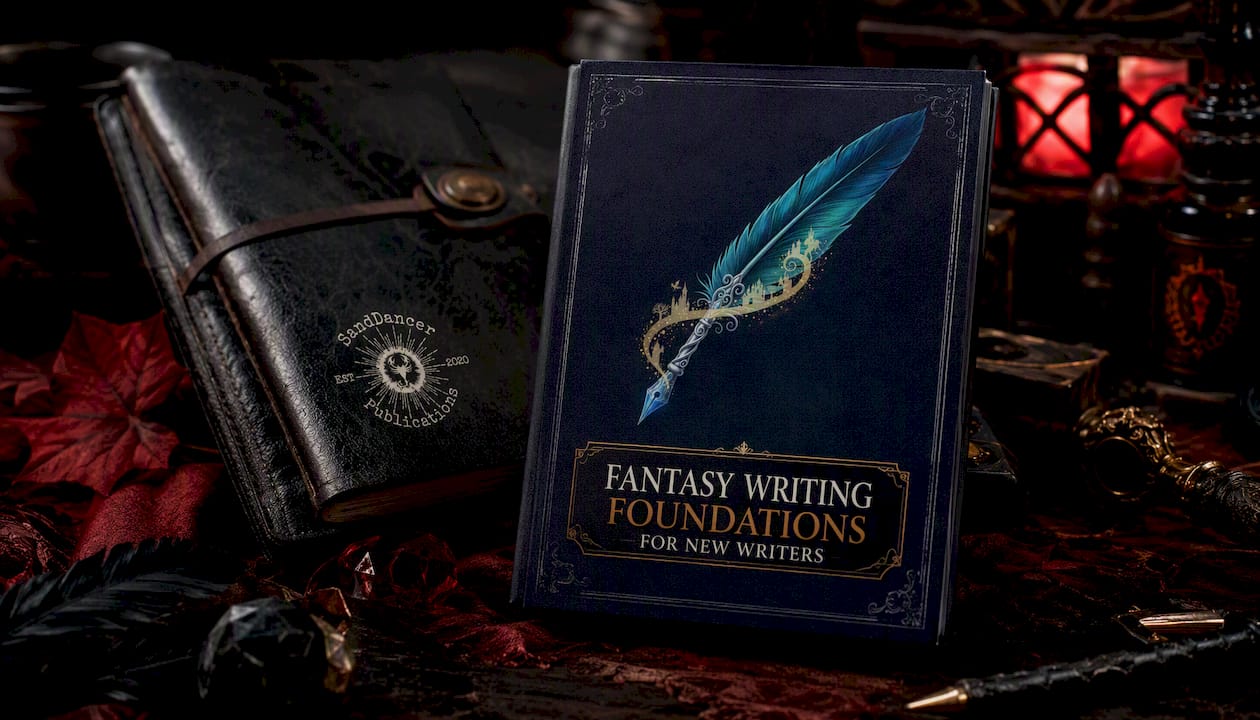
It's built for writers early in their fantasy or dark fantasy journey who've read the theory (maybe even this article) and now want exercises, feedback prompts, and a clear sequence to follow instead of a blank page and good intentions. Each module pairs a short lesson with a practical writing task, echoing the kind of applied, exercise-driven learning that platforms like Coursera have shown works for building craft skills at any level. If you've been circling the idea of formal instruction but weren't sure where to start, this is the next concrete step. Check out the Fantasy Writing Foundations course and see which module speaks to the scene you're stuck on right now.
Sources
- Stories in action: how narratives influence cognition and behavior | SAGE Journals
- Narratives, social impact, persuasion, and attitude change | Advanced Psychology
- Narrative Techniques: Definitions and Examples | StudioBinder