

How to craft immersive fantasy worlds for dark fiction
TL;DR:
- Effective dark fantasy and gothic horror worldbuilding relies on interconnected systems, atmospheric details, and a focus on emotional resonance rather than exhaustive lore. Building pillars such as theme, symbolism, and history creates a believable, immersive setting that reflects moral and psychological complexity. Prioritizing sensory specifics, small rituals, and character perceptions makes the world feel lived-in and hauntingly real.
Worldbuilding in dark fantasy and gothic horror is one of those things that looks simple from the outside and then absolutely humbles you the moment you sit down to actually do it. You’ve got a crumbling castle in your head, a magic system that costs blood, maybe a god who’s gone very wrong. And yet somehow, when it hits the page, it feels flat. Generic. Like a movie set with nothing behind the doors. We’ve been there. The good news? It’s a solvable problem, and this guide walks you through the real techniques that turn a sketch of a dark world into something readers can smell, fear, and believe in completely.
Key Takeaways
| Point | Details |
|---|---|
| Start with theme | Build your world around your story’s central themes, symbolism, and character journeys. |
| Connect your systems | Interlink magic, history, economics, and culture to create depth and logical consequences. |
| Use atmosphere and detail | Focus on mood, decay, ritual, and the mundane to bring dark fantasy and gothic worlds alive. |
| Prioritize immersion | Let character perspective and everyday life ground even the most fantastical elements. |
Understand the pillars of immersive worldbuilding
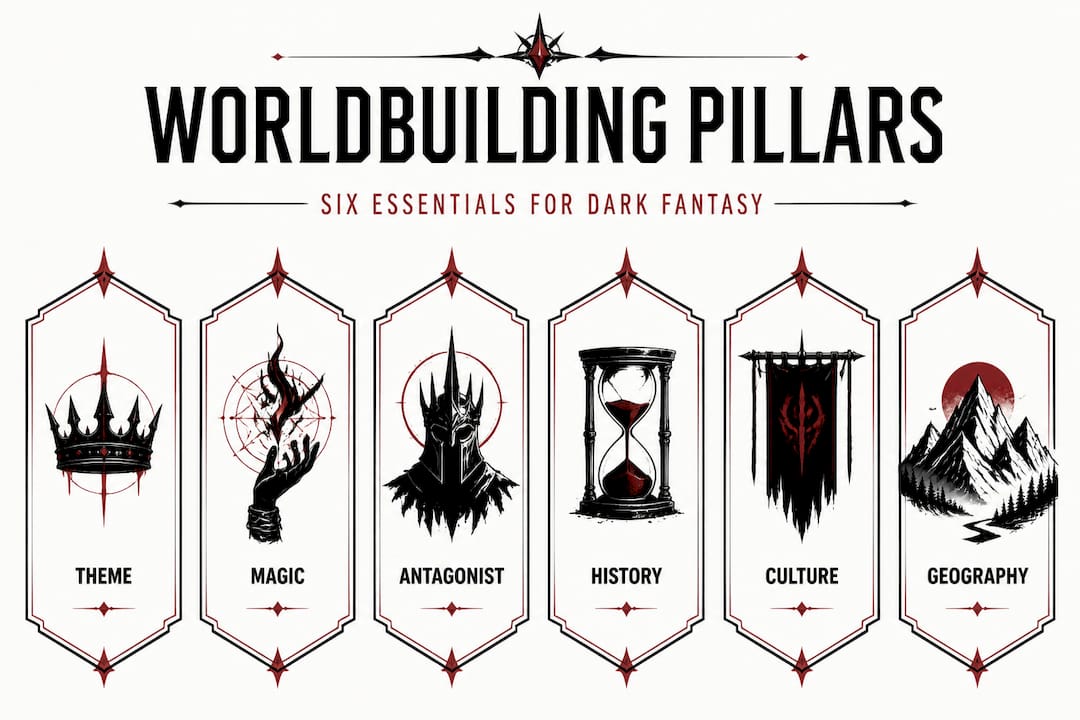
Before you name a single city or sketch a single coastline, it helps to know what you’re actually building. A lot of writers think worldbuilding is mostly geography and magic rules. It isn’t. Immersive fantasy worlds are built from theme, symbolism, character arc, magic and religion used as metaphors, an antagonist tied directly to world elements, and a history that actively shapes your protagonist’s present.
Think of it as six interlocking pillars: Theme and Symbolism, Magic and Religion, Antagonist and Climax, History and Culture and Government, Language, and Backstory. Miss one and the whole structure wobbles. In dark fantasy especially, each pillar should carry some weight of dread or moral complexity. Your magic system shouldn’t just be cool. It should reflect what your world believes about power and sacrifice. Your history shouldn’t just be backstory filler. It should be a wound your characters are still bleeding from.
There are two broad approaches to building these pillars. Organic worldbuilding means you discover the world as you write, letting story needs drive what gets developed. Systematic worldbuilding means you map everything out before chapter one. Neither is wrong. But for gothic and dark fantasy, where atmosphere is everything, we lean toward organic. Build what the story hungers for. You can always fill in the lore once you know what the story needs to feel whole.
A few good questions to ask before you do anything else: What does your world fear most? What does it worship, and why? What happened a hundred years ago that nobody talks about anymore? What does power cost here, and who pays? These questions produce story, not just setting. If you want a solid framework for all of it, this step-by-step worldbuilding guide is a great place to start.
| Approach | Best for | Risk |
|---|---|---|
| Organic worldbuilding | Character-driven dark fiction | World gaps, inconsistency |
| Systematic worldbuilding | Complex political fantasy | Over-detail, under-story |
| Hybrid (recommended) | Gothic horror with ensemble casts | Requires discipline |
Pro Tip: Before you write a single scene, identify one world element that mirrors your protagonist’s internal wound. If your hero is terrified of losing control, your magic system should probably have a cost tied to control. That kind of resonance is what makes a setting feel inevitable rather than decorative.
Interconnect systems for depth and believability
With your core pillars in place, the next move is weaving your world’s systems together so they actually push and pull on each other. A world where magic exists but has no economic impact, no political implications, and no religious controversy isn’t a world. It’s a backdrop. Interconnected world systems where magic, economics, politics, history, and culture all influence each other are what separate a setting that feels whole from one that feels like a Wikipedia article nobody finished.
Here’s a simple way to think about it. Magic disrupts labor. If one necromancer can raise a thousand undead workers, what does that do to the living poor who rely on manual labor for survival? Suddenly you’ve got class conflict, religious outcry, political instability, and a protagonist who might be caught right in the middle of all of it. That’s not extra work. That’s story, handed to you by your own systems.
How do you decide which systems to develop first? Start with whatever is closest to your main character’s daily life and immediate conflict. Then work outward.
First, identify your story’s central tension and ask which world system it lives inside. A story about a cursed king lives inside politics and magic. A story about a plague survivor lives inside economics, religion, and infrastructure.
Second, trace that system’s relationships. How does it affect the next closest system? Who benefits from the current arrangement and who is crushed by it?
Third, introduce at least one crack in the system, a point where it’s actively failing or being challenged. Stable worlds don’t generate story. Unstable ones do.
Fourth, give ordinary characters opinions about the system. Not just heroes and villains. The baker, the dockworker, the temple acolyte. Their perspective will tell you where the world feels real and where it still needs work.
For readers who want to think about representation and range of voices in these systems, our post on inclusive dark fantasy storytelling digs into this with a lot of practical warmth.
| System | What it shapes | What shapes it |
|---|---|---|
| Magic | Power, class, religion, fear | History, cultural taboos, politics |
| Economy | Daily survival, loyalty, migration | Geography, magic availability, war |
| Politics | Law, conflict, who has rights | History, religion, economic pressure |
| History | Trauma, myth, architecture | Previous politics, wars, magic events |
| Culture | Language, ritual, identity | Religion, geography, shared history |
Pro Tip: Before you lock in your world’s timeline or map, write out three cause-and-effect chains between systems. Something like: “The rise of necromancy disrupted trade, which drove the merchant guilds to fund a holy war, which accidentally gave the church enough military power to challenge the crown.” That chain is three chapters of conflict right there.
Infuse atmosphere: Dark fantasy and gothic horror essentials
Interconnected structures give your world its skeleton. Atmosphere gives it its skin and teeth. This is where dark fantasy and gothic horror get to be genuinely themselves, and it’s worth spending real time here because atmosphere is not just about describing fog and gargoyles. It’s about making the feeling of your world seep into every scene.
The essentials for gothic atmosphere include decaying settings used as characters, landscapes that reflect the psychological state of your cast, and a constant low hum of wrongness beneath normal life. Think crumbling estates where the architecture itself seems to watch. Storms that arrive exactly when secrets do. A silence that’s louder than noise. These aren’t clichés if you use them with intention.
For dark fantasy specifically, you want to layer in dangerous magic with real costs (blood, sanity, lifespan), monsters that feel like corrupted myths rather than random encounters, and ordinary daily life that keeps going even as terrible things happen around it. The market still opens. People still argue about bread prices. Children still play in the street, even under a sky that hasn’t been quite right since the necromancers came. That contrast is what makes horror land.
“The setting in gothic fiction isn’t scenery. It’s a participant. When the castle’s stone is described as sweating, when the moor stretches in a way that feels personally hostile, readers don’t just see where they are. They feel what they’re in for.”
Studies suggest that atmosphere and mood account for a massive portion of emotional impact in gothic storytelling, sometimes outweighing plot mechanics entirely. For readers of the genre, a beautifully horrible setting is often what they remember long after the plot details fade.
Some practical tools for building this atmosphere in your writing: anchor your dark fantasy settings in sensory specificity rather than general gloom. Don’t just say the castle is oppressive. Tell us it smells of old iron and candle fat, that the staircases spiral in a direction that feels anatomically wrong to descend. Lean into your gothic story elements with purpose.
On psychological horror: ambiguity does more heavy lifting than gore. When readers aren’t sure if what they just witnessed was real or imagined, supernatural or psychological, they stay unsettled for much longer. Gore shocks and then releases tension. Ambiguity holds it. Use that. For more on crafting that tension in your plot, we’ve got you covered.
Make your world feel lived-in: Mundane detail and subjective perception
Here’s the thing that separates a world that readers believe from one they just tolerate: the little stuff. The mundane details of how people eat, what they wear for warmth, how they count time, what they whisper to each other when they’re scared. These things cost almost nothing to include and pay enormous dividends in immersion.

A few practical steps for building this out. First, pick three daily routines specific to your setting and write them in full, even if they never appear on the page. How does your blacksmith start her morning in a city haunted by blood magic? What does a farmer in a region cursed with endless winter do about crop rotation? These exercises fill your brain with the texture of the world so it bleeds naturally into your prose.
Second, ask what your characters see, smell, and fear on a regular Tuesday. Not during the climax. On a boring day. The answer reveals infrastructure, economics, cultural norms, and class dynamics all at once.
Third, weave world information into scenes through character perception rather than exposition. Your protagonist doesn’t think “the kingdom uses silver coins because gold was outlawed after the Necromancer Wars.” She thinks about whether she has enough silver for bread and feels a flash of anger at the shortage. Readers absorb the worldbuilding without even noticing.
Fourth, give your world its small joys too. Even in the darkest gothic settings, people find moments of warmth. A shared joke, a good meal, a song everyone knows. These moments make the horror hit harder by contrast, and they make your world feel human even when nothing in it technically is.
Pro Tip: When you’re stuck or the world feels thin, write a single paragraph from the point of view of someone completely non-heroic. A laundress. A child selling herbs. A night watchman who’s seen too much. Focus on what they want, what worries them, what small pleasure they’re looking forward to. That perspective often unlocks the lived-in quality that no amount of lore-writing can manufacture. For more on bringing this to life in prose, our post on writing gothic dark fantasy has a lot of good material.
Reality, ritual, and rot: What most guides miss about immersive worldbuilding
Most worldbuilding guides, including good ones, have a tendency to frame the work as a completeness problem. Build enough systems, answer enough questions, and your world will feel real. We’d push back on that, gently but firmly.
The trap we see most often in dark and gothic fiction is writers spending enormous energy on exhaustive detail that never touches reader emotion. You can have the most airtight magic taxonomy and a six-thousand-year history and readers will still feel nothing if the world doesn’t connect to the wounds and hopes of the people living in it. Readers don’t remember the taxonomies. They remember the moment a character flinched at something everyone else had learned to ignore.
The uncomfortable truth about immersion in this genre is that what readers carry with them are rituals and routines that horror has seeped into. The annual festival that used to be about harvest but is now secretly about appeasing something. The way people in your world knock three times before entering a room because of something that happened in a war nobody survived to name properly. These small, specific, wrong details are worth more than paragraphs of geographic exposition.
Over-detailing can actively break immersion when the details don’t connect to story. A magic system explained in clinical terms with no emotional stakes feels like a rulebook, not a world. Inconsistencies in your logic, the kind that readers catch when they’re fully invested, break trust in a way that’s hard to recover from. So rather than trying to fill every gap, focus on editing your manuscript for emotional and sensory resonance first. The gaps that matter will reveal themselves. The ones that don’t won’t be noticed.
Trust your storytelling instincts. You know when something feels hollow. You know when a detail lands with weight. Lean into that knowing and resist the urge to over-explain or over-map. The best dark worlds aren’t the most complete ones. They’re the ones where every detail is doing two or three jobs at once.
Level up your dark fantasy worldbuilding
If you want to see these principles in action rather than just on a page of advice, one of the best things you can do is read great dark fantasy and gothic fiction with a writer’s eye.

We’re a little biased, but we think our catalog is a genuinely excellent place to find examples of immersive, layered dark worlds. Blood Tithe, the second book in the Gothika series, is packed with the kind of atmosphere, interconnected world logic, and lived-in darkness we’ve been talking about throughout this article. If you’re looking for a wider range, check out SandDancer’s entire collection for award-winning dark fantasy and gothic horror ebooks you can download instantly. And if you want to dip a toe in before committing, we also have free gothic stories available on the site. Reading as a writer is its own form of worldbuilding research, and this is a great place to do it.
Frequently asked questions
What are the most important elements for building immersive fantasy worlds?
Theme, interconnected systems, atmospheric detail, and a sense of lived-in reality are the foundations for memorable fantasy settings. Strong worldbuilding always starts with story’s theme, symbolism, and character arc rather than maps and taxonomies.
How do I make dark fantasy worlds feel genuinely frightening yet believable?
Anchor your supernatural elements in logical systems with real costs and keep ordinary daily life running alongside the horror. The contrast between normal routines and dangerous magic with costs is what makes darkness feel genuinely threatening rather than theatrical.
What’s the fastest way to break immersion in fantasy worldbuilding?
Inconsistencies or isolated details that don’t connect to character goals or ordinary experience shatter reader trust almost immediately. Grounding every element in consistent internal logic is the single fastest fix for a world that feels unconvincing.
Do I need to create an entire language or full mythology?
Absolutely not, and most of the time you shouldn’t. A few well-placed words or culturally rooted beliefs do far more work than exhaustive constructed languages. As long as you’ve genuinely crafted language and backstory in service of story, you have what you need.
How can I find inspiration for unique settings and atmosphere?
Study real history, architecture, and folklore because the strangeness of actual human culture is endlessly useful for dark fiction. Reading broadly in gothic and dark fantasy fiction also trains your instincts for what atmosphere actually feels like when it’s working.
Recommended
- How to Build Immersive Dark Fantasy Settings That Haunt – SandDancer Books
- Essential Tips for Writing a Dark Fantasy Novel with Gothic Flair – SandDancer Books
- How to edit dark fantasy manuscripts for vivid gothic storytelling – SandDancer Books
- Step-by-Step Guide to Inclusive Dark Fantasy Storytelling – SandDancer Books
- Unique Minecraft build ideas to inspire your next world