

How to Outline Dark Fantasy and Gothic Horror Novels
TL;DR:
- Effective fantasy outlining balances detailed structure with emotional stakes, ensuring characters and themes drive the story.
- Genre-specific considerations, such as magic costs in dark fantasy or atmospheric details in gothic horror, shape the outline's focus and depth.
- Maintaining flexibility and tracking emotional promises throughout the outline helps create immersive, memorable novels that resonate deeply with readers.
Outlining a fantasy novel can feel like being handed a map to a continent you invented five minutes ago. The world is huge, the lore is half-formed, and your protagonist is staring at you from across the void asking, “So what exactly am I supposed to do?” Dark fantasy, gothic horror, and urban fantasy make this even trickier because these genres carry specific emotional weight, atmospheric demands, and plot conventions that a generic outlining guide simply won’t cover. We’re going to fix that. This guide walks you through every stage, from gathering your tools to finalizing a draft-ready outline, with real methods, honest warnings, and plenty of fellow-writer solidarity.
Key Takeaways
| Point | Details |
|---|---|
| Tools and vision | Start by gathering outlining tools and drafting a clear vision statement tailored to your subgenre. |
| Step-by-step methods | Use tested models like Snowflake, Hourglass, and Plot Grid to organize plot, character arcs, and themes. |
| Genre adaptation | Customize your outline for dark, gothic, or urban fantasy by adjusting tone, world-building, and stakes. |
| Flexibility matters | Avoid common pitfalls by keeping your outline flexible and revising as you develop new ideas. |
| Emotional promise | Focus on emotional stakes and tension in your outline to elevate your fantasy novel above technical structure. |
Gather Your Tools and Define Your Fantasy Vision
With your challenge established, let’s start by assembling everything you need and making key creative decisions before outlining.
Before you write a single scene card, you need the right tools and a clear sense of where your story wants to live. On the practical side, a dedicated notebook or outlining software goes a long way. Many dark fantasy writers swear by Scrivener for its corkboard view, which lets you shuffle scenes around without chaos. Plottr is another favorite for visual timeline mapping. Both work beautifully for genre fiction with layered subplots.
Beyond software, your biggest tool is a simple vision statement: one or two sentences that capture your novel’s core theme, tone, and emotional promise. Think of it as a compass. When you’re forty scenes deep and wondering whether the necromancer subplot is pulling its weight, your vision statement will tell you. Core steps for outlining fantasy novels include defining your core idea and theme before anything else, because everything from magic systems to character arcs flows from that foundation.
Now let’s talk genre-specific needs. Dark fantasy lives in a space where dark fantasy setting tools and moral ambiguity are non-negotiable. Your outline needs to build in the cost of magic, the bleak landscape, and the emotionally punishing decisions your characters face. Gothic horror leans heavily on atmosphere. We’re talking crumbling mansions, fog that means something, psychological dread that accumulates slowly. Urban fantasy, on the other hand, requires you to map a secret magical world hidden inside a real city, and that dual-reality structure needs to be baked into your outline from day one.
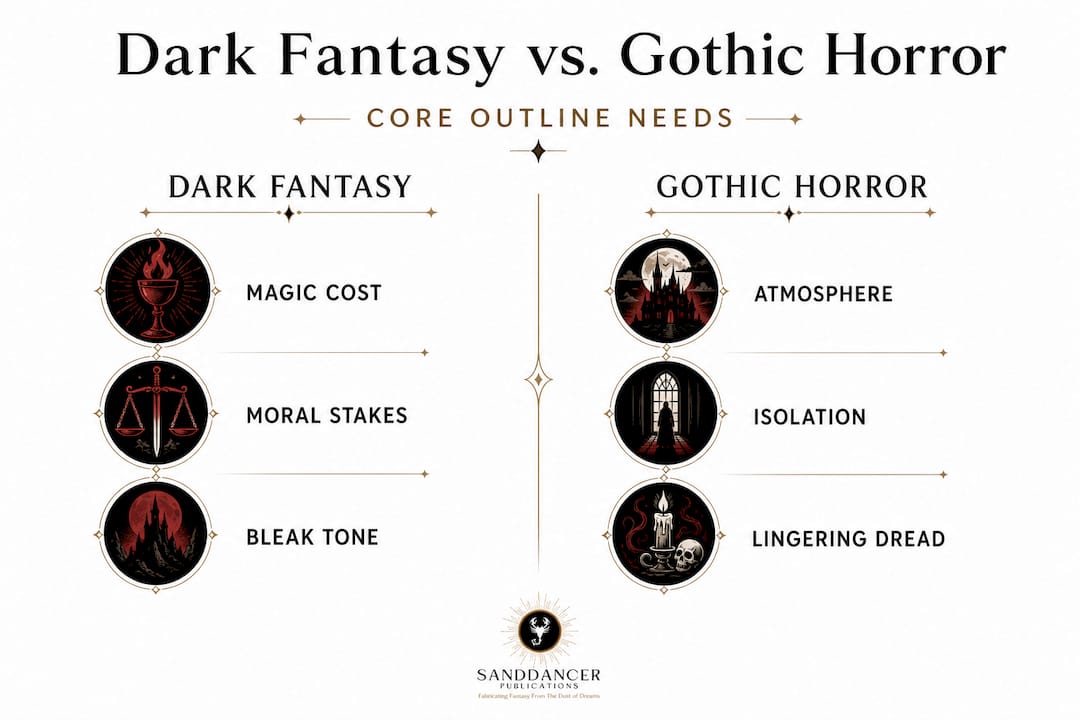
The difference in how setting and atmosphere function in horror versus adventure fantasy is enormous. In horror, atmosphere IS plot. In adventure fantasy, setting is backdrop. Know which one you’re writing.
| Genre | Core Outline Priority | Emotional Tone |
|---|---|---|
| Dark fantasy | Magic cost, moral stakes | Bleak, haunting |
| Gothic horror | Atmosphere, psychology | Dread, melancholy |
| Urban fantasy | Dual worlds, secret societies | Tension, mystery |
Pro Tip: Write your vision statement before opening any software. One sentence, present tense, naming your protagonist, their core conflict, and the emotional feeling you want readers to have when they close the book. Pin it above your desk. Seriously.
Step-by-Step Outlining Framework for Fantasy Novels
With your vision established, you’re ready to map out your fantasy novel step by step. Here’s how.
Start with your premise and theme. These are not the same thing. Your premise is the situation: a disgraced witch discovers her murdered mentor hid a forbidden spell inside her memory. Your theme is the question underneath: what do we owe the dead? Once both are clear, you have a heartbeat for your story.
Next, outline your world-building essentials. This is where the worldbuilding process gets interesting. You don’t need to build the entire world right now. You need the parts that touch your plot: the magic system and its rules, the geography your characters move through, the cultural tensions that create conflict, and the history that haunts the present. Write these as brief bullet notes, not encyclopedia entries. An outline is not a wiki.
Then move into character arcs. Outline your protagonist’s internal arc alongside the external plot. In dark fantasy, these two arcs often mirror each other in painful ways. Your antagonist needs their own outlined motivation. Supporting characters need clear roles that serve the story’s emotional spine.

Now choose your narrative structure. Specialized methods include the Hourglass Method, which is great for stories with strong central concepts that need to narrow before they can expand again. The Snowflake Method starts with a one-sentence summary and expands outward, like a crystal forming, layer by layer. The classic three-act structure works well when your story has a clear turning point at the midpoint. The Hero’s Journey maps beautifully onto fantasy but can feel formulaic if you’re not actively subverting it.
A Plot Grid (a table tracking each subplot across your story beats) is genuinely one of the most useful tools for complex fantasy, where three storylines are running at once and you need to know when each one surfaces and how it intersects with the others.
The horror outlining approach offers a great reminder that every scene in horror needs to carry a specific emotional promise to the reader. Dark fantasy benefits from that same discipline.
| Method | Best For | Core Strength |
|---|---|---|
| Hourglass | Strong concept, converging arcs | Controlled tension |
| Snowflake | Writers who love detail | Organic expansion |
| Three-act | Clean turning points | Clear momentum |
| Plot Grid | Multi-subplot tracking | Arc visibility |
Pro Tip: Create a simple scene chart with three columns: scene number, external event, and emotional stakes. Even ten scenes mapped this way will reveal where your tension is thin before you draft a single word.
Adapting Your Outline for Dark, Gothic, and Urban Fantasy
With your outline structure in place, let’s customize your approach for your chosen fantasy subgenre.
Dark fantasy demands that you build the cost of power directly into your outline. If your magic system exists, your outline should track what using it takes from your protagonist, not just physically but emotionally and morally. This is where dark fantasy conflict becomes structural rather than decorative. Every plot point should carry the weight of a choice that could go wrong in multiple directions.
Gothic horror is a different beast. Your outline needs atmosphere as a structural element. When you’re planning scenes, ask yourself: what is the feeling of this location, and how does it reflect or contradict the character’s psychological state? The haunted house that mirrors the protagonist’s fractured grief is not an accident; it’s a deliberate outline decision. Check out our gothic fantasy tips for detailed guidance on this layering technique. The best gothic writers also outline their mysteries with the ending already known, working backward so every clue and atmospheric detail earns its place.
Urban fantasy has a wonderfully specific set of demands. Urban fantasy requires outlining a hidden magical underworld inside a real contemporary city, complete with secret society mechanics, species politics, neutral grounds, and a protagonist who is genuinely torn between their mundane world and magical obligations. Your outline needs to track both worlds separately and then show where they collide. Mystery plot structure works well here, because the villain’s agency drives the external plot while the protagonist’s personal stakes drive the internal one.
One angle we see writers miss a lot is the masquerade element, meaning the set of rules that keep the magical world secret. Your outline should track how those rules create pressure and where they might break down. That tension is pure story gold.
“Every scene in a genre-adapted fantasy should carry both an external conflict and an internal emotional promise. When those two things are pointing in different directions, you’ve found your most powerful story moment.”
Understanding urban legends in fantasy is genuinely helpful when crafting urban fantasy lore because readers already carry emotional weight around those myths. Tapping into that is smart outlining. Also, spend time with our gothic fantasy themes guide to understand which thematic patterns your readers expect and where you can subvert them meaningfully.
Pro Tip: For every major plot point in your outline, ask: “What emotional promise does this scene make to the reader, and which character’s wound does it press?” If you can’t answer both questions, the scene may not be pulling its full weight.
Avoiding Common Outlining Pitfalls and Keeping Your Outline Flexible
Now that you’ve adapted your outline to your genre, let’s cover the mistakes to avoid and how to stay agile during drafting.
The plotter versus pantser debate is especially loud in fantasy writing communities, and honestly, both camps make fair points. Detailed outlines manage fantasy complexity better than pure instinct when you’re dealing with multiple magic systems, political factions, and non-linear timelines. But rigid outlines can kill the creative sparks that make dark fantasy feel alive and surprising. The sweet spot, which most experienced genre writers land on eventually, is a flexible outline: your major beats are locked, but scene-level details are suggestions, not commands.
The most common pitfall we see is excessive world-building at the outline stage. It feels productive. You’re technically working on your novel. But spending three weeks building a complete cosmological history that appears in one paragraph of chapter fourteen is not outlining; it is very creative procrastination. Keep your outline’s world-building section focused strictly on what your characters will encounter in this story.
Over-complication is the other major trap, especially in world-heavy genres. If your outline has more moving parts than your story can support in a single reading, something needs to go. Trim subplots that don’t connect to your central theme. Cut characters whose arcs don’t intersect with the protagonist’s core journey.
Staying flexible during drafting is a real skill. One practical method is to maintain two versions of your outline: the original and a running updated version that reflects what you’ve actually written. When you discover in chapter eight that your antagonist has better motivations than you originally planned, you update the running version without erasing your original intention. It’s how editing gothic outlines becomes a natural part of the process rather than a crisis.
Troubleshooting horror outlines often comes down to one question: where is the dread accumulating, and where is it leaking out? Apply that same question to your dark fantasy outline.
Pro Tip: Keep a “change log” document alongside your outline. Every time you deviate from the original plan during drafting, note why. This makes revision infinitely easier and helps you spot patterns in how your story wants to evolve.
Reviewing, Verifying, and Finalizing Your Fantasy Outline
Once your outline is flexible and genre-adapted, finish the process by ensuring readiness for the drafting phase.
A good outline review is structured, not vague. Go scene by scene and ask four questions: Does this scene raise or resolve stakes? Does it advance at least one character arc? Does it connect to the central theme? And does it earn its place in the pacing? These four questions, applied honestly, will surface any weak spots before they cost you three drafting weeks.
The core steps for reviewing for flow and stakes remind us that foreshadowing and theme resonance should be checked during this stage, not as an afterthought in revision. Read your outline aloud, or better yet, summarize it to a writing partner or beta reader. If they can’t follow the emotional logic of your protagonist’s arc, your readers definitely won’t. Writing groups are genuinely useful at this stage because other genre writers can spot clichés and missed opportunities that you’re too close to see.
The review of fantasy lore is a specific step worth including here. Read through every lore element in your outline and ask whether it serves the story’s emotional core or just decorates it. The themes in fantasy outlining process shows that the strongest stories carry thematic resonance in even their smallest world-building details.
Finally, save your completed outline as a version-controlled document. Give it a date. You’ll thank yourself during revision when you need to remember what you originally intended for that subplot you changed in chapter six.
Pro Tip: Do one final “emotional arc pass” through your finished outline. Read only the internal character beats, ignoring all external plot points. If your protagonist’s emotional journey makes sense as a standalone story, your outline is ready.
Why Most Fantasy Outlining Advice Misses the Emotional Stakes
After mapping your outline, consider a perspective that elevates your story above structure alone.
Here’s the thing we’ve noticed after reading mountains of outlining advice: most of it is secretly about logistics. Scene order, word count targets, magic system rules, map-making. All useful. None of it explains why some dark fantasy novels haunt you for years while others, technically perfect in structure, fade from memory within days.
The missing ingredient is almost always emotional stakes built into the outline from the start, not added in revision. We’re talking about the moment in your outline where your protagonist doesn’t just face a plot obstacle, they face a version of themselves they’re terrified to become. That’s not a structural beat. That’s fantasy conflict advice at the deepest level, the kind that requires you to know your character’s wound before you know their destination.
The contrarian view we want to offer: stop outlining your magic system before you’ve outlined your character’s needs. The magic system is only interesting to readers when it costs something the character can’t afford to lose. Power dynamics, sacrifice, and desire are the real architecture of dark fantasy. World-building is the wallpaper. Brilliant wallpaper, sure, but wallpaper.
Successful gothic horror and dark fantasy writers often work with what we’d call “unresolved emotional contracts,” meaning promises made to the reader early that the story keeps circling back to but refuses to easily resolve. Outline for those. Build them deliberately. That unresolved tension is what keeps readers up past midnight.
Explore Dark, Gothic, and Urban Fantasy Stories and Outlining Resources
If you’ve made it this far, you’ve got a genuinely solid foundation for outlining your dark fantasy, gothic horror, or urban fantasy novel. And we’d love to keep that momentum going with you. 🖤

At SandDancer Publications, we’ve built a home for exactly this kind of fiction, award-winning, atmospheric, unapologetically dark. Our catalog includes the Gothika series alongside other urban and dark fantasy ebooks that function as living examples of everything we’ve talked about here: emotional stakes, layered world-building, and outlines that clearly had teeth. Browse our ebook collection for stories that show these techniques in action, and sign up for our newsletter where we share ongoing writing tips rooted in real genre experience. Your outline is ready to become something unforgettable.
Frequently Asked Questions
What is the best outlining method for dark fantasy novels?
Both the Hourglass and Snowflake Methods work well for dark fantasy, but prioritize whichever one emphasizes emotional conflict and multi-directional tension over pure structural mechanics.
How much world-building is too much for fantasy outlines?
World-building risks analysis paralysis when it exceeds what your plot and character arcs actually need; limit your outline’s lore to elements that directly shape the story your readers will experience.
What makes urban fantasy outlines unique?
Urban fantasy outlines require a carefully tracked dual-world structure including hidden magic, secret societies, species politics, and a protagonist whose personal stakes tie directly to both worlds colliding.
Should I outline or write by instinct (pantsing) for fantasy novels?
Outlining manages fantasy complexity far better than pure pantsing when multiple magic systems and subplots are involved, but a hybrid approach, locked major beats with flexible scene details, tends to give writers the best of both.
Recommended
- Essential Tips for Writing a Dark Fantasy Novel with Gothic Flair – SandDancer Books
- How to Edit Dark Fantasy Manuscripts for Vivid Gothic Storytelling – SandDancer Books
- How to Build Immersive Dark Fantasy Settings That Haunt – SandDancer Books
- Step-by-Step Guide to Inclusive Dark Fantasy Storytelling – SandDancer Books