

How to plot epic fantasy: Your step-by-step dark fantasy guide
TL;DR:
- Effective epic fantasy plotting relies on choosing a flexible macro structure like the Hero’s Journey or three-act, then layering gothic atmosphere and escalating stakes to maintain tension. Starting from a core “spark,” writers should define their character’s goal, build obstacles, and engineer a surprising yet inevitable climax while embracing discovery beyond the outline. Balancing structure with artistic freedom ensures a story that resonates emotionally, especially when integrating gothic and dark fantasy elements throughout each act.
You’re somewhere around chapter twelve. Your protagonist has crossed the first threshold, your world is vivid and strange, and your villain is deliciously wicked. Then it happens. The plot just… stops moving. You keep writing scenes, but nothing feels like it’s building toward anything. The stakes feel muddy. The tension keeps slipping through your fingers. Sound familiar? We’ve been there. Plotting epic fantasy, especially when you’re weaving in dark, gothic, or horror-adjacent elements, is genuinely hard. But with a clear structure and some genre-specific tools, you can get your story moving again and keep it moving all the way to a satisfying, haunting conclusion.
Key Takeaways
| Point | Details |
|---|---|
| Macro structure is essential | A foundational story framework helps organize epic plots while allowing for genre customizations. |
| Escalate both world and personal stakes | Make plot twists affect its characters’ inner lives, not just the fate of the world. |
| Sustain tension with rising obstacles | Ensure your protagonist’s journey becomes more complex and challenging with each act. |
| Gothic mood needs subtlety | Slow reveals and unresolved mysteries create deeper dread than nonstop spectacle. |
| Use structure as a guide | Let your outline serve as helpful scaffolding, not a cage—adjust as your story grows. |
Understand the foundations: Story structure for epic fantasy
Every memorable epic fantasy novel, from the grimdark to the gothic, is built on a macro structure. A macro structure is basically the big skeletal shape of your story. The most common ones you’ll hear about are the Hero’s Journey (popularized by Joseph Campbell) and the classic three-act structure. There are others too, like the Dan Harmon Story Circle or the five-act structure, but these are the workhorses for a reason. They work. According to the epic fantasy plotting advice at Quill and Steel, epic fantasy plotting works best when you choose a macro structure and fill it with genre-appropriate beats.
Here’s a quick comparison to help you choose:
| Structure | Core Shape | Best for |
|---|---|---|
| Hero’s Journey | Call, threshold, ordeal, return | Quest-driven narratives |
| Three-act | Setup, confrontation, resolution | Character-focused arcs |
| Five-act | Exposition, rising action, climax, falling action, denouement | Multi-POV epics |
| Story Circle | 8-beat cycle from comfort to transformation | Psychological or gothic arcs |
Now, here’s where it gets fun for us dark fantasy folks. These structures aren’t straitjackets. They’re flexible narrative scaffolds you can dress in shadow and dread. The Hero’s Journey doesn’t have to end with a triumphant return. Your hero can come back broken, changed, or haunted. A three-act story doesn’t need a clean resolution if sustained unease serves the story better. That’s the gothic way.
When you’re working with plot structure for dark fantasy, think about layering a sense of slow dread onto whatever structure you choose. Gothic stories breathe differently. They simmer. The atmosphere itself becomes a structural element, building pressure even when the external plot seems quiet. Check out some dark fantasy plotting tips to get a feel for how tone and structure work together in this genre.
Pro Tip: Start with your “spark,” that one core image, emotion, or question that made you want to write this story, and then loosely map it onto your chosen structure. Don’t force it to fit perfectly right away. Just see where it naturally wants to land.
Step-by-step plotting: From idea spark to narrative engine
With the foundation of story structure in mind, let’s walk step-by-step through building your plot. This is the process we recommend, and it doesn’t require you to have everything figured out before you start writing.
Step 1: Name your spark. What’s the core emotional truth of your story? Fear of loss? Obsession? The price of power? This single idea will anchor every scene you write.
Step 2: Choose your macro structure. Pick one of the frameworks from the table above. Don’t agonize over it. You can always swap later. The goal is to give yourself a rough shape to work within.
Step 3: Define your character’s central goal. Not “save the world,” but something personal. What does your protagonist want more than anything, and why can’t they simply have it?
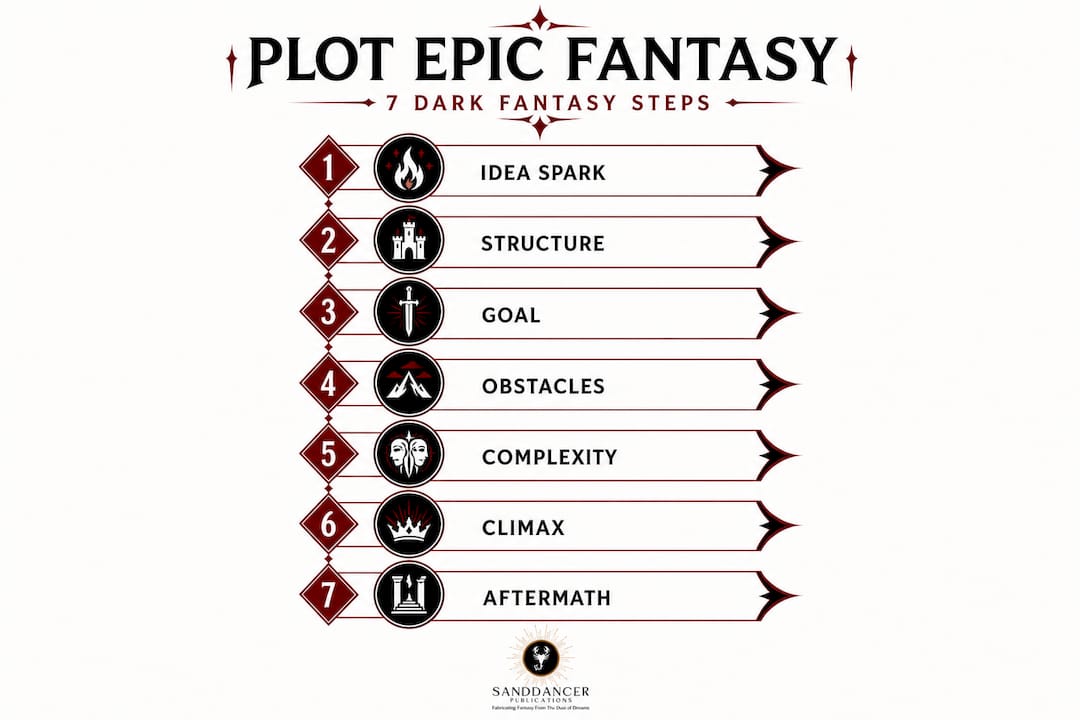
Step 4: Build your obstacles. Obstacles should escalate. Start with inconveniences and social friction, then move toward genuine danger, moral compromise, and irreversible loss.
Step 5: Escalate complexity. Each act should raise the emotional and external stakes. Introduce new information, new threats, and new internal conflicts that force your character to change.
Step 6: Engineer your climax. The climax should feel both surprising and inevitable. Your character must make a choice that costs something real. In dark fantasy, this often means a pyrrhic victory or a deeply ambiguous outcome.
Step 7: Write your aftermath. Don’t skip this. The aftermath is where the emotional weight of the story lands. It doesn’t need to be long, but it needs to feel true.
As the raising stakes advice from Sudowrite puts it, you should start from your spark, select a macro structure, and fill it with escalating stakes and character-driven beats. That’s the whole recipe, honestly.
Here’s a quick comparison of common plotting pitfalls and how to fix them:
| Pitfall | Solution |
|---|---|
| Stakes feel abstract or distant | Tie consequences directly to character relationships |
| Middle sags and loses momentum | Insert a major reversal or revelation at the midpoint |
| Villain feels like a plot device | Give the villain a personal connection to the protagonist’s flaw |
| Climax feels unearned | Foreshadow the key choice or sacrifice earlier in the story |
| World-building overshadows character | Let lore emerge through conflict, not exposition |
When you’re ready to build out your world’s history and magic systems alongside your plot, our guide on how to develop fantasy lore is a great companion resource. And if you’re writing stories that center diverse characters or experiences, our inclusive dark fantasy plotting guide will give you tools for doing that with real depth. Don’t forget to weave in gothic elements in plotting at every stage, not just during atmospheric scenes, but as structural and thematic features that run through the whole story.
Pro Tip: Tie your escalating external threats to your character’s internal or spiritual wounds. When the world outside mirrors the chaos inside, readers feel it in their bones. That’s what makes dark fantasy so emotionally powerful.
Raise the stakes: Building tension and sustaining momentum
Once you’ve outlined your major plot points, the real art of epic fantasy is keeping momentum strong throughout. This is where a lot of otherwise solid stories break down. The beginning crackles with energy. The ending lands hard. But somewhere in the long middle, readers check out. Here’s how to make sure that doesn’t happen to your story.
According to the research at Sudowrite, continuous escalation through failed plans, villain wins, and ever-increasing complexity is what keeps pacing strong throughout a long novel. That means you can’t let your hero coast. Every time they make a plan, something should complicate it. Not every plan fails completely, but every success should come with a cost.
Here are the core tactics we rely on for building tension across a long story:
Failed plans and partial victories. Your protagonist succeeds, but loses something important in the process. A friend is captured. A magical resource is depleted. A relationship fractures. Bittersweet progress is more interesting than clean wins.
Villain victories. Let your antagonist actually win sometimes. Not just temporarily inconvenience the hero, but genuinely set them back. This makes the villain credible and the conflict feel real.
Compounding mysteries. Every answer should open two new questions. In gothic dark fantasy, this is especially effective because unanswered questions generate dread. The reader’s imagination fills the gaps, and it’s almost always scarier than what you’d spell out.
Shifting alliances. Who can your protagonist trust? Loyalty that gets tested or betrayed creates emotional stakes that run parallel to external conflict.
“The real risk isn’t losing the battle. It’s becoming someone unrecognizable by the time you win the war.”
That’s the kind of internal dilemma that makes epic fantasy sing. When your character’s external struggle mirrors an internal one, every plot event carries twice the weight. For deeper craft advice on this, check out our post on building epic conflict that stays with readers long after they close the book.
One thing we want to flag: don’t fall into the trap of making “the fate of the world” your only stake. World-ending threats are fine, but they’re actually hard for readers to feel emotionally. Personal stakes, a specific person who might die, a value the hero has to sacrifice, a relationship that can’t survive the choices being made, these hit harder. Combine both and you’ve got something genuinely gripping. Your setting can carry a lot of this emotional weight too, so don’t underestimate setting-driven suspense as a plotting tool.
Infusing gothic and dark fantasy elements
After mastering escalation and tension, you’ll want to make sure your dark and gothic elements shine in every act. This is where your story stops being a generic fantasy and becomes something genuinely unsettling and memorable.

Gothic fiction has a specific toolkit, and the good news is it meshes beautifully with epic fantasy structures. Here’s how to weave these elements throughout your plot:
Atmosphere as a structural force. Gothic mood isn’t decoration. It signals to the reader that the world itself is unreliable. Use setting, weather, and architecture to create a persistent sense of wrongness even in quiet scenes.
Moral ambiguity in every act. Your protagonist shouldn’t always know if they’re making the right choice. Dark fantasy lives in the gray zone. Structure your plot so that the hero’s victories raise ethical questions, not just resolve them.
Psychological complexity. Let your characters carry real trauma, obsession, or guilt that shapes their decisions. These internal forces should influence the plot directly, not just flavor the narration.
Slow revelation over shock. As the craft advice at Dark Skies Film puts it, the best gothic stories build unease through slow revelation and unanswered questions rather than constant spectacle. Jump scares and shock moments get used up fast. Sustained dread is far more effective, and far harder to shake.
Parallel spiritual and external arcs. In the best dark fantasy, the protagonist’s internal spiritual or psychological journey mirrors the world’s external crisis. When your hero’s loss of faith coincides with a world slipping into darkness, the reader feels it on every level.
Pro Tip: Plan at least one slow-burn mystery or revelation per act. Not every mystery needs to be solved. In fact, some of the most powerful gothic endings leave a question open, something that lingers in the reader’s mind long after the book is finished.
The gothic mood you’re building should also shape your pacing choices. If you’re writing in a slower, more atmospheric register, your chapter breaks, scene transitions, and dialogue rhythms all change. For hands-on help with this, our guide to editing for gothic tone walks through exactly how to adjust your prose to match the mood you’re building.
Why structure matters—but shouldn’t limit your discovery
Now that you have a system, it’s time to question it a little. Here’s what years of dark fantasy plotting have taught us about structure and artistic freedom: the writers who produce the most memorable epic fantasy are the ones who use structure as a launching pad, not a landing strip.
Structure gives you a safety net. It means you’re never completely lost. When you’re forty thousand words in and you can’t find the thread, a solid macro structure tells you roughly where you should be and what needs to happen next. That’s genuinely invaluable. But it can also trick you into following the outline even when your characters are telling you something else entirely.
The best plots we’ve seen, and the best ones we’ve written, emerged from a conversation between planning and discovery. You plan, you write, a character does something unexpected, and suddenly you realize the outline needs to change because what just happened is more true than what you planned. That’s not a failure. That’s your story finding its own voice.
As the Hero’s Journey framework reminds us, narrative structure works best as a tool, not a shackle. Use beats as flexible support. Let them guide you, but don’t let them boss you around.
Formulaic plotting asks: “What should happen next according to the structure?” Organic narrative growth asks: “What does this character, in this moment, have to do?” The second question almost always produces better fiction.
If your story demands that you break your outline, break it. The outline exists to serve the story, not the other way around. For more on developing your own instincts for this balance, our post on writing dark fantasy is full of perspective from writers who’ve wrestled with exactly this question.
Ready to write your epic? Discover more dark fantasy guides and stories
Once you’ve plotted your own story, these curated stories and guides will help fuel your imagination and sharpen your skills. Reading widely in your genre is one of the most practical things you can do as a writer, and reading excellent dark fantasy is even better.

If you want to see gothic dark fantasy plotting done with real craft, check out Blood Tithe, the second novel in our Gothika series. It’s a masterclass in escalating personal and world-level stakes while keeping the gothic atmosphere thick and suffocating. If you’re newer to the series, Raise the Dead is the place to start, and it shows exactly how to hook a reader in the first act and never let them go. And if you’re not quite ready to commit, we’ve got free gothic fantasy ebooks available to read right now. Dive in, see how the pros do it, and let it fire up your own plotting instincts.
Frequently asked questions
What is the best structure for plotting an epic fantasy novel?
Macro structures like Hero’s Journey or three-act drive most successful epic fantasy novels, and they can be flexibly adapted to fit dark, gothic, or morally complex genre needs.
How can I keep readers engaged in a long epic fantasy story?
Escalate complexity and stakes each scene by giving characters failures, partial victories, and new dilemmas that continuously raise the emotional and narrative pressure.
How do I add gothic atmosphere to my epic fantasy plot?
Build unease with slow revelation and leave some questions deliberately unresolved, letting the reader’s imagination generate dread more effectively than any explicit shock moment could.
Should I stick to my plot outline while writing?
Use your outline as a flexible guide, and treat structure as a tool, not a strict rulebook, adjusting whenever your characters or themes reveal a more compelling direction.
Recommended
- Step-by-Step Guide to Inclusive Dark Fantasy Storytelling – SandDancer Books
- How to edit dark fantasy manuscripts for vivid gothic storytelling – SandDancer Books
- Essential Tips for Writing a Dark Fantasy Novel with Gothic Flair – SandDancer Books
- How to Build Immersive Dark Fantasy Settings That Haunt – SandDancer Books