

Craft compelling female leads in dark fantasy fiction
TL;DR:
- Writing a compelling female protagonist in dark fantasy requires emphasizing her agency, genuine flaws, and emotional depth to create a relatable character. Balancing internal conflicts and genre-specific traits ensures she feels authentic within gothic or urban settings, avoiding stereotypes. Regularly testing her actions and relationships helps refine her multidimensionality, ensuring she drives the story with authenticity and complexity.
Writing a female protagonist in dark fantasy sounds straightforward until you actually try it, and then suddenly your fierce, complicated heroine starts doing whatever the plot needs her to do instead of whatever she would actually do. We’ve seen it happen, and honestly, we’ve done it ourselves. The good news is that the difference between a flat female lead and one readers genuinely root for comes down to a handful of craft decisions made early and consistently. This guide walks you through those decisions, from building genuine agency all the way to genre-specific techniques for gothic and urban fantasy.
Key Takeaways
| Point | Details |
|---|---|
| Agency drives impact | Female leads must make choices that actively affect the story, not just react to events. |
| Avoid surface clichés | True strength includes vulnerability, growth and emotional nuance, not just physical prowess. |
| Genre shapes character | Gothic and urban fantasy offer rich terrain for tormented pasts and morally complex stakes. |
| Refine through testing | Validate your female lead’s appeal by seeking feedback and reviewing her agency and flaws. |
Clarifying agency and motivation: Where strong female leads begin
Agency is the single most important quality a female protagonist can have, and it’s also the quality that gets quietly strangled first. Agency means she makes choices that drive the plot forward, not choices that simply respond to what the villain or love interest just did. When you look back at your draft and realize your heroine has been reacting to other people’s decisions for three chapters straight, that’s your signal something has gone sideways.
Here’s how active and reactive roles actually look in practice. An active lead decides to infiltrate the necromancer’s tower because she needs answers about her stolen memories. A reactive lead gets dragged into the necromancer’s tower because her friend was kidnapped and she has to go. Both scenarios can work, but the second one only works if she is the one who decides to act, not just the one who gets swept along. The distinction is subtle and incredibly easy to blur, especially when you’re deep in a plot that has a lot of moving parts.
Before you write a single chapter, sit down and answer these questions about your character. What does she want above everything else? What is she terrified of? What mistake from her past still follows her around? What lie does she tell herself? Build from internal motivations and genuine flaws because those are the raw materials of every real decision she makes in the story. Strength here means emotional resilience as much as any ability to swing a sword.
The other thing we’d strongly recommend checking out early on is our writing dark fantasy tips resource, which goes deeper into building the tonal and atmospheric framework that makes these character decisions land with weight. A motivated, agentic heroine in a thin world still feels hollow. You need both.
Pro Tip: Run what we privately call the “plot puppet test.” Cover your character’s name throughout a pivotal scene and ask whether any other character could make the exact same choices without changing the story. If the answer is yes, your heroine isn’t driving that scene. She’s just filling a role.
The comparison between an active and a reactive character is worth looking at side by side.
| Quality | Active female lead | Reactive female lead |
|---|---|---|
| Decision making | Initiates action based on goals | Responds to others’ actions |
| Story impact | Her choices create plot events | Plot events happen to her |
| Reader connection | Readers understand her reasoning | Readers watch her get moved around |
| Emotional stakes | Personal investment in outcomes | Obligation or circumstance |
That table is not a judgment, by the way. Reactive moments happen to every character. The goal is that active choices outnumber reactive ones across the arc.
Building multidimensionality: Beyond stereotypes and surface strength
Here’s the thing about the “strong female lead” label: it has almost eaten itself. Somewhere along the way, strong started meaning stoic, physically tough, romantically unavailable, and vaguely contemptuous of softness. That is not a three-dimensional person. That is a costume.
Avoiding stereotypes means more than not making her purely sexy or purely tough. It means giving her vulnerabilities that actually cost her something, a support network she both relies on and sometimes fails, and a growth arc that genuinely changes her rather than just confirming she was right all along. Vulnerability is not weakness. In dark fantasy especially, a character who feels real fear, real grief, or real longing is infinitely more compelling than one who stares into the abyss with a smirk.
Strength in a female protagonist is not the absence of softness. It is the presence of honesty, including honesty about fear, loss, and the moments she falls apart.
Think about the specific fears that make your heroine human. Maybe she’s terrified of becoming her mother. Maybe she trusts too easily or not at all, and she knows it, and she does it anyway. Maybe she’s brilliant at strategy and terrible at apology. Those are the textures that make readers feel like they know someone. For deeper context on building that kind of inclusive dark fantasy storytelling into your narrative, it’s worth thinking carefully about whose experiences you’re drawing from and how broadly your character’s emotional world is imagined.
The networks of support angle is one that gets skipped constantly. Your heroine having friends, mentors, complicated family members, or even reluctant allies is not a sign of weakness. It’s a sign she lives in a real world with other people in it. And those relationships are where your richest dark fantasy conflict often lives, not in the big battle but in the quiet scene where she has to ask for help and hates every second of it.

Pro Tip: Once you have a draft, hand the first few chapters to a beta reader with one specific question: “Does this character ever feel forced or convenient?” Not “is she likeable” or “is she strong.” Forced and convenient are the things that break immersion, and other readers catch them faster than we do.
Genre mastery: Writing female leads for gothic and urban fantasy
Gothic fantasy and urban fantasy are cousins who were raised in very different houses. Understanding what each genre asks of your female lead is how you make her feel native to the world you’re building.
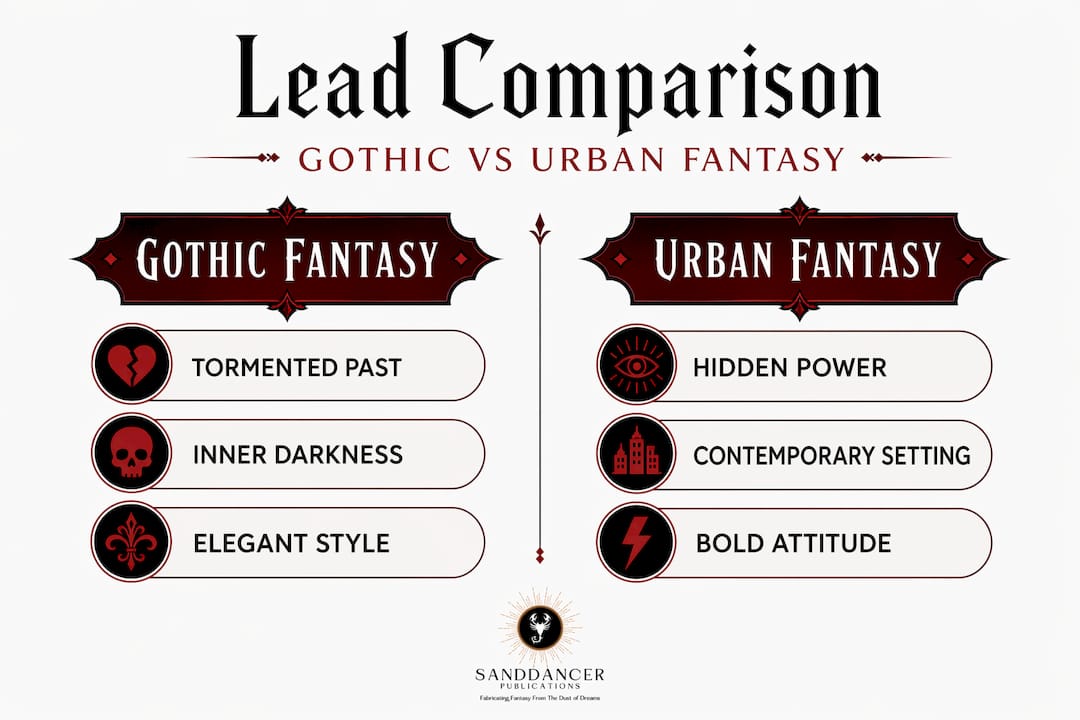
In gothic fantasy, the female gothic legacy runs deep. Gothic heroines are often defined by tormented pasts, internal conflicts that mirror or echo the supernatural threat, and what you might call Byronic traits: brooding, passionate, morally complicated. The chiaroscuro effect, meaning that sharp contrast between light and shadow, applies to character as much as setting. Your gothic heroine should have a brilliant or powerful side that exists in direct tension with something shadowed or destructive in her. She may be unreliable in her own narration. She may desire things that frighten her. That tension is the engine of gothic storytelling. Embrace it rather than resolve it too neatly.
For practical guidance on threading gothic fantasy themes through your character work, we’ve got a guide that breaks down the major conventions and how to use them without falling into parody.
Urban fantasy works differently. The settings are contemporary and grounded, which means the supernatural intrudes on a world the reader already knows. That context puts extra pressure on your female lead to feel genuinely modern. The badass urban fantasy trope where she’s a leather-wearing, quip-slinging fighter with a mysterious past has become so familiar that it often reads as noise rather than characterization. The freshest urban fantasy leads are often non-fighters or reluctant fighters. They win through knowledge, negotiation, emotional intelligence, or sheer stubbornness. Their stakes are personal: family, home, identity, community. The hidden magical world doesn’t just threaten the city; it threatens her specifically, in ways tied to who she is.
| Feature | Gothic fantasy lead | Urban fantasy lead |
|---|---|---|
| Core tension | Internal darkness vs. desire | Hidden world vs. personal life |
| Key trait | Byronic, tormented, unreliable | Resourceful, morally complex |
| Setting relationship | Mirrors her psychological state | Invades her real-world stakes |
| Common pitfall | Over-romanticizing the darkness | Defaulting to “badass” archetype |
| Emotional register | Cathartic, intense, melancholic | Grounded, urgent, scrappy |
Your worldbuilding choices feed directly into how your lead operates, too. A dark fantasy setting that feels genuinely alive gives your heroine real things to interact with, real textures to push against, and real consequences to her decisions. Character and world are not separate projects.
Verifying depth and appeal: How to test and refine your female lead
You’ve built her from motivations up. You’ve given her flaws that cost her things, relationships that complicate her, and genre-specific qualities that make her feel native to your story. Now comes the part where you poke at her to make sure she holds.
First, go back through major plot points and identify who initiated each one. If someone else initiated more than half of them and she simply responded, flag those moments. Look at whether a revision could shift the initiation to her without breaking the plot logic.
Second, pick her most emotionally intense scene and ask whether her response in that scene is consistent with her deepest fear or her most fundamental desire. Characters who feel real react from their core wounds, not from narrative convenience. If her behavior in that scene could belong to any stressed person rather than specifically her, revise until it couldn’t.
Third, check her relationships. Does she have at least one person she genuinely trusts? Does she have at least one relationship that challenges or complicates her worldview? Isolated protagonists can work, but total isolation often signals a character who exists in a vacuum rather than a world.
Fourth, read her dialogue out loud, just hers, in sequence. Does it sound like one person? Can you hear her particular rhythm, her favored deflections, the things she says when she’s uncomfortable? Voice consistency is one of the most effective tests for whether a character is real or assembled from parts.
Fifth and finally, ask whether you like her as a person. Not whether she’s good or moral or even kind. Whether she’s interesting company. You’re going to spend a long time with her. She should be someone you’d want to have a very long, probably tense conversation with over a cup of something strong.
Editing your gothic fantasy manuscript with fresh eyes specifically for character consistency is something we’d recommend doing as a dedicated pass, separate from your prose or pacing edits. It keeps the focus sharp.
True success, as any honest guide to female protagonists will tell you, doesn’t come from hitting a checklist. It comes from writing a relatable, agentic human being and trusting that her humanity will carry the story.
Pro Tip: Create a one-page character document that you keep open while you draft. Not a full character bible, just her core want, her core fear, her defining mistake, and her voice. When a scene feels off, check it against that page before you change anything else.
What most writing advice misses about female leads in fantasy
Here’s our honest, slightly uncomfortable take: most writing advice about female protagonists is still too focused on avoiding criticism rather than creating connection. The conversation tends to center on “don’t make her weak, don’t make her a cliché, don’t do this, don’t do that” without spending nearly enough time on what you should be actively building toward.
What you’re building toward is catharsis. Especially in gothic and urban fantasy, your female lead exists to take readers somewhere they can feel things they don’t normally let themselves feel. Anger. Grief. Desire. The specific kind of longing that comes from wanting something you were told you shouldn’t want. Gothic fiction in particular has always been a space where women’s interior lives get permission to be big and unruly and dark, and that’s a genuinely radical thing when it’s done well. We talk about this more in our gothic storytelling advice guide, and it’s worth reading if you want to understand the tradition you’re writing into.
The uncomfortable truth is that the most memorable female leads in dark fantasy are the ones who make readers slightly uncomfortable. Not in an exploitative way. In the way where you finish a chapter and think, “Oh, I understood her too well just then.” She conventions not because the plot tells her to be unconventional, but because her specific humanity leads her somewhere unexpected. That’s the goal. Not a perfect feminist icon. Not a flawless fighter. A real, complicated woman who could only exist in exactly this story.
Explore dark fantasy leads and guidance from SandDancer Books
If you’re hungry to see multidimensional female leads in action alongside craft guides that actually dig into the dark stuff, we’ve got you covered. At SandDancer Publications, we publish dark fantasy, gothic horror, and urban fantasy ebooks built around exactly the kind of complex, morally layered characters we’ve been talking about here.

Take a look at Blood Tithe for gothic tension done with real depth, or check out House of Cards for an urban fantasy read that avoids every cliché we warned you about. If you’d rather start exploring before you commit, we have free ebooks you can read right now. Come see what female leads in dark fantasy can look like when the craft is genuinely honored.
Frequently asked questions
How do I avoid creating cliché female protagonists in fantasy?
Skip the “tough and sexy” shorthand and focus instead on genuine flaws, emotional complexity, and a network of relationships that challenge her. Avoiding stereotypes means building a character whose humanity is more interesting than her surface traits.
What makes a female lead compelling in gothic or urban fantasy?
Gothic leads thrive with Byronic traits and tormented pasts and work best when their inner darkness mirrors the external supernatural threat. Urban fantasy leads become compelling through personal stakes and moral ambiguity rather than badass fighter tropes.
Are there empirical rules for successful female fantasy leads?
No fixed formula exists. The most honest guidance confirms that success comes from relatable, agentic characters rather than meeting a predefined checklist of traits or attributes.
How can I test if my female lead is multidimensional?
Review her choices throughout the story and confirm that her actions drive the plot forward in ways that could only belong to her specifically, then gather feedback from beta readers on whether any moments felt forced or convenient.
Recommended
- Essential Tips for Writing a Dark Fantasy Novel with Gothic Flair – SandDancer Books
- Craft dark fantasy conflict that haunts your readers – SandDancer Books
- Step-by-Step Guide to Inclusive Dark Fantasy Storytelling – SandDancer Books
- Craft romantasy plot structure for dark fantasy magic – SandDancer Books