

How to write adventure scenes for dark fantasy writers
TL;DR:
- Effective dark fantasy adventure scenes feature a protagonist with immediate goals fighting against an active, threatening world. They rely on escalating conflict, atmospheric setting, and deliberate pacing to build suspense and emotional engagement. Many scenes fail due to passivity, premature resolution, or exposition intruding on action, which can be rectified by ensuring internal conflict, stakes growth, and immersive sensory details.
Adventure scenes are where dark fantasy lives or dies. You can build the most haunting gothic world imaginable, populate it with morally complex characters, and still watch your story stall the moment your protagonist needs to do something dangerous. Knowing how to write adventure scenes that feel genuinely tense, atmospheric, and purposeful is one of the hardest skills in our genre, and honestly, most writing guides gloss right over the parts that matter most. We’re going to fix that here.
Key Takeaways
| Point | Details |
|---|---|
| Stakes-threat-uncertainty | Effective adventure scenes clarify and escalate stakes, credible threats, and uncertainty to maintain suspense. |
| Obstacle-driven scenes | Every scene should present obstacles forcing protagonist adaptation, or it risks feeling passive. |
| Balanced pacing | Mix fast, punchy action with slower, atmospheric moments to sustain reader engagement. |
| Grounding magic realistically | Integrate magical elements subtly within mundane settings to preserve urban fantasy tension. |
| Avoid info dumps | Reveal worldbuilding through character actions and conflict instead of exposition. |
What makes a gripping adventure scene in dark fantasy?
Every adventure scene in dark fantasy needs one thing above everything else: a protagonist who wants something and a world that actively fights back. That sounds simple. It is not. The mistake most of us made early on (and we include ourselves here) was writing scenes where things happened but nothing was truly at stake. Characters moved through fog-soaked corridors, traded ominous dialogue, and generally looked cool. But readers could sense the scene wasn’t going anywhere.
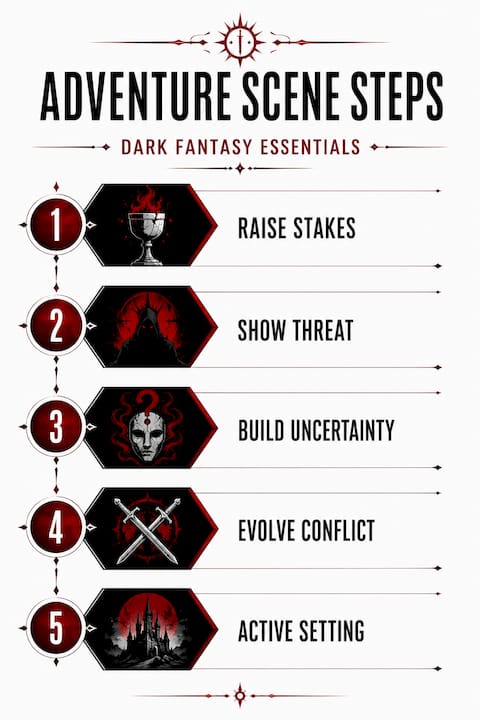
The real engine of any effective adventure scene is what we call the stakes-threat-uncertainty triangle. Every beat needs to clarify at least one corner of that triangle. The stakes-threat-uncertainty triangle keeps readers engaged because they always feel the outcome is genuinely uncertain. When your protagonist is chasing a blood witch through a flooded cathedral, we should feel what she stands to lose, what the witch can do to stop her, and whether this ends well for anyone. All three, ideally in the same scene.
Conflict must also evolve. An adventure scene that begins and ends with the same problem is a summary, not a scene. Every obstacle-driven scene should raise the stakes or complicate the protagonist’s goal by the final line. If your vampire hunter enters a crypt looking for one creature and finds a nest of them, the exit of that scene looks nothing like the entrance. That evolution is what creates forward momentum in dark fantasy conflict.
Gothic and urban fantasy settings are a massive asset here, but only if you use them actively. The setting should function like a secondary antagonist. Rain-slicked cobblestones make running harder. Crumbling architecture blocks escape routes. Gas lamp shadows hide things that shouldn’t be there. Setting shapes atmosphere in ways that mechanical plot beats simply can’t replicate, and when you make the environment feel dangerous, the scene breathes. Check out our dark fantasy novel tips for more on building genre-specific tension from the ground up.
Preparing your story and setting for immersive adventure scenes
Before we talk about actually writing the scene, let’s talk about the work that happens before the first word. This is prep work, and skipping it is a little like sprinting before you know where the finish line is.
First, lock down your protagonist’s goal for this specific scene. Not their arc goal. Their right now goal. “Survive the ambush” is a scene goal. “Defeat evil” is not. The clearer that immediate goal, the easier it becomes to generate obstacles, and obstacles are what build your adventure scene from the inside out.
Second, build your setting with sensory anchors rather than paragraphs of description. When your character steps into a scene set in an immersive dark fantasy setting, readers should smell the damp stone, feel the cold pressing against exposed skin, hear something that shouldn’t be moving. Those details don’t need to arrive all at once. Drop them through action and reaction, not inventory lists.
Third, if your story includes magic or supernatural elements, integrate them through character behavior rather than exposition. Urban fantasy works best when magic feels like a barely-contained secret rather than a system lecture. Show your mage pulling glamour over a wound before entering a crowded pub, not explaining how glamour works in a paragraph of internal monologue. This approach keeps tension intact and trusts your reader’s intelligence. For building out the underlying rules of your world in a way that supports scene work rather than sabotaging it, our guide on fantasy lore creation is worth a read.
Pro Tip: Write a one-sentence scene brief before drafting: “Character X wants Y, but Z stands in the way, and this changes because of W.” If you can’t fill in all four variables, your scene isn’t ready to write yet.
Writing adventure scenes that balance pacing and suspense
Pacing is the thing writers talk about constantly and practice the least. And in dark fantasy, getting pacing wrong is almost worse than having no conflict at all. Too fast, and the atmospheric dread you worked so hard to build evaporates. Too slow, and readers start checking the page count.

The cleanest tool we know for controlling pace is sentence length. Short sentences punch. They move. They land hard. Longer sentences, especially ones that linger on sound and sensation and the particular shade of gray in the sky before a storm, do something different. They make readers slow down, breathe, and feel the weight of a moment. Mixing both within the same scene is how you create rhythm. Fast-paced scenes balanced with sensory-rich slower beats prevent reader exhaustion, which is a real thing that happens in high-intensity fiction.
Within each scene, aim to include two to three conflict beats where your protagonist’s goal collides with something. Friction beats work best when each one is slightly worse than the last. The first obstacle redirects your character. The second threatens to stop them entirely. The third forces a sacrifice or unexpected choice. That escalating structure is what crafts thrilling narratives that feel earned rather than manufactured.
Here’s a quick look at how pacing tools map to scene goals:
| Scene goal | Pacing technique | Sentence style |
|---|---|---|
| High-action chase or fight | Short beats, rapid conflict | Clipped, 5-10 words |
| Building dread before a reveal | Sensory pauses, slowed breath | Long, layered, atmospheric |
| Character decision under pressure | Mixed rhythm, internal tension | Medium with short punches |
| Post-conflict regroup | Reflective, consequences land | Moderate, character-focused |
For deeper work on dark fantasy plot structure, including how to sequence adventure scenes across a full manuscript, we’ve covered that in detail. And when you’re in revision mode, our resource on editing dark fantasy manuscripts walks through trimming scenes that drag without losing their Gothic atmosphere. For a horror-specific perspective on narrative pacing strategies, the folks over at Mark Watson Books have some strong craft notes worth bookmarking.
Pro Tip: After drafting an action-heavy scene, read it aloud. If you run out of breath in the middle of a sentence, cut it in half. If you catch yourself yawning between paragraphs, a conflict beat is missing.
Troubleshooting common mistakes in adventure scenes
Flat adventure scenes almost always trace back to one of three problems. Let’s name them plainly so you can stop doing them.
Problem one: the passive scene. This is a scene where your character reacts but never drives. They dodge, hide, wait, observe. Nothing is wrong with any of those actions individually, but a character who never makes a meaningful choice is a character readers stop caring about. Every scene needs at least one moment where the protagonist does something that changes the situation, even if it makes things worse. Especially if it makes things worse. Scenes without conflict or stakes should be cut or heavily compressed because conflict is what pulls the story forward.
Problem two: suspense that collapses too soon. We’ve all done this. We build a genuinely terrifying setup, the reader is gripping the book, and then we resolve it too cleanly, too quickly. It’s a reflex, honestly. Writers want to take care of their characters. But in dark fantasy, easy wins destroy your credibility. Suspense suffers equally from readers knowing too much or too little, so the information gap has to be managed carefully.
“The moment a reader believes your protagonist is truly safe, the scene is over. True suspense requires genuine uncertainty about whether the character will survive the scene, let alone the story.”
Problem three: exposition hiding inside action. This one is sneaky. It looks like your character is doing something, but really they’re narrating a history lesson to themselves. Worldbuilding details should emerge through direct sensory experience and conflict, never through convenient internal recaps. If a character stops a fistfight to remember the political history of the faction attacking them, your scene just died. Tighten the immersive settings by keeping exposition subordinate to immediate action, always.
Expected results: what good adventure scenes accomplish
Here’s the encouraging part. When adventure scenes work, they do several things at once without any of them feeling forced.
Good adventure scenes raise stakes progressively. Each scene should leave your protagonist in a measurably harder position than when they entered, whether that’s external danger, fractured relationships, or lost resources. Scenes that escalate stakes and maintain uncertainty while weaving in atmospheric detail are the ones readers can’t stop thinking about on their commute.
They reveal character without being obvious about it. What your protagonist does when the bridge is collapsing tells us more about who they are than any amount of backstory. Do they go back for the injured stranger? Do they let something precious fall to save their own life? Adventure scenes are character scenes in disguise.
They reinforce the specific texture of your dark fantasy world. Great gothic adventure scenes make readers feel like they’re inside a particular place with particular rules, not just inside “a fantasy world.” The distinction matters enormously to genre readers. Our guide to gothic fantasy themes covers how thematic layering in scene work reinforces your story’s identity at the atmospheric level.
| What well-crafted adventure scenes deliver | Why it matters for dark fantasy readers |
|---|---|
| Escalating external conflict | Maintains forward momentum across the full narrative arc |
| Visible internal character stakes | Creates emotional investment beyond just plot outcomes |
| Atmospheric genre immersion | Distinguishes your story from generic fantasy |
| Unresolved tension at the scene’s close | Keeps readers turning pages instead of putting the book down |
Why many adventure scenes fall flat and how to fix them
Here’s our honest take, from one group of dark fantasy writers to another. The single biggest reason adventure scenes fail isn’t bad writing. It’s a misconception about what adventure scenes are for.
A lot of writers treat adventure scenes as delivery mechanisms for plot information dressed up in action. Character fights their way through guards so that they can find the document. Character escapes the ambush so that the story can advance to the next location. The action is scaffolding, not story. And readers feel that hollowness, even if they can’t name it.
The fix isn’t adding more action. It’s adding internal consequence alongside external conflict. Every adventure scene should change what your protagonist wants or believes, not just where they are physically. If your character enters a fight believing they can still trust their mentor and exits that fight knowing they can’t, something real happened. The external conflict was the trigger. The internal shift is the scene’s actual purpose.
We also see writers defaulting to constant high speed because they fear boring readers. But here’s the thing: relentless pace creates a different kind of boredom. Readers need the atmospheric pauses in dark fantasy specifically because the genre’s dread lives in anticipation, not just event. Those slower moments where your character listens to something wrong in the dark are where suspense actually builds.
After every scene you draft, ask yourself this: how have your protagonist’s goals grown more difficult or changed entirely? If the answer is “they haven’t really,” the scene needs another pass. We covered the editing side of this in our post on editing gothic manuscripts, and it’s one of those reads that changes how you approach first drafts too.
Support your dark fantasy writing journey with SandDancer Publications
If you’ve been working through how to write adventure scenes that carry the weight and atmosphere your dark fantasy stories deserve, we think you’ll find a lot to love in what we’ve built at SandDancer.

SandDancer Publications is home to award-winning gothic and dark fantasy fiction, including titles like Blood Tithe, a novel that puts these exact adventure scene techniques to work in a blood-soaked gothic world. Reading in your genre is one of the fastest ways to internalize what makes scenes work, and our catalog is built specifically for writers who take dark fantasy seriously. We also publish ongoing dark fantasy writing tips covering craft topics from worldbuilding to conflict construction, all written with indie authors in mind.
Frequently asked questions
How many conflict moments should I include in one adventure scene?
Aim for two to three friction beats per scene where goals collide, escalating in difficulty with each one to maintain momentum and keep reader interest alive throughout.
What’s the best way to integrate magic in urban fantasy adventure scenes?
Ground magical elements in everyday settings through character actions rather than explanations, preserving the sense of secrecy and believable tension that makes urban fantasy feel distinct from high fantasy.
How can I balance fast action and atmospheric reflection in my scenes?
Alternate short, punchy sentences for high-action beats with longer, sensory-rich descriptions for slower reflective moments, letting sentence length itself signal the scene’s emotional temperature to readers.
What makes a scene feel passive and how can I fix it?
A passive scene lacks clear obstacles or fails to shift the stakes; fix it by ensuring each beat forces your protagonist to make a decision that changes story momentum rather than just advancing them to the next location.
Recommended
- Essential Tips for Writing a Dark Fantasy Novel with Gothic Flair – SandDancer Books
- How to Build Immersive Dark Fantasy Settings That Haunt – SandDancer Books
- How to edit dark fantasy manuscripts for vivid gothic storytelling – SandDancer Books
- Step-by-Step Guide to Inclusive Dark Fantasy Storytelling – SandDancer Books